
byChrisWhite – 2018
For reasons inexplicable to even the most astute of thinkers, I had long fancied Liverpool as a charming little working-class English village, a quaint hamlet tucked comfortably amidst rolling green fields, with the occasional steeple rising above a picturesque skyline. I imagined coal-smudged faces, industrious folks bustling about, and a leisurely accordion player somewhere in the background. You could say it was an illusion of the quaintest order, the sort of notion one might entertain while sipping tea and wearing rose-tinted spectacles. But, as I soon discovered, Liverpool is anything but quaint.
If you happen to be north of fifty, as I am, the mention of Liverpool will inevitably invoke a reflexive image, a foursome that shuffled across Abbey Road barefoot, charmed the entire planet, and even had the audacity to declare they were bigger than Jesus. Yes, the Beatles were Liverpudlians through and through, though in truth, Liverpool is far more than a Fab Four museum. The city pulsates with energy that defies pigeonholing. It’s a grand amalgamation of cultures, ideas, accents, and let me tell you, those accents are as bewildering as a game of charades in the dark.
Liverpool, in all its glory, can hardly be described with the narrowness of “quaint.” No, the city is a proper metropolis with a nightlife that will rattle even the most stoic traveler. Here, the locals speak in a distinct brogue, half-Irish, half-pirate, with a twist of mischief. It’s as if they’ve spent their lives marooned in some delightful pub, where every other sentence is punctuated with an “Arr!” I admit that my own accent, a Southern drawl seasoned liberally with redneck inflection, probably comes across just as foreign to the locals as their Scouse dialect did to me. Nonetheless, we managed to exchange nods and smiles, those universal expressions that require no translation.
Despite the linguistic gymnastics, Liverpool won me over. And, astonishingly, not simply because of its Beatles associations. No, Liverpool is a feast for the senses, an architectural delight for anyone willing to look beyond Penny Lane and Strawberry Fields. The city’s core is adorned with Greek and Romanesque grandeur, public buildings that hint at a bygone era when Liverpool was a bustling nexus of empire and trade, a hub of far-flung fortunes and ill-gotten gains. Beyond the city proper lie pockets of quiet villages, precisely the sort I had conjured in my misguided musings. And in one such village, Woolton, the legend of the Beatles was born.
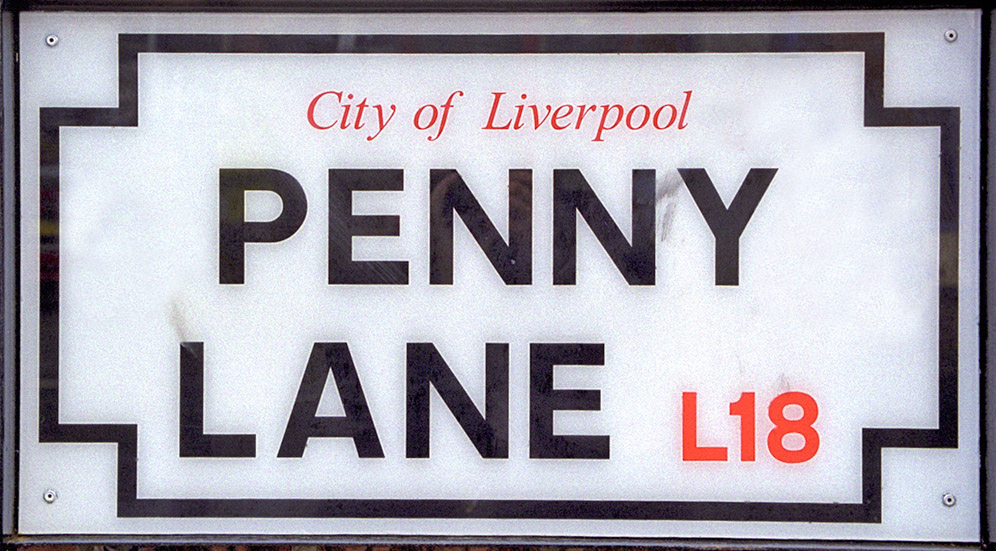
The Beatles left breadcrumbs, or perhaps guitar picks, all over this city, starting with Penny Lane. Not more than twenty seconds after crossing into Woolton, there it was, the very lane immortalized in song. Yes, the bank is there, though the “mac” banker is not, and the barber still hangs his photographs. The roundabout where young Paul once found himself “in my ears and in my eyes” exists, as does the sense of nostalgia that washed over me, as if I, too, had once taken that bus to St. Barnabas Church, an eager choir boy with dreams yet to be written.
And so we drove, past Menlove Avenue and by the boyhood home of John Lennon, up to Beaconsfield Road, where the gates of Strawberry Field still stand, albeit a little worse for wear, much like the memories we all try to preserve as the years wear on. Liverpool’s “blue suburban skies” looked down upon us, and I could not help but wonder what other treasures awaited.
To my delight, Liverpool turned out to be infinitely more. As I have often observed, a person can learn much about a people by their churches. Liverpool is home to one of the largest Protestant cathedrals in existence, a structure so enormous that fitting the whole thing into my camera frame was an impossible task, no matter how many steps back I took. And then there’s the Catholic Cathedral, a modern marvel that defies convention. Its circular design invites the congregation to surround the pulpit completely, a powerful metaphor for unity, though, I suspect, also a means to ensure the preacher can keep a wary eye on his flock.
But churches were only the beginning. Liverpool’s history is layered with the sort of intrigue that makes for wonderful storytelling. During the American Civil War, or, as my Southern brethren prefer, the War of Northern Aggression, Liverpool was a genuine hotbed of clandestine dealings. Cotton flowed into the city, slave ships were built along the docks, and Liverpool’s sympathies lay decidedly with the Confederacy. The infamous CSS Alabama was built here, and in a curious twist, the CSS Shenandoah surrendered at Liverpool’s Salt House Docks, marking the true end of the war months after Lee’s surrender at Appomattox.
It seems the past has a way of lingering. Take Penny Lane, for instance. Named not for the tune, but for George Penny, a man whose wealth was built on the backs of slaves and sugar plantations. There is now a movement to rename the street, to cleanse it of that painful association. I understand the impulse, though erasing history is not the same as confronting it. I, for one, am just relieved that Lennon and McCartney didn’t pen a tune about Robert E. Lee, we’d be in quite a bind indeed.
Strolling along the Mersey, I found Liverpool’s docks to be an architectural treasure trove. The buildings that once housed Cunard and White Star, those famous shipbuilders of the Titanic and the Queen Mary, still stand, repurposed now for dining and shopping, but retaining their Victorian splendor. Liverpool has taken great care in preserving its past while embracing the future, and the docks are a testament to that balance.
Of course, every city has its curiosities. Liverpool’s green spaces are plentiful, but some have been transformed into community gardens, a lovely idea, in theory. In practice, they often resemble a patchwork of desperation, with rickety sheds cobbled together from discarded shower curtains and bits of tin. There is something noble in the attempt, but also a touch of tragedy. These makeshift plots tell a story of human resilience and human folly, side by side, as if each little garden square held a mirror to our contradictory natures.
Enough about shanty gardens. Liverpool, I assure you, has far more to offer. I would encourage anyone to visit, to take the winding steps down into the Cavern Club, where the Beatles first found their stage, or wander the narrow streets in search of a “four of fish” or a “finger pie,” the latter being a culinary adventure best left to the adventurous.
And what became of the CSS Shenandoah, you might ask? Well, its battle flag eventually made its way back to Virginia, where it now rests in a museum, and the ship itself found a final home with the Sultan of Zanzibar, before meeting its end in a hurricane off the East African coast. There is a kind of poetic justice there, for a Confederate ship to end up in Africa, owned by the very people whose lives had been so devastated by its namesake states.
And poor Eleanor Rigby? She sits on a bench in Stanley Street, a bronze statue dedicated to “all the lonely people.” The irony of her immortal loneliness is almost too much to bear.
As for Penny Lane, I do not know what its fate will be. Perhaps you, dear reader, might have an opinion, one way or the other. Change is inevitable, but history, like an old song, has a way of lingering in the corners of our minds.
And Strawberry Field? Well, it’s still there, its gates red and worn, and if you feel inclined, you can even support its preservation. Liverpool is more than the Beatles, more than the docks, more than its churches. It is a city with a soul, and I would urge you to visit, to see for yourself the place that gave us the melodies of a generation. As for me, Liverpool was never quaint, but it was, and still is, unforgettable.

 Ramblings & Revelations
Responses
Great blog Chris! We loved Liverpool and want to return.
LikeLiked by 1 person
Thank you Sandi! We’re following you guys too, living vicariously through your Facebook posts.
LikeLike
I was very happy to search out this internet-site.I wished to thanks on your time for this glorious learn!! I definitely having fun with every little bit of it and I have you bookmarked to take a look at new stuff you weblog post.
LikeLiked by 2 people