
byChrisWhite – 2018
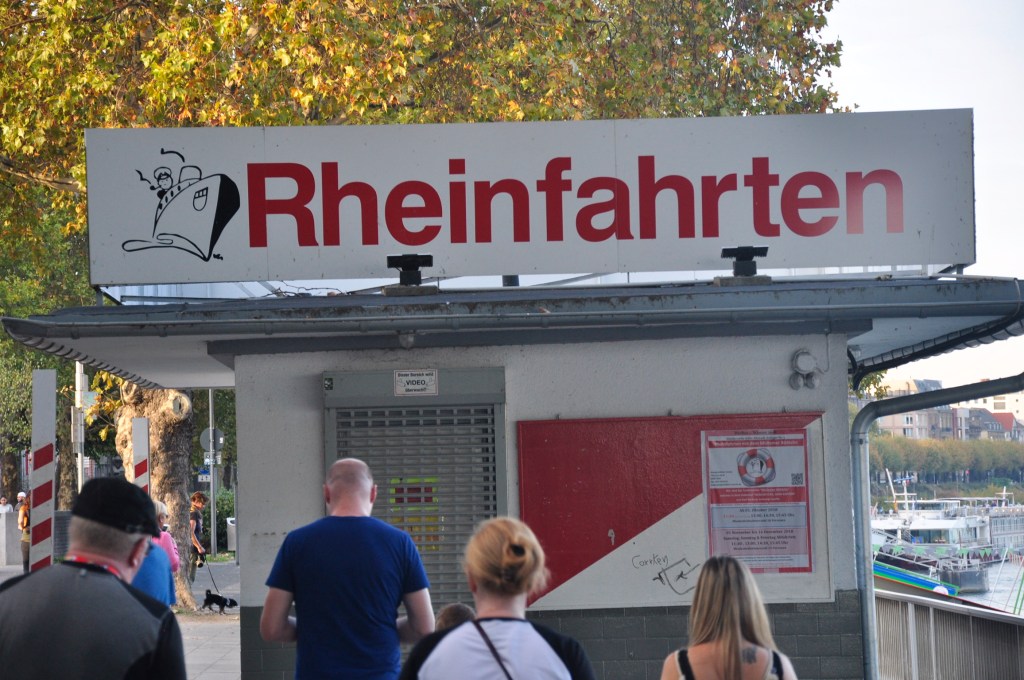
There is something irrepressibly absurd, and thus wholly irresistible, about foreign travel. It has a way of shrinking the world, of turning continents into cul-de-sacs and cultures into neighborhoods, all the while stretching the human mind just as far as the limits of patience will allow. Which is to say, for me, about as far as the length of a Rhine cruise can float without incident. The journey was the sort that promised spectacle and mystery, castles perched on every hill like old men counting their treasures, but left me distracted by a question of grave seriousness: “Why, in all of Europe, does every sign seem intent on announcing its ‘fahrt’?”
You see, in Germany, to “fahrt” is to travel, or so the local linguists assure me, but I could hardly be blamed for indulging my inner schoolboy at the sight of it on every road sign. Exit the autobahn? “Ausfahrt,” or as my irreverent American brain insisted, an ‘exit-fart,’ marked each ramp like an unintentional joke, repeated over and over again, until the humor of it had ballooned to proportions too grand to be ignored. Here I was, amid the majesty of castles and vineyards, stuck instead on linguistic flatulence, proving that even the well-traveled mind is susceptible to juvenile pleasures.
Of course, one must pay homage to the indomitable Gate One Travel for organizing this journey, or “fahrt”—along the legendary Rhine, from Amsterdam to Lucerne. They are quite masterful at planning and executing excursions in Europe, a fact that I am pleased to acknowledge, even though Mother Nature herself conspired against us. Our cruise along the Rhine was abruptly cut short due to the river’s record-low water levels. As Emily and I were forced off the water and onto the bus, feeling less like glamorous travelers and more like stowaways, I could not help but admit that Gate One made the best of a situation that smacked of irony. We fahrted halfway up the river in the comfort of our boat until we had to, well, hold our noses and transfer to dry land.
Low water on the Rhine? Surely that’s a joke meant to outdo my own musings about fahrt signage. But as it turned out, it was real enough. We found ourselves with a new travel itinerary, coaches and hotels instead of leisurely gliding downriver. And so, with our journey unexpectedly taking on the character of an improvised comedy, I had ample opportunity to observe my fellow travelers, particularly the Chinese contingent among us, whose approach to lines and queues seemed more like a contact sport. I should note, I am not one of those folks who delights in grumbling about ‘foreigners,’ no, I like to think of myself as an enlightened traveler, aware that our differences enrich the experience. But I must admit, the perpetual elbowing and jostling left me marveling at how efficiently impatience seems to operate under certain cultural conditions. Perhaps it was an urban phenomenon, honed by densely-packed cities. Perhaps, in some subtle way, it was just another curious form of fahrt, the perpetual thrust forward.
Now, for all the linguistic jest and elbow-to-rib companionship of our fellow travelers, the Rhine itself was as scenic as advertised, a rolling landscape of castles perched atop their hills, gazing down with all the haughty expectation of old landlords. The historic cities that rose along its banks gave testimony to a deep heritage, leaving us tourists to meander cobbled streets where Roman, Medieval, and Renaissance Europe all shook hands in uneasy truce.
Cologne was the next stop on this journey, a city of cathedrals and Roman ruins, home to what our guide assured us were the bones of the three wise men. Though in truth, we didn’t quite catch sight of them. “The holy relics,” he explained in accented English, “were housed beyond the reach of tourists.” A wise move, considering the enthusiasm of our group, I’d say. No sense in risking the relics to a bunch of shutter-clicking travelers who’d spent more time snapping selfies than examining the history behind the lens. If those wise men have truly been resting there for centuries, let them rest without intrusion from iPhones.
As we left Cologne behind, the cruise became a sequence of ancient villages, Koblenz, Spay, Boppar; castles that adorned the heights like ornamentation. We disembarked at Boppar to tour Marksburg Castle, the only one left untouched by the flames of war, its medieval kitchens and dining halls still boasting a ghostly grandeur. For the briefest moment, I felt as though I could hear the whispered echoes of feasts long past, laughter carried on the wind, only to dissipate into the quiet halls.
That night in Boppar, well, I fear a single moment may have changed how the entire town regarded us. It was the evening of “The Incident,” Rachel, one of our dear traveling companions, brought Adolf Hitler into conversation at a sophisticated Italian restaurant. She proclaimed, in a voice too loud to ignore, “Did you know Hitler’s name is incredibly common?” If you’ve never experienced the simultaneous silence of a dozen German patrons pausing mid-fork, allow me to paint the scene: it’s the quiet of a library during a thunderstorm, when all are waiting for the next clap to land. I laughed out of pure, exasperated discomfort, the kind of laugh that erupts when you’re not supposed to, which only served to make the moment worse. Needless to say, the rest of the meal was a somber affair.
The route led us on to Darmstadt, then on to Speyer, a city with a Roman pedigree, rich in cathedrals that stood as silent witnesses to history’s ceaseless march. Onward, onward we traveled, the bus humming like a contented bumblebee, taking us from one ancient locale to another. We fahrted across borders, crossing over into Strasbourg, France, where the lovely Gothic architecture cast deep, restful shadows over the old town, a place where France and Germany seemed to flirt with one another, a beautiful and peculiar cultural waltz.
Eventually, we found ourselves in Lucerne, Switzerland, where the old town spread itself before us like a jeweler’s display, brilliant and meticulously arranged. Lucerne was the highlight, a fitting crescendo to a journey of unanticipated turns. Even as our time in Europe drew to a close, I found myself struck by the surreal experience of it all, part adventure, part misadventure, and wholly unpredictable, the way every journey ought to be.
And as I sat back, savoring a glass of something finer than I deserved, I reflected on all those fahrts, the metaphorical ones, mind you, and how they had brought us to this strange, beautiful land. For all its unpredictability, there was something deeply satisfying in it. There, among those mountains and beneath that Swiss sky, I was struck by the notion that travel, for all its ups, downs, missed connections, and awkward restaurant faux pas, is a little like life itself. We are constantly fahrt-ing, each and every one of us, toward something unknown, jostled about by circumstances and fellow travelers, but propelled all the same by the belief that whatever lies beyond the next hilltop castle is worth the ride.
So yes, we fahrted, sometimes loudly, sometimes clumsily, and sometimes with a surprising elegance, but that is just the nature of life and travel alike. And after all the bus rides and missed destinations, I suppose I’d rather be traveling with friends, no matter how haphazard the journey may become, than sitting idly by, waiting for the world to come to me.



Response
I AGREE!!! Except one (or 2?) comments….pizza is best in Brooklyn (NY) and? ….well I’ll save that thought for the next time I see you and Emily! And “Gate One” has been delivering us all they publish for Terry and I too.
LikeLiked by 2 people