
byChrisWhite – 2019
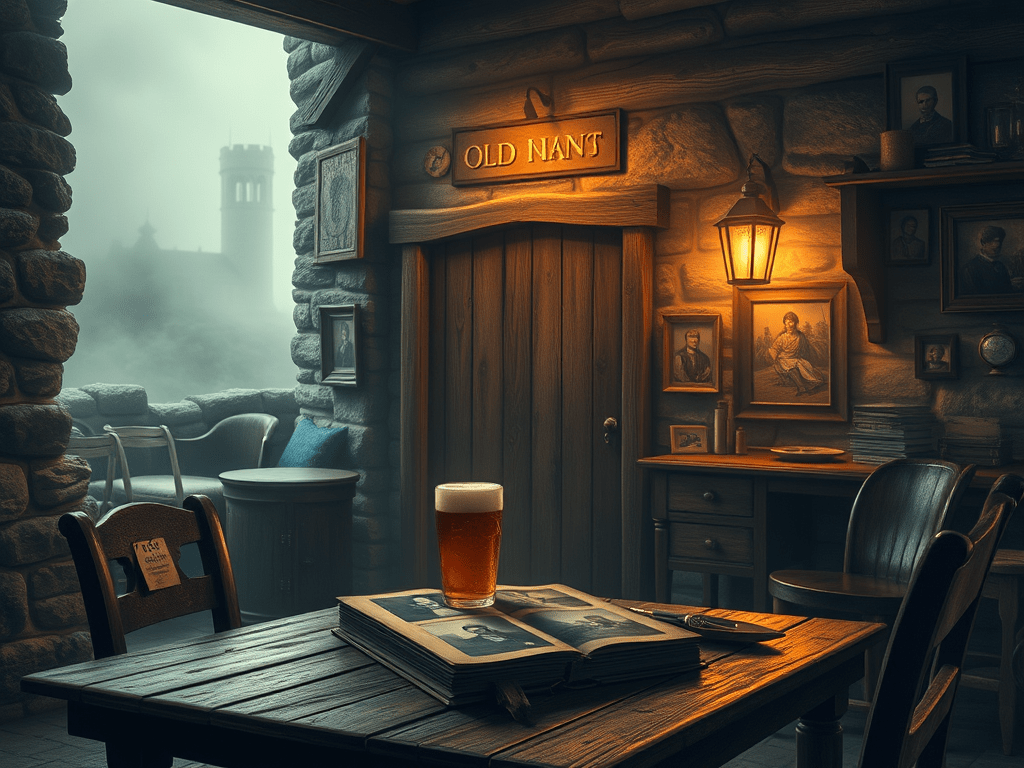
It begins not with revelation but with a photograph. A woman in black lace gloves, fingers perched on the edge of a sepia-toned frame, tilting it toward the light. In her expression, a flicker of something half-felt—remorse, awe, doubt. The kind of look you give a face you think you know but haven’t seen in sixty years or six centuries. A quiet heresy of recognition. That was the start, though I wouldn’t have called it such at the time. I had no grand ambition. I had no map.
What I had was an album, brittle and half-mouthed, each page cleaving to the next with a glue of time and neglect. And what I had was the debt that comes for all who ask questions of the dead.
Genealogy, then, is not a hobby. It is not the innocent pastime of retired schoolteachers nor the gentle indulgence of middle-aged men in cable-knit sweaters. It is a compulsion. A descent. And like all descents it begins with something small: a name, a ledger, a wedding certificate scored in ink as brown and cracked as mud on an old pair of boots.
I have been digging for three decades. Not digging. Tunneling. Carving out the strata of my past with bare hands and broken fingernails. Every census record another bead on the rosary of accident and intention that led to my being. Every marriage license an unspoken war treaty. Every death notice a toll.
The deeper I dug, the more unstable it became. Names changed. Spelling warped by dialect and apathy. Entire branches of the tree vanished into smoke. I followed a line to 18th-century Virginia only to find a man who’d fled a debt in Edinburgh, changed his surname, and remarried under a false identity. My ancestor. My liar. My architect.
Technology made it worse. Or more precise. One vial of spit, and I was laid bare. My chromosomes decoded like scripture. Welsh blood. Spanish blood. The blood of shepherds, whores, knights, tailors, slaves, kings, and sailors. Some of them godless. Some of them cruel. All of them mine.
So let me tell you about the day Emily and I stood in front of the Old Swan Inn in Wales. A battered relic of stone and timber, its roofline sagging like a spine in surrender of arthritis. A pub, if you were dull enough to call it that. If you missed the bone-deep creak of centuries in its beams, the soot ghosts grained into the fireplace, the gnarled knot in the floorboard where someone, long ago, had carved a name now worn illegible. That someone was, by records murky and municipal, my 12th great-grandfather. Sir Robert Ragland. Born 1510.
I stood where he once might have stood. Might. These are the games you play with history. But the truth of blood is stubborn. I ate fish and chips above his bones. I drank ale from a chipped mug and imagined his voice in the next room complaining about a tax levied on his grain. Emily smiled, but I was not smiling. I was possessed.
Not by pride. But by the improbable brutality of existence. That I should live. That any of us should. That the chain of war, famine, pestilence, rape, fire, and grief had, for six hundred years, failed to snuff out this particular thread of Ragland lineage. That my blood, though diluted and wrung through centuries of error and marriage, had returned to the source.
The madness of it. The arithmetic of impossibility. That the Black Death alone killed two hundred million. That a single flea on a single rat on a single ship could have ended the chain. But it did not. That the fire of London did not consume him. That the Viking raids did not orphan his children. That famine in the Welsh hills did not reduce his heirs to carrion. That the earth, howling in its cruelty, had spared him just long enough.
You begin to see yourself not as a miracle but as a fluke. A statistical aberration. Every death your ancestor dodged, every war in which he was not butchered, every childbirth that did not hemorrhage into stillness—these are your credentials. This is your fragile, screaming birthright.
Consider this. You are here because a woman in the 1300s did not drink from a poisoned well. Because a soldier in 1759 held his rifle to his shoulder a second sooner than the man across from him. Because a boy in 1812 crossed the road before the carriage turned the corner.
Seven-point-eight billion souls erased by war, plague, flood, and famine. More than now walk the Earth. Seven-point-eight billion stories silenced. But not yours.
Yours endured.
Somewhere, a mountain slid and crushed a village. A volcano belched fire and stone and sealed an entire generation into ash. A famine peeled the meat from a mother’s bones. And still, impossibly, your line continued.
There is no poetry in it. Only math. Unsentimental, awful math.
I have seen the ledgers. The ship manifests. The lists of children lost before they ever drew breath. My great-great grandmother gave birth nine times and buried six. My great-great-grandfather was conscripted at thirteen, returned at seventeen, toothless and blind in one eye.
The luck of survival is not grace. It is carnage endured.
And what are you doing with it? This grotesque inheritance? This brutal triumph of mere biology?
We sat that night in a tavern that bore his name. I held my pint with both hands and said nothing. Emily spoke of the amazing cemetery down the street. I nodded. I was counting the ghosts. Every one of them who had to live so that I might.
This is not a love story. It is not a travelogue. It is not even a memory.
It is a reckoning.
Genealogy, when done correctly, will rob you. It will strip you to bone and show you the odds you outran. It will show you how easily you could have not been. It will make you kneel.
And if it does not, You have not gone deep enough.

 Ramblings & Revelations
You must be logged in to post a comment.