

byChrisWhite – 2021
PART ONE:
The Eye’s Have It
In every profession, there is a moment, often quiet and unceremonious, when a person shifts from participant to practitioner. For me, it happened in a backyard, in Tennessee, with a pistol in my hand and an idea in my head that would not leave me alone. I was 25 years old, working narcotics and violent crime in a region that still measured men by the quickness of their draw and the firmness of their word. And I had begun, quite by accident, to question one of the most fundamental tenets of close-quarters gunfighting: the eyes.
That moment, however, was preceded by years of half-formed convictions, a stubborn kind of curiosity, and a cultural upbringing where guns were neither political nor theatrical, they were just part of the furniture. The kind of place where children learn to distinguish between a Winchester and a Remington before they can spell either. You didn’t have to be in the military or law enforcement to be interested in guns. You just had to be from here.
Now, before we indulge too heavily in nostalgia, let’s acknowledge a simple truth: being interested in guns does not make you good with them. And being good with guns does not make you an expert. What makes someone an expert. what creates real expertise, is harder to quantify. It’s a cocktail of repetition, pattern recognition, critical thinking, and failure. It’s not glamorous. And it rarely involves wisdom handed down like sacred lore.
By the time I decided I wanted to become a firearms instructor, I had already spent six years in law enforcement. I’d fired thousands of rounds, trained in several disciplines, and been in enough real-world situations to know that proficiency under pressure was a vastly different beast than static range performance. But there’s a curious thing that happens when you get good at something early. You start to believe that your skill alone is a kind of credential, a permission slip to teach. You confuse competence with comprehension. Like many young men in their twenties, I was convinced I had something important to offer, even if I didn’t yet understand what it was.
What sparked my curiosity that day in the backyard wasn’t some mystical insight or cinematic revelation. It was an accident. I fired without aligning my sights, just a quick draw and point, and to my surprise, the round struck dead center on a soda can I’d placed thirty feet away. Once could have been luck. Twice was interesting. Three times, and I began to ask a dangerous question: What if the experts were wrong?
To understand the implications of that question, you have to understand the mythology of instinctive shooting. In shooting circles, particularly the tactical, law enforcement, and self-defense arenas, there’s a long-standing reverence for what is called “point shooting.” The theory is simple in premise and seductive in its promise. Under stress, they say, the human body loses the fine motor control required for sighted fire. Your vision narrows, your heart rate spikes, your fingers tremble. Therefore, in a gunfight, relying on traditional aiming is not only futile but potentially fatal. The solution? Train your body to shoot without sights at all.
The technique goes by many names; reflexive fire, intuitive shooting, combat draw, but the common thread is the same: forget what your eyes tell you. Trust your body. Let your subconscious take the wheel.
To someone raised in a shooting culture, this idea had an almost mystical allure. It was the equivalent of muscle memory elevated to religion. Everyone talked about it. Few could explain it. And fewer still could actually do it.
That’s where my skepticism began to ferment.
The promise of instinctive shooting is powerful, but the pedagogy is remarkably flimsy. Ask a dozen self-proclaimed experts how to learn it, and you’ll get a dozen variations on the same vague advice: practice, practice, practice. But what does that mean? Practice what? With what feedback mechanism? In what context? Under what pressure?
It’s here that our story begins to drift from personal anecdote into the broader realm of psychology, cognition, and culture. Because what I was stumbling into, without realizing it, was a classic example of what Malcolm Gladwell might call an “intellectual blindspot.” A place where traditional wisdom survives not because it’s correct, but because it has never been rigorously tested.
And in this case, the test is complicated. You can’t simply set up a lab experiment with adrenaline, fear, and live ammunition. The conditions of a real gunfight are nearly impossible to simulate. So instead, instructors leaned into dogma, and trainees leaned into repetition, and nobody asked too many hard questions.
But I was always the type to ask hard questions, often to the irritation of those around me. It’s not that I thought I was smarter. I just couldn’t leave things alone. If a rule didn’t make sense, I poked at it until it either revealed its logic or collapsed. In that sense, firearms instruction wasn’t a calling for me in the noble or moral sense, it was simply a problem to be solved. And I liked solving problems.
Still, there is a distinction between being contrarian and being correct. That distinction only becomes clear through testing.
So I began to test.
I took the backyard experiment into more formal settings. I developed a methodology, loosely at first, then with increasing rigor. I tested at different distances, under different lighting, from different draw angles. I tracked outcomes. I recorded what worked and what didn’t. And over time, a pattern emerged: success was not random. It was repeatable. And most surprisingly, it was visual.
Which brings us, finally, to the eyes.
The prevailing assumption in combat shooting circles is that stress hijacks vision. You lose peripheral awareness. You can’t focus on your front sight. You experience what’s often referred to as “tunnel vision.” But what if that assumption was incomplete? What if, instead of losing vision, we were simply misusing it?
The human eye is capable of extraordinary feats. We have depth perception, spatial awareness, and a built-in predictive mechanism that allows us to intercept moving objects with uncanny precision. We use it every time we catch a ball, or drive through traffic, or reach for a coffee cup while half asleep. In these cases, our eyes don’t freeze, they adapt. They gather the most relevant information for the task at hand and discard the rest. So why would gunfighting be different?
The answer, I found, is training.
Most shooting curricula teach sight alignment as a binary process: either you see your front sight clearly, or you don’t. But in practice, the eye works along a continuum. You can track alignment with less conscious focus than you think, particularly if your body posture, grip, and muscle memory are consistent. This doesn’t mean sights are irrelevant. It means that how we use our vision under pressure may be more flexible than we’ve been led to believe.
It’s not that instinctive shooting is a myth. It’s that it’s been poorly defined. What many call “instinct” is actually a refined combination of visual input, procedural memory, and kinesthetic awareness. It’s a learned response, not a magical one.
Yuval Harari, in Sapiens, talks about the myths that hold civilizations together—shared fictions that allow us to cooperate in large groups. In the microcosm of tactical shooting, instinctive fire has become just such a myth. It offers comfort. It simplifies complexity. But it doesn’t hold up under scrutiny.
The real skill, as it turns out, isn’t learning to shoot without sights. It’s learning to shoot with them—under duress, with limited focus, and without relying on the luxury of time. The eye doesn’t vanish under stress. It becomes selective. And if trained properly, it becomes decisive.
This realization didn’t make me the best shooter on the task force. But it did make me a better teacher. Because once you understand what you’re actually doing—what your brain and body are coordinating in those crucial fractions of a second—you can begin to teach it in a way that others can replicate. You move from mysticism to methodology.
There’s a quote by Harlan Ellison I’ve always loved: “You are not entitled to your opinion. You are entitled to your informed opinion.” That distinction lives at the heart of everything I came to believe about firearms training. We don’t need more opinions. We need more informed ones. Especially when lives are at stake.
So here’s what I came to understand, through thousands of rounds, countless hours, and more failures than I care to count: shooting is not about instinct. It’s about perception. And perception, like any human faculty, can be trained.
But only if we’re willing to see clearly.
Forged in Fire
If you’re looking for the moment when theory collided with experience, when interest fused with identity, and when an obscure neurological quirk began to shift the way I understood both vision and violence, then you have to begin with a modest gun shop in LaVergne, Tennessee, tucked inside a former indoor range that still smelled faintly of cordite, plywood, and black mold. The shop itself was little more than a narrow aisle of pegboard and Formica, but for me, it became the crucible. Not just for commerce or hobby, but for transformation.
The building belonged to George, a neighbor with a complicated relationship to federal law. Years earlier, George had been caught in what some would call a sting, and others would recognize as a textbook example of what would later be defined, quite officially, as entrapment. The story goes that an undercover informant working with the Bureau of Alcohol, Tobacco, Firearms and Explosives asked George, repeatedly, to saw off the barrel of a shotgun. George initially refused. But after enough cajoling and the promise of a generous cash exchange, he relented. The saw came down. The cuffs went on.
He did his time. Three years. And when he returned, George reopened his shop, now stripped of anything regulated under the National Firearms Act. Archery gear, black powder rifles, muzzleloaders. Legal curiosities in a postmodern arsenal. And then, sometime after that, he handed me the keys.
Technically, they were metaphorical keys. I wasn’t old enough to obtain a Federal Firearms License on my own. But one of my closest friends, also named Chris, was. He was 25, easily impressed by my enthusiasm and apparently unbothered by the legal risk of entering into business with a barely post-adolescent entrepreneur. That, in itself, may say more about the strange alchemy of ambition and ignorance than it does about either of us individually.
Our arrangement was simple. I ran the shop. He signed the papers. We were twenty-something gunslingers with retail dreams, trying to pass animal biology exams by morning and sell .30-06 rounds by afternoon. In truth, it was a magnificent experiment in overstretch. I’d attend college classes at MTSU each morning, then make my way back to LaVergne, open the doors to the shop, and spend the rest of the day talking to local hunters, preppers, hobbyists, and, perhaps most influential of all, cops.
Cops, it turns out, are excellent storytellers. Not polished, theatrical storytellers, but honest, salty, deadpan raconteurs of human absurdity. They spend their days on the friction points of society, where logic and law meet chaos and impulse. Every afternoon in the shop, they’d swap tales, some harrowing, others hilarious, of people doing profoundly irrational things at exactly the wrong moments. I was enthralled.
And somewhere between those war stories, those long digressions about calibers and case law, I began to wonder if maybe I was cut out for that life too.
By nineteen, I was submitting applications. Police work, it turned out, wasn’t just accessible to me, it was magnetic. And not in the way that people talk about callings or higher purposes. For me, it was mechanical. Procedural. Fascinating. I loved systems. I loved complexity. I loved solving puzzles. Police work, oddly enough, offered all of that. At least on the surface.
Around this time, my fascination with machines deepened through my part-time work in a machinist’s shop, owned by the father of my then-girlfriend. He was a brilliant craftsman, the kind of man who could transform blocks of steel into surgical instruments. I helped where I could, mostly with mundane work, but I was absorbing everything, the logic of tolerances, the physics of friction, the secrets of the lathe. The guns I’d once seen as tools of power now revealed themselves as marvels of precision. I became obsessed with the mechanics behind the recoil, the function behind the click.
That mechanical awareness followed me into my first police job, which I received before turning twenty. The badge came with a revolver, a Smith & Wesson Model 67, chambered in .38 Special. The revolver, to me, was less a weapon and more an instrument of intricate timing. I would dry-fire it in front of the television each night, shooting fictional villains and sometimes, unintentionally, the good guys, depending on how persuasive the editing was.
More than that, I disassembled it. Reassembled it. Traced the tension points. Studied the subtle relationship between hammer and sear. I began to sense, through sheer tactile repetition, what the trigger was doing beneath the surface of the frame. It wasn’t just about squeezing. It was about orchestrating a sequence.
By the time the department ran us through our initial weeklong handgun qualification course, I had already trained my fingers to whisper across the trigger with surgeon-like calm. The training officer, seeking a baseline, asked all cadets to shoot a full qualification course on the first day. I fired fifty rounds. Forty-nine landed dead center in the 10 ring. One strayed to the 9. My baseline score: 99.6.
I would never again score below perfect for the rest of my career.
That pursuit of perfection became its own quiet addiction. When I entered the Tennessee Law Enforcement Training Academy, I carried that obsession with me. I maintained it through every exercise, every repetition, every stress course. At graduation, I received the award for top firearms score. My only imperfection during the entire program? The stress course. One bullet in the 9 ring. Score: 99.6.
This relentless drive to improve was not based in ego or competition. It was, rather, a neurotic kind of curiosity. I needed to know what could be done, and then what could be done faster, smoother, more efficiently. And so, after my discovery at age 25, the one that would shape my philosophy on gunfighting, I practiced relentlessly.
It was a pond that started it. A backyard pond, surrounded by forest. Safe, secluded, and filled with leaves and snapping turtles. If you’re unfamiliar, turtles in a pond are not pets. They’re predators. At least that’s what I believed. They eat fish at a rate that would make any bass angler uneasy. So I took to thinning the herd.
One fall afternoon, while aiming at a drifting leaf rather than a turtle, I stumbled upon something I still consider the foundation of my shooting method. I was using a .22 rifle. My eyes, both open, remained fixed on the leaf, even as I raised the rifle. And in that instant of misalignment, between focus and action, I noticed something peculiar. Two barrels. Not in reality, of course, but in perception. A sort of doubled vision created by the fact that my attention was still on the target, not on the sights.
I fired. The bullet struck the leaf dead center.
I tried again. Same result.
This was not luck. At least, not consistently. I repeated the action. The trick, it seemed, was in the illusion. By keeping both eyes open and focusing solely on the target, not the sights, I could create a visual frame: two barrels flanking the leaf-a quasi rear sight bookending the front/leaf, providing an instinctive point of reference.
Here’s the interesting part. When I focused on the gun, the two barrels collapsed into one. Standard monocular alignment. But when I kept my attention on the target, the double-barrel effect returned, creating a kind of natural bracket. Visually, the brain filled in the gap.
If you’ve ever played around with depth perception, you’ll recognize this immediately. Each eye views the world from a slightly different angle. Together, they triangulate. Separately, they distort. This is why marksmanship instruction often tells you to close one eye. It’s a simplification, a control mechanism. But in real-world encounters, particularly under stress, closing an eye is not only impractical, it’s counterintuitive.
It turns out, the human visual system is exquisitely evolved for motion, prediction, and instinctive alignment. What we lack in focal precision, we often compensate for with spatial judgment. In other words, the brain learns to hit what it sees, not what it aims at.
And over time, with repetition and experimentation, I trained myself to compensate for elevation errors, slight deviations in up-and-down placement, by relying on intuitive calibration. At first, my vertical groups at fifteen yards varied by as much as a foot. But gradually, as the technique became less conscious and more procedural, those groups tightened. Eight inches. Then four.
Lateral accuracy—windage—was consistently more precise. Likely because of how our eyes interpret horizontal deviation versus vertical. It’s easier to detect drift from left to right than from top to bottom. A function of evolutionary perception, perhaps. We track threats laterally, predators, people, vehicles. But gravity, the great vertical force, is more predictable and less urgent.
Eventually, even under rapid fire, my groups shrank. What began as an odd visual trick became, through sheer persistence, a viable methodology. And not just one I could perform, but one I could teach.
And here, we return to the point where practice becomes principle. What I discovered, through snapping turtles, red maple leaves, and a .22 rifle, was not a new magic. It was a recognition of how the brain works when the body is trained and the senses are trusted.
Skill, after all, is not just the repetition of motion. It is the deliberate refinement of perception.
PART TWO
Knowing What You Don’t Know
At the heart of every human endeavor, whether you’re a stonemason, a pianist, a diplomat, or someone who finds themselves aiming a firearm at another human being, is the question of expertise. What does it mean to know something? More importantly, what does it mean to know that you don’t?
The Greeks had a word for this tension. Aporia. It’s the state of puzzlement that comes not from a lack of information, but from realizing the limitations of what you already know. Socrates, who made a career out of bothering Athenian politicians and craftsmen by pointing this out, famously claimed that he was wiser than other men only because he knew that he knew nothing. A paradox, of course. But also, a starting point.
This is relevant because in gunfighting—and we’ll use that term unapologetically throughout this discussion—your beliefs about your competence can be the single most dangerous thing you carry. Not your weapon. Not your adversary. But your sense of certainty.

Let’s begin with a practical question: what actually qualifies someone as an expert? Is it hours logged? Scores achieved? Peer recognition? There’s no licensing board for combat intuition, no PhD for decision-making under extreme duress. So how does one arrive at mastery?
A partial answer can be found in something psychologists call the Hierarchy of Competence. It’s not exclusive to firearms or martial disciplines, but it maps surprisingly well onto them. There are four levels:
- Unconscious Incompetence – You don’t know what you don’t know.
- Conscious Incompetence – You’ve realized that you don’t know and wish to learn.
- Conscious Competence – You’ve acquired the skill but must apply it deliberately.
- Unconscious Competence – You perform the skill intuitively, almost reflexively.
You will see this again in more detail in Part Four.
Most people live their lives toggling between the first two. They operate with partial knowledge, falsely confident. Or they sense the limits of their knowledge but struggle to move beyond them. Only through deliberate repetition, failure, and correction do they ascend to conscious competence. And even then, mastery remains elusive. Only when the skill becomes integrated into your nervous system—so deeply rehearsed that it no longer feels like a choice—do you reach the final stage.
In the context of combat shooting, this means that the weapon is no longer external. It becomes an extension of perception. Decision and action begin to blur.
But before we rush toward mastery, let us pause at the threshold of competence. Because not everyone who trains becomes competent, and not everyone who becomes competent becomes useful.
The problem lies in the map we draw inside our heads before we ever draw our weapon. We imagine what a fight might look like. We plan for it. We simulate outcomes and responses. But here’s where we encounter a fascinating flaw in human cognition: proactive thinking, particularly when misapplied, becomes a liability. It installs mental furniture that gets in the way when the room catches fire.
This is not just a philosophical argument. It is a neurological one. The more you script your responses, the more you delay your adaptation. You are, in essence, solving the last problem instead of the present one.
In Japanese martial philosophy, there is a word for the ideal state of mind during combat: Mushin. It is often translated as no-mindness, though that risks sounding either overly Zen or utterly meaningless. But the concept is both practical and profound.
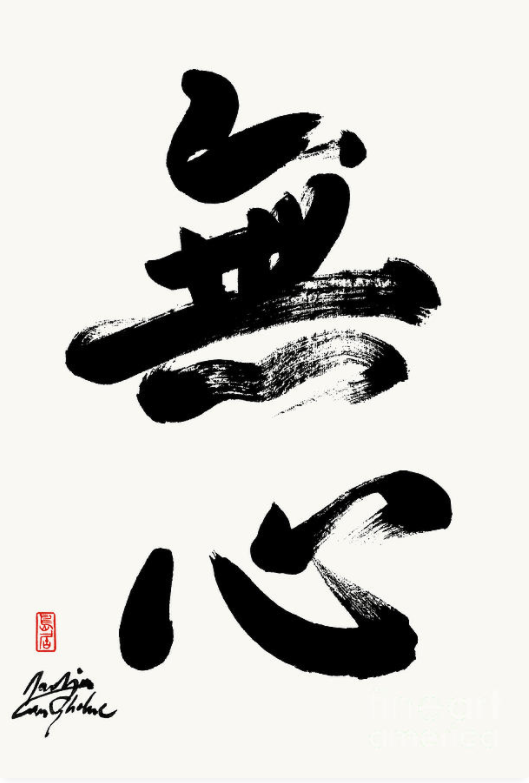
Mushin is the state in which a person acts without hesitation, without conscious deliberation, without fear or ego or premeditated intention. It is not the absence of thought but the absence of self-interference. It is the mental posture that allows true instinct to emerge—instinct, that is, backed by relentless training and deep familiarity.
It’s tempting, especially in the West, to dismiss such concepts as mystical. But neuroscience now backs what ancient warriors already practiced. The brain, under high stress, defaults to its most rehearsed pathways. In combat, this means that when cognition stalls, muscle memory prevails. But only if it’s there to begin with.
Now let’s connect this back to the discipline of shooting. You’ve likely heard the phrase “10,000 hours,” attributed to the development of mastery in any field. While the number is more metaphor than prescription (and perhaps misrepresented altogether), the core idea is sound. Repetition builds reflex. Reflex under pressure becomes survival.
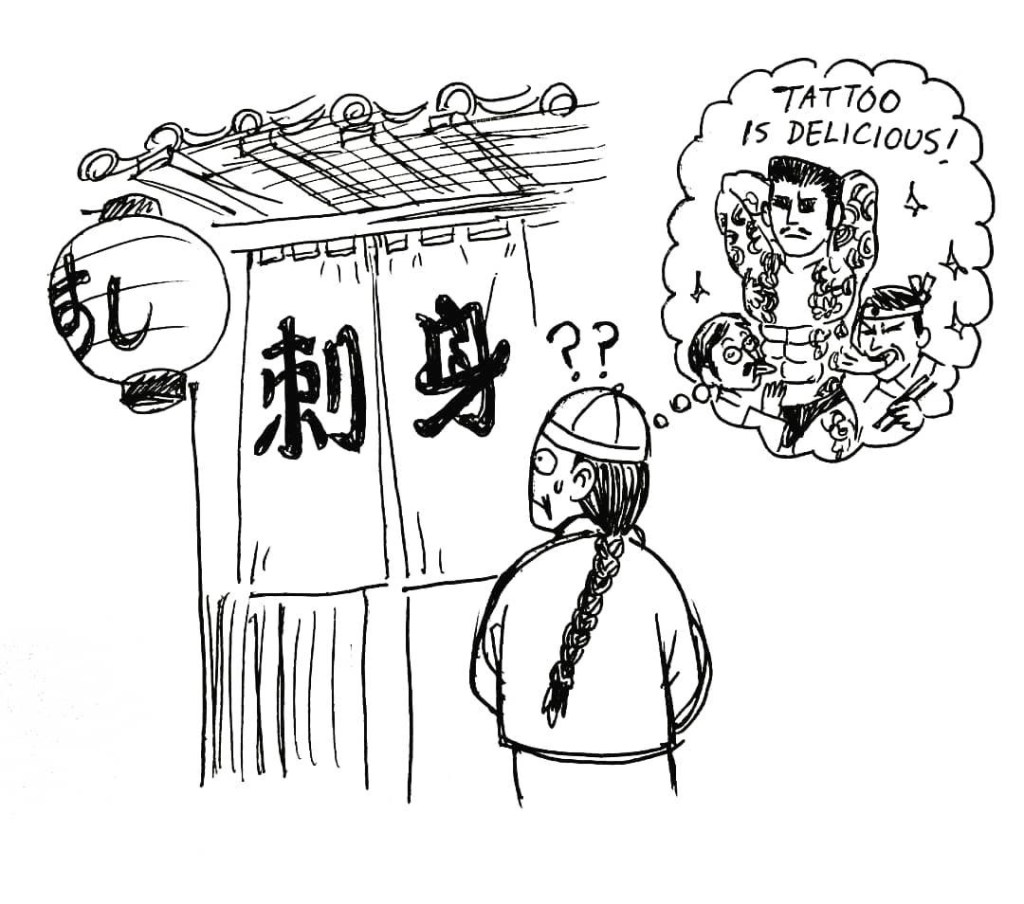
Side Note: If you’re into tattoo’s, I’m offering you fair warning to avoid the use of Japanese Kanji characters as embellishments to your bodies. Each kanji character can have many meanings, the context and other content collaboratively deciding it’s general meaning. Also, Chinese kanji characters don’t align with the same meanings in identical Japanese characters. Example: “Delivery” in Japanese can mean “pooping place” in Chinese – “sashimi” in Japanese could mean “tattoo” in Chinese. And on and on and on.
But here’s a critical refinement: not all repetition builds mastery. You can do the wrong thing 10,000 times and become remarkably efficient at failure. Real improvement comes from deliberate practice—focused, feedback-rich, and incrementally challenging. You must seek not just to repeat, but to refine.
In my own journey, the process of refining instinctive shooting methods required abandoning some of the very assumptions I’d started with. Like many, I’d been taught to visualize success before action. Picture the threat. Picture the draw. Picture the sight alignment. But the real world, in its rude unpredictability, rarely conforms to our imagined choreography.
Violence does not arrive with rehearsal. It arrives mid-sentence.
And so, you must be prepared not for the scenario, but for the unfolding. Not for the story you’ve written, but for the page that writes itself as you act.
That’s why Mushin matters. It is not spiritual detachment. It is operational clarity.
And here’s where culture plays a role. In the East, particularly in Japan, martial traditions emphasized mental discipline alongside physical technique. Concepts like zanshin (remaining mind) and mushin (no mind) were baked into the training ethos. In the West, particularly in American law enforcement and military instruction, we favored tactics, muscle, and gear. Philosophy, if present, came later. Often too late.
During one of the later chapters in my professional life, I found myself inside the U.S. Embassy in Bogotá, Colombia. My defense contracting company had been contracted by the U.S. Army SOC, to deliver advanced shooting instruction to AFEAU, an elite Colombian counter-terrorism unit. These were not beginners. They were lethal, disciplined, and experienced. The kind of people who could dismantle an assault rifle, along with your spleen, with the same ease you might scramble eggs.
As we waited for our escort to the compound, I glanced at a wall adorned with photographs, men labeled as HVT’s, High-Value-Targets. Some of the images were marred with thick black lines, signaling capture. Other’s bore bold red X’s. Those had been killed. It was a wall of statistics told through faces.
A colleague nudged me and whispered, half-joking, “You’re not nervous? Teaching trained killers how to kill?”
My response was honest, and perhaps annoyingly calm. “Why would I be nervous? They know how to kill; they know what they know. But they don’t know what I know.”
What I meant was not arrogance. It was clarity. I wasn’t there to prove anything. I was there to offer a tool. A different optic. A way of aligning the eye and the body through a method forged not by theory, but by practice. I wasn’t hoping to impress. I was simply demonstrating.
When I shoot in a demonstration, I don’t think about my grip. I don’t think about the trigger. I don’t think about my stance, my breathing, or my target. I look. I act. I let the training do what the conscious mind no longer needs to.
Because if you have to think in a gunfight, you’re likely already dead.
This is the paradox of high-level training. The better you get, the less you think. Not because you’re careless, but because your thinking is pre-installed. It’s there, already wired. And this, in many ways, is the point of training altogether, not to fill your head with plans, but to free it of clutter when it counts.
Of course, there are dangers on the opposite end of this spectrum. Training without awareness can lead to overconfidence. You can become so efficient in your method that you miss the shift in circumstances that calls for a different response. This is where cognitive bias meets muscle memory, and together they can lead you into moral or tactical failure.
The seasoned operator who shoots too soon. The officer who interprets movement as threat. The soldier who follows orders without reassessment. These are not failures of technique. They are failures of perception.
Mushin guards against this. Not by encouraging detachment, but by reinforcing responsiveness. It creates space between stimulus and response. Enough space to act without reacting. Enough space to shoot, or not shoot, with clarity.
So the real measure of expertise is not just what you can do. It’s whether you can not do it when the situation demands restraint. True mastery lies in the ability to pause, even if that pause lasts less than a heartbeat.
Let me end this section with this.
Expertise, in its highest form, is not just a catalog of skills. It is a condition of being. It is the alignment of training, awareness, and emotional neutrality in real time. It is confidence without narrative. Action without burden. And the humility to admit, always, that there is more to know.
Even when your life depends on it.
PART THREE
The Power of Observation & Persistence
In the long arc of human progress, whether we’re talking about mapping the stars, decoding DNA, or hitting a human target under extreme stress, the real breakthroughs rarely announce themselves with fanfare. They arrive, more often, as footnotes. Glimpses. One part persistence, one part observation, and several parts accidental discovery.
At age 36, well into my law enforcement career, I enrolled in a course at the State Police Academy focused on the psychology of violent student behavior. On the surface, this was not a firearms class. There were no weapons, no tactical drills, and certainly no bullets. The room was filled with binders, PowerPoint presentations, and instructors eager to explain the finer points of adolescent aggression. Most of my classmates endured the neuroscience segments like a long dental appointment. I, on the other hand, was captivated.
Not because I had a secret passion for brain chemistry, but because buried inside those “boring” lectures were explanations, concrete, empirical explanations, for phenomena I had been encountering for years. There, in fluorescent-lit classrooms, I found language for the anomalies I’d seen in real-world confrontations. Human behavior under stress wasn’t just erratic. It was predictable. Patterned. And, perhaps most importantly, it could be trained for.
This was a turning point. I had been developing my own shooting methodology for more than t`en years by then, largely through experience, intuition, and trial-and-error. But now I had something more: science. A scaffolding. A framework for understanding why certain things worked, and why others failed catastrophically.
A few months later, I came across an article about a California Highway Patrol officer named Luis Chiodo. Chiodo was a firearms instructor, but not a typical one. He had developed a shooting method called the Target Focused Fire System (TFFS), which emphasized a simple principle: in a gunfight, focus on the threat, not your sights.
At first glance, this sounded almost identical to what I’d been practicing and teaching. His rationale mirrored mine. Most gunfights, he argued, occur at close range. They unfold quickly, often without warning, and typically in poor lighting. Under such circumstances, the act of consciously aligning your sights becomes not only impractical but detrimental. You shoot where you’re looking, and in real violence, you look at what is trying to kill you.
This approach wasn’t revolutionary in theory. But in practice, it had measurable impact. According to reports from the California Highway Patrol, officers trained under the TFFS system saw a dramatic reversal in hit ratios during actual shootings. Before the program, more than 90 percent of rounds fired by officers in actual combat missed their targets. After TFFS was implemented, over 80 percent of those same rounds struck their mark.
That kind of improvement, measured in real-world outcomes, not just range scores, was impossible to ignore. And yet, something about it still felt incomplete. Chiodo’s system lacked detailed drills. It lacked structure. It lacked a pedagogical roadmap. The underlying principle was correct. But principles, without method, are difficult to teach. And more difficult to sustain.
I wasn’t interested in building a philosophy. I wanted a system.
Around that same time, I came across an FBI Law Enforcement Bulletin that compiled national data on officer-involved shootings. The numbers, while unsurprising to anyone who’d spent time on the range with police recruits, were deeply troubling: over 80 percent of rounds fired in actual gunfights – Nationwide, were missing their intended target.
This wasn’t about poor character or lack of concern. It was, quite simply, a training problem.
To illustrate, let me take you back to a certification session I conducted not long after. One officer, let’s call him “Officer X”, was struggling with the standard qualification course. The requirement was simple: hit a full-size target from various distances, including 25 yards. Not a particularly demanding standard, even for intermediate shooters.
But something was clearly off.
I watched as Officer X raised his weapon and fired several rounds. No impact. Not on the paper target. Not on the wooden frame. Not even on the dirt berm behind it. I checked his stance. I checked his grip. Then I did what instructors are trained to do: I looked at the muzzle.
What I saw sent a very specific kind of chill down my spine. With each trigger pull, the barrel of the pistol snapped sharply upward. The rounds weren’t missing low. They weren’t even staying in the county. They were sailing into the sky.
This wasn’t poor shooting. It was dangerous.
Now, to be fair, Officer X was not a violent man. He was not lazy or careless. He was simply someone who had never been forced—until that moment—to integrate stress, decision-making, and fine/complex motor control under pressure. Unfortunately, that description fits more officers than the public would care to believe.
Most police departments in America require officers to qualify with their service weapon once per year. That’s it. Twelve months between tests. In the intervening time, unless they seek out their own training, most will not fire their weapon again. Now add the psychological weight of using deadly force, the stress hormones flooding the system, and the chaos of a real-world encounter. It’s not hard to see why the numbers look the way they do.
Gunfighting—if we define it properly—is not simply a technical skill. It is a dynamic negotiation between perception, cognition, and decision-making under threat. It is not enough to teach someone how to align sights and squeeze triggers. We must train them to act amidst physiological breakdown. We must prepare them for altered hearing, tunnel vision, time dilation, and the sudden implosion of all previous expectations.
Under stress, the human body changes.
Heart rate spikes. Peripheral vision collapses. Auditory exclusion sets in. Blood pulls away from the fingertips. Fine motor skills degrade. The brain prioritizes survival. And all the polished fundamentals vanish unless they have been fused—permanently—into muscle memory.
This is why so much criticism of law enforcement use-of-force incidents is deeply flawed. It assumes, often smugly, that civilian observers can place themselves inside the experience of the officer. That they can see what the officer saw, perceive what the officer perceived or know his capabilities based on his training and training scores, and judge his decisions in hindsight without distortion.
But this is neurologically impossible.
Officers engaged in a life-threatening event are not operating in the same perceptual universe as those watching a video or reading a transcript. They are not working from the same sensory data. Their memory, cognition, and perception are all filtered through a state of physiological crisis. They are, quite literally, in another world.
And yet, these events are judged as if all human beings share the same experience of reality at all times. We do not.
There is an idea, rooted in ancient philosophy and echoed in modern neuroscience, that observation without judgment is the highest form of awareness. In training, we call it situational clarity. It requires practice. Repetition. Observation. And persistence.
Because in the real world, you may have less than a second to act. And that second may be obscured by fear, hesitation, or a deep biological urge to survive. The power to see clearly—and act cleanly—amid that chaos is not a gift. It is a skill. One that must be earned.
My discovery, however minor it may have seemed in those early years, was never about technique alone. It was about integrating the realities of human physiology into a system that worked when everything else fell apart. The power of that system was not that it replaced training. It was that it respected biology.
And so, I kept observing. I kept testing. I kept pushing my students to find calm in disorder, clarity in speed, precision in panic.
Because if we’re going to ask human beings to make life-or-death decisions in moments of crisis, the least we can do is give them a system built for the actual world in which they’ll be making them.
In the next section, I’ll lay out the biological and psychological shifts that take place during violent encounters, and how a properly designed shooting method can account for them, train around them, and perhaps even use them to our advantage.
Because real mastery begins not when you’ve controlled the body, but when you’ve come to terms with what it does without your permission.
PART FOUR
The Continuum of Competence
There’s a quote often attributed to marketing thinker Seth Godin: “Competence is the enemy of change.” Like many such aphorisms, it’s pithy, perhaps overly broad, and yet—when unpacked—contains something vital.
We tend to imagine competence as a finish line. The trophy room of our hard work. And why not? We spend years getting there. Mastery, after all, is seductive. It comes with accolades, maybe even book deals or endorsements, perhaps a few thousand social media followers and some complimentary hats. It confirms what we’d like to believe about ourselves—that we’ve arrived. That we know. That we’re done learning.
Which is precisely the danger.
In firearms culture, especially in America, this phenomenon is amplified by the competitive shooting world. Scores become identity. Precision is performance. Expertise calcifies. You get good at hitting tiny groupings on paper, and you stop asking whether that skill has any real bearing on what you might face in the unpredictable chaos of a violent encounter. And when someone—say, a curious Tennessee redneck with an eye for anomalies—starts talking about “gunfighting” instead of “combat shooting” or “reflexive firing,” it’s easy to scoff.
But here’s the problem: paper doesn’t shoot back.
Let’s be clear. This isn’t an indictment of competition shooters. Many of them are brilliant, talented, and committed. But if your performance is conditioned on perfect lighting, controlled conditions, and complete foreknowledge of what you’re about to do, it’s not a gunfight. It’s a demonstration. It’s ballet.
A gunfight is something else entirely.
And if we want to train for that, if we want to genuinely prepare for violence as it exists in the real world—messy, spontaneous, rapidly evolving—we have to be willing to enter a different arena. One that is governed not by the principles of choreography, but by the realities of cognition, stress, and bio-physiology.
To make that leap, we must understand where we are on what psychologists refer to as the competence continuum, which we were first introduced in Part Two. This model, which you’ve likely encountered if you’ve ever studied skill development, lays out four distinct phases:
- Unconscious Incompetence – You don’t know what you don’t know.
- Conscious Incompetence – You know what you don’t know, and you want to improve.
- Conscious Competence – You can perform the skill, but you must concentrate to do it.
- Unconscious Competence – The skill is instinctual, embedded, automatic.
Each stage is important. But progress depends on honesty, particularly at the beginning. Most danger, in fact, originates in the first stage. The person who believes they know what they’re doing but has no true grasp of the realities. In the firearms world, we see it all the time. A person who has learned to pass a qualification course, perhaps even to score well in competition, but has never been tested under pressure. Never drawn a weapon in fear. Never felt their body betray them with adrenaline.
They don’t know what they don’t know.
It’s not their fault. Most shooting programs are designed to teach sight alignment, breath control, trigger discipline. all worthy skills. But they do not prepare the student for the psychological dislocation that occurs in real violence. They do not simulate the fear. The cognitive narrowing. The auditory exclusion. The impossibility of coherent thought.
And so, they produce shooters. Not gunfighters.
That’s why I use the term gunfighting. Not to be dramatic. Not to sound tactical. But to distinguish the context. A gunfight, like a fistfight, is about the collision of human will and violence. It is an argument settled not with words but with force. It is unpredictable. It begins on someone else’s terms. It happens in alleys, bedrooms, stairwells, parking lots and in bumber-to-bumber traffic. It’s personal. It’s intimate. It doesn’t care about your resume.
To train for this is to accept a kind of discomfort. A breaking of patterns.
The first step in that journey is often the hardest: admitting that our current skill set might not apply.
This is especially difficult for people who are already successful. Who already have competence. Because if you’ve achieved a high level of performance in any discipline, it’s natural to want to defend that achievement. You identify with it. You protect it. You resist change.
But change is the prerequisite to evolution.
I didn’t become obsessed with this method because I thought I had all the answers. I became obsessed because I saw a pattern. A consistent failure in real-world shootings. Officers missing their targets. Civilians fumbling their weapons. Trained professionals hesitating at the moment of truth.
And I kept wondering—what are we missing?
The answer, I think, lies at the intersection of perception and stress.
In the moment of a real attack, the body doesn’t perform as it does on the range. Your fine motor skills degrade. Your pupils dilate. You experience time distortion. If your method requires careful thought, it will fail. If it requires multi-step choreography, it will falter. If it relies on a sequence of remembered steps, it will evaporate.
Which is why the highest goal is not just skill, but instinctive skill. The kind of action that emerges from the nervous system without conscious input. The kind that is performed with unconscious competence.
Getting there takes work. It requires repetition. Reflection. Discomfort. You have to put aside your trophies. Forget your accolades. Stop performing and start preparing.
And here’s the uncomfortable truth: not everyone will do this.
Everyone could. But not everyone will.
Some will cling to what they know. They’ll cite their scores. Quote their credentials. And that’s fine. But they’re not the audience I’m writing for. I’m writing for the person who understands that the real world is not a shooting lane. That you don’t get points for tight groupings if you’re dead. That the purpose of training is not to impress others, but to survive and ensure others survive chaos and evil.
It’s hard. Especially for those who have excelled in other arenas. Your ego will resist. Your habits will push back. But if you persist, if you let yourself become a beginner again, you will find something else waiting on the other side. A new form of competence. One that doesn’t just work on the range, but in the world.
In that world, the person who draws first, and fires first, usually wins.
Now, that statement may seem crude. Uncivilized. But it’s borne out by the data. In gunfights, milliseconds matter. The person who acts decisively under stress, without hesitation or ritual, is often the person who walks away.
That’s not bravado. That’s biology.
And if we train ourselves accordingly, if we internalize the right kinds of skills, the right ways of seeing, we can tip the odds in our favor.
Let’s revisit the context.
You are not standing on a flat range in ideal light. You are not wearing hearing protection or thinking about your stance. You are at a gas station, pumping fuel, when a meth-addled man shoves a pistol in your face. There is no countdown. There is no signal. Only a moment. A flicker.
What happens next is not governed by your theory. It is governed by your training.
In that moment, you will not rise to your potential. You will fall to your level of preparation.
And here’s where it becomes deeply human.
Because the act of firing a weapon at another person, especially for a decent, moral, law-abiding individual, is not mechanical. It is existential. You must cross a line. You must overcome not just fear, but conscience.
Many do not.
Even when their life depends on it. Even when they have been trained very well.
And so, I return to the idea of unconscious competence. Because at that level, you no longer require permission. You no longer seek justification. You simply do. You act, cleanly and decisively, because you have trained to act in defense of your life, and because your body recognizes the moment without waiting for your mind to catch up.
This is not the suppression of humanity. It is the refinement of it.
It is not callousness. It is clarity.
And in that clarity, you may find the edge that allows you to win.
To be clear, this is not just a personal crusade. It is informed by decades of experience, on the range, in the field, in gunfights, in classrooms, in conversations with other cops, soldiers, and civilians. It is informed by neuroscience. By psychology. By failure.
It is a system, not a slogan.
And it is yours, if you are willing to accept the discomfort of change.
There is one last idea I want to leave you with, and it may be the most important of all.
Survivors of gunfights, those who live to tell the story, often describe something fascinating. A turning point. A moment when they stopped being the victim and became the aggressor. When they took control. When they flipped the script.
That psychological pivot is everything.
Because violence is not just a contest of speed or precision. It is a contest of will. The person who can seize initiative, who can confuse, overwhelm, or disorient their attacker, gains the advantage. The brain, under stress, freezes when the expected narrative is disrupted. That freeze is your opportunity.
And the key to achieving it?
Preparation. Training. And a commitment to clarity under chaos.
In the end, gunfighting, real gunfighting, is not about domination. It is about survival. It is about doing what must be done, when it must be done, with clarity, calm, and conviction.
And that requires more than competence.
It requires evolution.
PART FIVE
The Downward Spiral & Mission Parameter Deviations
“The man who does not read has no advantage over the man who cannot read.” – Mark Twain
In the crucible of a true fight, the human body does not ask for permission before it changes. It does not seek clarity. It reacts, because that is how we survived the eons: by surrendering to something deeper than logic.
By design, the human nervous system divides its labor between calm and calamity. The former is the domain of the Parasympathetic Nervous System (PNS), the keeper of homeostasis and digestion, the manager of breath and focus. But when a threat appears suddenly, often without warning, another system takes over: the Sympathetic Nervous System (SNS), the engine behind fight or flight.
The problem is not that it activates. The problem is that modern combat operates at a speed and violence for which the SNS was never engineered.
Bruce Siddle defined combat stress not as a vague unease, but as the perception of imminent threat to life or serious injury, either to oneself or to others, where the time available to react is nearly nonexistent. In these moments, the brain does not behave as it does in a classroom. It behaves as it did when we were the prey of monsters. Vision narrows. Hearing fades. The fine motor control required to manipulate a trigger or align a sight dissolves. The world does not slow down. You do.
Yet we continue to train people, both in law enforcement and in the civilian world, using systems that assume we will be calm, composed, and capable of fine decisions in those seconds. We are not. And when reality proves this, the results are catastrophic. Officers who routinely score 90 percent on the range miss 80 percent of their shots in the field. This is not failure of character. This is failure of preparation. The body under SNS activation does not seek out a front sight. It physically cannot see one.
Let us speak plainly: gunfights are rarely neat. They are surprise attacks. The criminal controls the time and place. You react. Your heartbeat accelerates, your blood vessels constrict, your visual field narrows to a tunnel. You become a creature of reaction. The neocortex, the part of the brain responsible for reasoned judgment and logic, all but shuts down. You are left with instinct and whatever training has been baked so deeply into your muscle memory that it no longer requires permission from your conscious mind.
The downward spiral begins here. First, the SNS takes control. Then, as your body begins to misfire under pressure, as you miss your target, as your hands shake, as your vision tunnels, you begin to panic. That panic becomes a feedback loop. Your performance degrades. You try harder, but harder in the wrong way. You grip tighter. You jerk the trigger. You miscalculate. And with each misstep, your stress increases.
Now, the system collapses. You no longer perform the task. The task performs you.

Even Tier 1 operators, the best-trained soldiers in the world, experience this when a mission goes off script. They operate best when they are the aggressors, when they plan the mission, choose the terrain, and control the pace. But when a plan is disrupted, when a civilian vehicle unexpectedly enters the kill zone, or a bomb detonates early, or an ally goes down, even the elite can descend into that spiral.
Colonel Arnold Neil Gordon-Bray, former commander of the 82nd Airborne Division, spoke of these moments as “ROE transition periods,” when the Rules of Engagement suddenly change without warning. The mission plan evaporates. Chaos blooms. And if the team has not been trained to think beyond that moment, to adapt in the middle of disorder. they fail. This is not just a theory. It is evidenced in military history, in law enforcement records, and in thousands of civilian confrontations.My training system exists for this space: the moment when a routine has collapsed, when your neocortex is offline, when your hands and eyes must act before your brain has finished processing. It is not designed for performance under ideal conditions. It is designed for survival in degraded ones.
Here is the science. During SNS activation, the body releases adrenaline and cortisol, shifting blood flow to major muscle groups. Capillaries constrict. Pupils dilate. Fine motor control fades. This is excellent for running or fighting with fists. It is catastrophic for tasks requiring finesse.
Near vision disappears. You cannot focus on objects closer than four feet. You lose access to your sights. You lose the ability to perform precise trigger control. You cannot plan. You cannot think. What you can do is perform whatever movement has been rehearsed so often that it now bypasses conscious control.
This is why training must change. We cannot afford to teach techniques that fail under real stress. We must train for the way the body actually performs in combat. That means practicing responses that align with the human body under SNS activation. It means embracing the science, not ignoring it.
Legacy systems fail here. They teach slow, deliberate sighted fire. They demand control in a moment when control is physiologically impossible. They produce students who panic when their system breaks down in real-time. These shooters look for sights that are no longer visible. They try to breathe deliberately while their diaphragm locks up. They try to calm themselves when the SNS is surging through their bloodstream like a fire.
Gunfighting is not a martial art. It is not a competitive sport. It is a short, violent, ugly interruption of life. It is a close-range ambush that comes when your hands are full of groceries or your eyes are adjusting to low light. It is the moment where technique must yield to instinct, but only if that instinct has been trained correctly.
The solution is to train in alignment with how the body actually responds. That means developing systems that exploit tunnel vision rather than fighting it. It means training with movement. It means integrating threat-focused targeting. It means accepting that near vision is not available and building techniques that do not rely on it. And it means preparing psychologically, not just technically.
This is not theory. It has been tested. In high-threat environments, training built around SNS-compatible methods shows dramatically improved performance. Hit ratios increase. Reaction times decrease. Survivability rises. Officers and civilians trained in this way enter gunfights with a plan that their body can actually execute.
And when the fight begins, they do not panic. They do not hesitate. They act.
What I teach is not for everyone. It is for the individual who accepts that traditional training may not serve them in the worst moment of their life. It is for the soldier who has seen the plan fail. For the officer who has felt their hands tremble. For the civilian who wants more than platitudes and drills designed for daylight and calm weather.
Gunfights are not about glory. They are about survival. And survival, as it turns out, can be taught.
In the next section, we will examine how to apply these insights into drills, practice, and policy. Because the goal is not just knowledge. The goal is action.
And the time to prepare for that action is now.
PART SIX
The Science Behind Combat Confrontation
The biology of battle begins not with the gun, but with the nervous system. Hidden beneath the polished exterior of self-discipline and doctrine lies a series of ancient impulses, vestigial circuitry that predates our institutions, our training, our modern weapons. The Autonomic Nervous System, like a ghost governor, operates beneath our consciousness, regulating the very tempo of our existence. It comprises two great engines: the Parasympathetic Nervous System (PNS), which manages the rhythms of rest and reason, and the Sympathetic Nervous System (SNS), which takes the helm when danger appears.
In the sterile calm of a firing range, it is the PNS that reigns. Under PNS control, fine motor skills flourish, depth perception remains intact, and the body handles oxygen and posture with surgical grace. But the moment a deadly threat is perceived, a flicker of movement, a raised voice, the glint of a weapon, the entire orchestra is interrupted. The baton passes violently to the SNS. The concert becomes a war drum.
SNS activation is a blunt, primal mechanism. It floods the bloodstream with epinephrine and norepinephrine, heightens arterial pressure, constricts blood vessels in the extremities, and directs energy toward the body’s largest muscle groups. This evolutionary adaptation once allowed our ancestors to sprint from predators or stand their ground with primitive tools. Today, it does something else. It robs a shooter of the very capacities they have trained to depend on.
Consider the effects in sequence. Vision narrows. The world collapses inward. Your ability to focus on close objects, like the front sight of your pistol, vanishes. The fine coordination between finger and eye, honed over thousands of dry-fire drills, disintegrates. Auditory exclusion muffles the world, as if you have submerged beneath the surface of water. Memory formation becomes selective, distorted. The mind records fragments and feelings, not facts.
This physiological storm is not failure. It is biology. But traditional training systems rarely account for it. Instead, they operate on an assumption that the mind will behave under stress as it does in peace. That assumption is catastrophically wrong.
The advantages of SNS activation are, in truth, contextual. You become faster. Your muscles contract with more force. Pain becomes irrelevant. These benefits are useful if you are lifting debris off a loved one or sprinting from a collapsing structure. But they are not precision tools. They are survival flares, and in the tight quarters of a gunfight, they may burn more than they illuminate.
Let us quantify the gains first. Reaction time accelerates as sensory input bypasses the neocortex and routes directly to the amygdala. This allows you to act without conscious thought. ATP/PC energy systems give you a burst of power for ten to fifteen seconds. Gross motor function, punches, running, even basic firearm manipulation, can improve. Tunnel vision eliminates distractions. The body, in short, becomes a war machine.
But the costs are grave. Cognitive processing suffers. Judgment degrades. Strategy evaporates. You may fire too soon, or not at all. You may fixate, submit, or cycle through repeated motions without realizing it. Siddle and his contemporaries have documented these effects with disturbing clarity. Officers who could speak with brilliance in a classroom forget entire procedures in a live confrontation. Soldiers with photographic recall of mission briefings go blank. The system is overloaded, and when that happens, the body turns to what it has practiced most.
This is the essence of muscle memory. It is not muscle at all, but brain. Neural circuits etched through repetition. But the value of this memory depends entirely on the quality of what was rehearsed. Bad habits survive SNS activation just as well as good ones. The key, then, is not only practice, but practicing the right things in the right way.
Vision presents the greatest betrayal. During high-stress encounters, the eye’s ciliary muscles relax, flattening the lens and eliminating near vision. If your training depends on aligning your sights at four feet, you will find yourself blind to them in the moment you need them most. Tunnel vision can reduce peripheral input by seventy percent. Your field of vision may constrict to a mere twenty-four inches. Innocents to your left and right vanish. You may not even see their faces.
Depth perception also fails. You may misjudge distance, believe a threat is closer than it is, or further away than you hope. It is not a question of error, but inevitability. The visual system is no longer calibrated for precision. It is calibrated for raw survival.
Memory fragments under these conditions. You will remember an image, a color, a sound. You will not remember the order of events. This is not deception. It is neurology. Cortisol floods the hippocampus, interrupting the formation of sequential memory. Witnesses, officers, and even suspects experience this. Post-incident reports become puzzles of partial truths.
Motor function suffers as well. Fine motor skills, such as magazine changes or slide manipulation, deteriorate rapidly past 115 beats per minute. Complex motor skills, those requiring timing, tracking, and coordination, fail beyond 145. Only gross motor skills remain dependable beyond 150. This is where technique dies and instinct reigns.
Inter-limb interaction becomes a liability. A startle reflex tightens both hands. A stumble results in an unintentional contraction. Overflow from one hand crosses to the other. Accidental discharges occur. Not from malice. Not from carelessness. From biology.
We must train accordingly. The goal is not to suppress the SNS. That cannot be done. The goal is to build systems that can survive it. Threat-focused targeting. Movement. Tactics that exploit the body’s narrowed field of view. Responses that do not rely on fine motor skills. Actions that require no thought, only execution.
This is the science behind confrontation. It is not an abstraction. It is the real terrain on which all gunfights are fought. It is what the body does when it no longer has time to ask the brain what to do.
And it is here, in this crucible, that survival is decided.
PART SEVEN
OMG, Finally I Get To Shoot My Gun
The word “gunfight” conjures more than danger; it invokes urgency, uncertainty, and the involuntary confrontation with mortality. A gunfight is not a contest. It is not a sport. It is not the extension of your range day. It is an event that unfolds in violent increments of real time, one in which your training, your physiology, and your very identity collide. When I say the word gunfight, I mean precisely that: two people, or more, trying to kill one another at short range before the other can do the same.
There is a crucial distinction between a shooting and a gunfight. A shooting is one-sided. It is controlled, rehearsed, often initiated by surprise or ambush. A gunfight, on the other hand, is chaotic. In a gunfight, bullets come from directions unknown. There are no second chances, and you are not the author of the timeline. The other person is.
This reality demands more than marksmanship. A person does not win a gunfight because they placed first in a pistol competition or because they can walk and shoot at the same time. They win because they have trained their bodies and minds to function when the body is under siege by its own ancient emergency systems. In short, they win because they understand what it is to shoot under the thumb of biology.
The most foundational concept in this system is deceptively simple: you will fire with both eyes open. This is not a style choice. It is not a technique borrowed from a competition shooter. It is a neurological inevitability. Under stress, your brain refuses to close one eye. It refuses to focus on the near field. It forces both eyes open and plants them squarely on the threat. Any system of gunfighting that ignores this fact is not a system. It is a delusion.
With the Sympathetic Nervous System activated, anything within four feet blurs. The sights on your weapon may as well not exist. Instead, what appears is a visual phenomenon known as parallax. The weapon appears doubled, distorted, hovering in your lower field of view. You cannot focus on it, and your brain knows it. What you can see, with crystal clarity, is the threat.
This leads to what I call the quasi-sight picture. Your mind can easily interpret the two blurred images of your weapon as a makeshift rear sight. The threat itself becomes the front sight. Center the threat between those ghost images, as shows in the below image, and your body will do the rest. You are no longer aiming with your eyes. You are aiming with your survival system.
You can practice this without the benefit of SNS activation simply by making a fist and sticking your thumb up. Push the fist forward toward an object (the threat) just as you would if it were a handgun. The threat could be a door, a television, your spouse, etc., and focus intently on whatever the object is you’ve chosen, but with both eyes open. Then, while focused on the door, observe the thumb in your unfocused near vision, but without losing focus on the door. In that unfocused near vision, you will see two thumbs. This is what your gun will look like during SNS.

Now consider your posture. In a firefight, movement is life. Your head must be upright, balanced, aligned with the vertical plane of your spine. Not like the thug in the image above who is using his sights (mistake). A tilted head changes the horizontal disparity between your eyes. This disrupts the illusion. It skews your perception of where your weapon is pointing. If your head is canted, the two ghost weapons in your near field will appear at different altitudes, and your shot will suffer.
Stoner understood this when he designed the M16. He wasn’t building a cosmetic accessory with that iconic carry handle. He was elevating the sight plane to let soldiers shoot while advancing with their heads upright, their bodies moving, their balance preserved. Ironically, few who inherit the platform understand its original intent. They return to canting their heads, firing from static positions, as though the rifle itself hadn’t evolved.
The human body is meant to move forward. It is meant to push. In a fight, retreating becomes disorientation. Advancing simplifies the problem. By pressing forward into the threat, you give your attacker a problem he did not anticipate. He expected panic. He expected retreat. He expected obedience to fear. What he gets is an interruption of his narrative.
You’ve forced the attacker into SNS, and to attempt to engage his neocortex. He needs a new plan. He cannot do it. Now he’s the one with the problem.
When you train to advance in crisis, you invert the scenario. You become the author. You seize control of the tempo. And more importantly, you exploit the attacker’s own biology. He now experiences SNS activation. His advantage dissolves. His focus narrows. His coordination falters.
This is the critical moment. The turning point. Not because you are better trained, but because you are trained specifically for this. You have rehearsed the act of advancing into gunfire. You have rehearsed seeing through the blur, aiming with both eyes open, firing as you move.
Shot placement becomes less about precision and more about interruption. You are not waiting for the perfect shot. You are delivering rounds that change the math. A shot to the pelvis disrupts mobility. A shot to the torso disrupts breath. A shot anywhere bleeds. A missed shot delivers concussive blows and unburned powder to his face. The attacker, now bleeding, begins to doubt. Doubt is delay. Delay is your ally.
Forget the movie logic of instant incapacitation. Most attackers do not fall after one round. They continue, often fatally wounded, driven by momentum, drugs, or ideology. Only through multiple, damaging impacts to vital structures can you guarantee cessation. Your first shot buys you time. Your second may end the encounter.
The legal context cannot be ignored. If you are justified in using deadly force, then you must use it fully. Partial commitment gets people killed. Either the law supports your decision to act, or it does not. Once engaged, do not hesitate. Do not negotiate with someone trying to kill you.
Your training must reflect these realities. Practice slowly at first. Every movement must be examined, refined, repeated. Perfection precedes speed. Let speed arise naturally, as a consequence of mastery. Do not chase it. It will come.
Begin with your draw. Marry your hands early. Drive the weapon to the centerline. Maintain alignment. Press the trigger as soon as it is safe to do so. Incorporate movement as soon as consistency is achieved. Lateral steps. Diagonal surges. Use cover not as a hiding place but as a vantage.
Train with resistance. Add stress. Simulate confusion. Make yourself think under duress. This is where expertise is forged. Not in clean, sterile repetitions, but in the messy interplay between speed, movement, and intention.
At close range, parallax and instinct replace traditional sighting. You fire where you look. You move as you shoot. Your weapon becomes an extension of intention, not deliberation. It lives in your hands, but it fires from your brain.
You begin to notice your bullet impacts. You notice things you never knew were possible, such as retreats, compliance; evolving no-shoot situations. You can make micro-adjustments to bullet impact by just noticing where they are landing downrange or simply stop and reassess.
This is not target shooting. It is not hunting. It is gunfighting. The rules are different. The stakes are immediate. The metrics are survival, not score.
And yet, oddly, it is through this chaos that clarity emerges. You learn to read intent. You learn to detect the moment before the moment. You begin to understand violence not as abstraction, but as language. And in that understanding, you find control.
This system exists because traditional training systems fail. They train you for calm environments and static threats. They do not account for vision loss, cognitive shutdown, or auditory exclusion. They do not prepare you to fight in the way the body fights.
I do. That is the difference.
The gunfight is not won by who draws first. It is won by who remains functional when everything else has failed. It is won by systems that survive the storm.
That is the fight I teach you to win.
REFERENCES
Allender, L., Salvi, L., & Promisel, D. (1997). Evaluation of human performance under diverse conditions via modeling technology. In Proceedings of Workshop on Emerging Technologies in Human Engineering Testing and Evaluation, June 1997. Brussels, Belgium: NATO Research Study Group.
Anderson, J.R. (1983). The architecture of cognition. Cambridge, MA: Harvard University Press. Mahwah, NJ: Lawrence Erlbaum.
Anderson, J.R., Matessa, M., & Lebiere, C. (1997). ACT-R: A theory of higher level cognition and visual attention. Human Computer Interaction, 12, 439-462.
Anno, G.H., Dore, M.A., & Roth, T.J. (1996). Taxonomic model for performance degradation in combat tasks. (DNA-TR-95-115). Alexandria, VA: Nuclear Defense Agency.
Bear, Mark F., Connors, Barry W., Paradiso, Michael A. (2002) Neuroscience: Exploring the Brain. New York: Lippincott Williams & Wilkins; Second Edition
Bowers, C.A., Weaver, J.L., & Morgan, B.B. (1996). Moderating the performance effects of stressors. In J.E. Driskell and E. Salas (Eds.), Stress and human performance. (pp.163-192). Mahwah, NJ: Lawrence Erlbaum.
Carlson, Neil R. (2007) Physiology of Behavior. London: Allyn & Bacon
Cortina, J. (1993). What is coefficient alpha? An examination of theory and applications. Journal of Applied Psychology, 78, 98-104.
Deckert, J. C., Entin, E. B., Entin, E. E., MacMillan, J., & Serfaty, D. (1994). Military decision-making expertise: Final report. Fort Leavenworth, KS: U. S. Army Research Institute.
Ericsson, K., & Simon, H. (1980). Verbal reports as data. Psychological Review, 87, 215-251. Ericsson, K. A. (1996). The Acquisition of Expert Performance. In K. A. Ericsson (Ed.), The Road to Excellence. (pp. 1-50). Mahwah, NJ: Erlbaum Associates.
Fleishman, E.A. & Quaintance, M.K. (1984). Taxonomies of human performance: The description of human tasks. Orlando, FL: Academic Press.
Hancock, P.A., Szalma, J.L., & Weaver, J.L. (2003). The distortion of perceptual space-time under stress. Unpublished white paper.
James, L. R. & McIntyre, M. (2000, November). Conditional reasoning test of aggression. Presentation to the Personnel Testing Council of Metropolitan Washington.
James, L. R., McIntyre, M. D., Glisson, C. A., Green, P. D., Patton, T.W., Mitchell, T. R., & Williams, L. J. (Under review). Use of conditional reasoning to measure aggression Organizational Research Methods.
Kieras, D. E. & Meyer, D. E. (1997). An overview of the EPIC architecture for cognition and performance with application to human-computer interaction. Human-Computer Interaction, 12, 391-438.
Lebiere, C., Anderson, J.R., & Bothell, D. (2001). Multi-tasking and cognitive workload in an ACT-R model of simplified air traffic control task. In Proceedings of the 10th Conference on Computer-Generated Forces and Behavior Representation (pp.91-98), May 15-21. Norfolk, VA.
Lebiere, C., Biefield, E., Archer, R., Archer, S., Allender, L., et al. (2002). IMPRINT/ACT-R: Integration of a task network modeling architecture with a cognitive architecture and its application to human error modeling.
Lussier, J. W., Ross, K. G., & Mayes, B., (2000). Coaching techniques for adaptive thinking. Proceedings from the 2000 Interservice/Industry Training, Simulation, and Education Conference.
Lussier, J. W. (1998). Developing expertise in battlefield thinking: Models of battlefield thinking (Unpublished briefing). Ft. Leavenworth, KS: U. S. Army Research Institute.
Lussier, J. W., Shadrick, S. B., & Prevou, M. I. (2003). Think Like a Commander prototype: Instructor’s guide to adaptive thinking (ARI Research Product 2003-01). Alexandria, VA: U.S. Army Research Institute for the Behavioral and Social Sciences.
O’Brien, L.H., Simon, R., & Swaminathan, H. (1992). Development of the personnel-based system evaluation aid (PER-SEVAL) performance shaping functions. ARI Research Note 92-50, United States Army Research Institute for the Behavioral and Social Sciences.
O’Shea, P. G. (2001, June). Presumed aggressive: Strength and correlates of hostile spontaneous trait inferences. Poster presented at the 13th Annual Conference of the American Psychological Society, Toronto, Ontario, Canada.
Pew, R.W., & Mavor, A.S. (1998). Modeling human and organizational behavior: Applications to military simulations. Washington DC: National Academy Press.
Ross, K.G., Battaglia, D., Phillips, J., Domeshek, E., & Lussier, J.W. (in preparation). Mental Models Underlying Tactical Thinking Skills. Proceedings from 2003 Interservice/Industry Training, Simulation, and Education Conference.
Siddle, Bruce (1995). Impact of The Sympathetic Nervous System On Use of Force Investigations, PPCT Research Publications
Szalma, J.L., & Hancock, P.A.(2003). On mental resources and performance under stress. Unpublished white paper.
Ward, P., Szalma, J.L., & Hancock, P.A. (2003). The stress-performance relationship and performance mediators: Evidence from a meta-analysis of noise and memory. Paper presented at the 2003 Human Factors and Ergonomics Society Conference, October, Denver, CO.
Wickens C.D. (1980). The structure of attentional resources. In R. Nickerson (Ed.). Attention and performance VIII (pp.239-257). Hillsdale, NJ: Erlbaum.
Wickens, C.D. (1996). Designing for stress. In J.E. Driskell & E. Salas (Eds.), Stress and human performance (pp.223-256). Mahwah, NJ: Lawrence Erlbaum.
Williams, J.M.G., Watts, F.N., McLeod, C. & Matthews, A. (1988). Cognitive psychology and emotional disorders. Chichester: Wiley.
 Ramblings & Revelations
You must be logged in to post a comment.