

byChrisWhite -2024
We came west with the ravages of war still in our teeth, the taste of revolution like copper on the tongue, thick in the blood and unshaken from the soul. America was still a child, bone-thin and bruised from birth, and in the year 1810 we laid down the frame of a town that would not kneel. Shelbyville, Tennessee.
The earth here had not yet forgotten the quiet gait of deer or the slow thunder of the mighty Duck River before modern men arrived to carve it with roads and law. We did not build around the courthouse. We built from it. Shelbyville’s square was laid with intention, as if geometry itself were a history book, radiating out in straight lines like a bee’s path. And in its center, this courthouse rose—not as an ordinary structure, but as a testimony.
Raised not in the style of the king who had once claimed the blood coursing through the veins of our patriots, but in the image of a place older than monarchs, older than tyranny: Greece, where men had once gathered under open skies to discuss and debate their laws; the place where democracy itself had been born.
Its columns as straight as upright oaths. Its pediments cut clean as verdicts. We were not citizens of happenstance. We were descendants of fire and grievance; men and women who had learned the cost of silence and set about forging a republic where law was not a foreign thing imposed from afar but a native growth, born of soil and self.
A Town Designed with Purpose, and a Courthouse That Meant Business
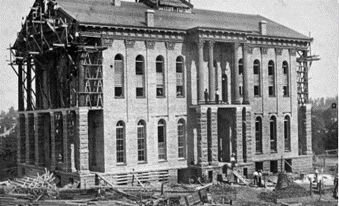
The Shelbyville Plan, they would call it in books not yet written, ¹ would soon distinguish itself uniquely, in what historians believe may be the first American county seat to feature a central courthouse block square town plan—both an architectural and cultural statement about the nation’s evolving identity. These wide streets and central axis were not born of whim or accident. They were blueprints of ideology, city planning as declaration, a civic geometry that declared the law belongs at the center of the people’s lives. Not in some corner. Not in some hall of mirrors. At its very heart.
Each stone of the courthouse was laid in that spirit, with the old gods of reason and debate watching, invoked not in prayer but in brick and beam. This public square was no mere village. It was a circle interrupted, the endless loop of community given angles and commerce and consequence. Here men traded mules and grain and lawsuits. Here women whispered politics in the shade of haunt-blue porches. Here the soil remembered everything. And so did the people.
They were not architects merely of buildings, but of meaning. Of myth remade. The Greek Revival style that crowns this courthouse was not just borrowed style but resurrection, a reaching back into the marbled past to find a structure that could bear the weight of a nation becoming. To say: this is where law and self-governance lives. This is where the republic stands. Not by force. But by agreement.
From the Greeks to the Tennessee Hills: The Birth of the Shelbyville Plan
This courthouse is not just masonry. It is the very breath of a recently free’d people calcified into legacy. It was the stone and brick embodiment of all the ideas that had floated down from Philadelphia to the frontier, carried westward with the settlers who broke the soil and raised their cabins.
This was a new world, born of old dreams, and there, in the middle of everything, was the law. Not the law as it had been wielded under the British crown, not the laws that had governed American’s from distant shores, but a law all its own.
Men have settled feuds beneath its observant eyes. Jurors have judged their neighbors and themselves in its hallowed chambers. This square, shaped like the patchwork-quilt farms that surround it, was never just a place to settle disputes—it is the soul of the town—the symbol of what men and women and children gave their lives to achieve. And when the night comes and the square empties out, it does not sleep; it is waiting and anticipating the commerce and comradery of tomorrow.
The Shelbyville Plan Goes Viral (The 19th-Century Version)
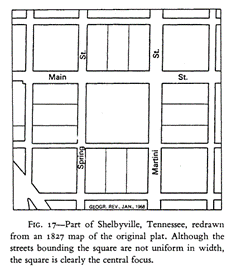
Shelbyville in 1810 was not alone. Towns and county seats across the south and west, recently liberated by the ratification of our constitution on March 4, 1789, mimicked its form. As many as 150 newly forming county seats copied the Shelbyville Plan like a page of gospel passed hand to hand, and the form became function, and the structure became symbol, and the South bent around its sense of order like steel in a forge. The form of it speaks without needing a tongue: Here is order. Here is justice. Here are people who will not be ruled by a King but by themselves.
And here in Shelbyville, still this stately courthouse stands—its fourth incarnation—yet still wearing its old uniform. Not untouched, but unbroken. It is not merely a relic. It is physical proof of a dream that became a belief system, of lofty ideals that inspired a flag, cemented into an identity. This building remembers. This square speaks, if you know how to listen. Not just to its past, but to what remains unwritten.
Not history. Continuance.
Come down and visit us.
References
¹The Central Courthouse Square in the American County Seat – Edward T. Price

 Ramblings & Revelations
You must be logged in to post a comment.