
byChrisWhite – 2024
Our first grand adventure on the river waters of Europe was aboard a skinny floating contraption, appropriately named “The Sound of Music,” that dared call itself a cruise ship, meandering along the Danube River, a waterway so charming and storied that it seemed to hum its own tune as it carried us through Austria and Germany. Emily, my better half, and I embarked at Vienna and disembarked at Prague, though the Danube had no part in that last leg of the journey, obliging us to go ashore like reluctant landlubbers in Regensburg. From there, it was a bumpy jaunt by bus to Nuremberg and finally to Prague, the jewel of Bohemia. Let’s begin with Vienna.
Vienna greeted us with the kind of imperial pomp and grandeur that could make even the most modest tourist feel underdressed and overwhelmed. This was a city that didn’t just dabble in history, it positively wallowed in it. With a roster of cultural icons that would send Nashville straight to the fainting couch, Beethoven, Mozart, Strauss, and a supporting cast of musical geniuses, it stood as a marvel of old-world elegance and unabashed opulence.
Our introduction came via the Ringstrasse, a boulevard so magnificent it could make any American freeway look like a back-alley shortcut. This grand circular road wasn’t just a street; it was a showcase of Vienna’s finest: palaces glimmering with aristocratic smugness, Gothic spires stabbing the heavens, and monuments so elaborate they practically screamed, “Take a photo and try not to look too impressed!”
Hofburg Palace, the main residence of the Habsburg emperors, was a sprawling testament to the benefits of absolute power and an endless supply of tax revenue. Its famed Lipizzaner stables housed horses so regal they might have demanded top billing over the emperors themselves. But for all Hofburg’s gilded excess, it was St. Stephen’s Cathedral that stole the show. That multicolored tiled roof shimmered in the sunlight like the back of a mythical dragon, daring all who passed to look up and be dazzled. As I stood there, jaw agape, I lamented the inadequacy of my camera lens, a mistake I vowed to rectify posthaste. You don’t come face-to-face with architectural dragons twice in one lifetime without being prepared.
That afternoon, as if Vienna hadn’t already shown us enough splendor to last a lifetime, we visited Schonbrunn Palace, the Habsburgs’ summer retreat. Let me tell you, if this was their version of “roughing it,” then I’ve been camping all wrong. The gardens were so meticulously groomed they might have been tended by angels with scissors, while the palace’s interior dripped with enough gold leaf to bankrupt Fort Knox. Walking through those halls, I half-expected a Habsburg ghost to appear and demand that I wipe my shoes before entering.
Vienna, in all its imperial arrogance and musical magnificence, had a way of making you feel small and awestruck, like a bewildered ant stumbling into the Louvre. And yet, beneath all that grandeur, you couldn’t help but be charmed. It was a city that demanded admiration and left you eager to oblige.
The next morning, the Danube, in its lazy, unhurried fashion, deposited us at the doorstep of Dürnstein, a village so picturesque it might well have been imagined by a poet with a soft spot for fairy tales and a fondness for cobblestones. The streets twisted and turned like a drunkard’s walk, lined with medieval homes that leaned companionably on one another, as if conspiring to keep the secrets of centuries past. Perched above it all was a blue-and-white Abbey so striking it could’ve been mistaken for a wedding cake.
Towering above the village, the ruins of Dürnstein Castle clung stubbornly to the hillside. It was here, so the locals claimed, that King Richard the Lionhearted was made an involuntary guest of Duke Leopold V. Richard, it seems, had a knack for making enemies; tossing Leopold’s battle flag into the mud after the Siege of Acre was apparently the 12th-century equivalent of an epic insult. Thus, the lion-hearted monarch found himself cooling his regal heels in a chilly castle far from his rainy homeland.
But the real eyebrow-raiser in this quaint little hamlet was the ossuary by the city gate. Picture, if you will, a dungeon-like alcove stacked to the brim with human bones, locked behind iron bars that served less as a deterrent to thieves (who in their right mind would steal a femur?) and more as a grim spectacle for passersby. The story goes that when a resident’s lease on their burial plot expired, likely due to a failure in the payment department, the remains were promptly evicted to make room for a new tenant. There it was, the eternal resting place interrupted by an overdue bill. “An affordable housing mandate,” Dürnstein style, though I suspect the term “affordable” was met with less enthusiasm by the dearly departed.
As we wandered through this strange blend of whimsy and macabre practicality, I couldn’t help but marvel at the audacity of this little village. It managed to be simultaneously enchanting and unsettling, a place where fairy tales meet grim realities, and where you might just find yourself renting eternity by the month.
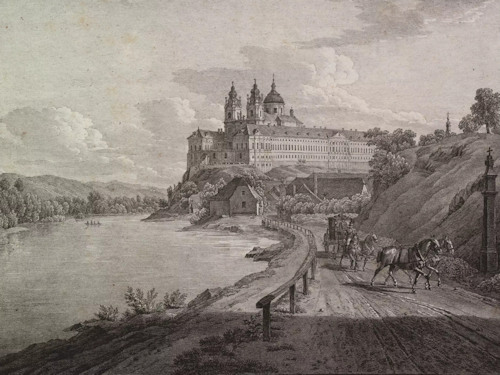
Sailing through the Wachau Valley was like flipping through the pages of a storybook, each turn revealing castles, vineyards, and ruins. We disembarked in Melk, a charming little town with a name as short and unassuming as its most famous attraction is grand and ostentatious. Awaiting us atop a hill was the Melk Abbey, an 11th-century Benedictine masterpiece so Baroque it practically screamed, “Look at me!” Baroque architecture, for the uninitiated, is what happens when architects decide that too much of a good thing is never enough. Columns, gilding, frescoes, and flourishes, if it could be added, it most certainly was.
Our tour began in the Abbot’s chambers, a series of rooms so lavishly adorned that one suspects the Abbot may have occasionally forgotten his vows of humility. From there, we walked the Kaiser’s Walk, a hallway designed to let emperors strut their stuff while commoners like us gawked in awe. The pièce de résistance, however, was the library, a cavernous treasure trove of ancient manuscripts, its shelves groaning under the weight of knowledge accumulated over centuries. If books could talk, I suspect these would scold us for not knowing our Latin.
After being thoroughly humbled by the intellectual and artistic achievements of monks who clearly had too much time on their hands, we descended into the village of Melk. The town itself was a picturesque cluster of shops and cafes, where we engaged in that most venerable of tourist traditions: buying trinkets we neither needed nor would likely ever use. I purchased a bottle of apricot wine, reasoning that if the monks of Melk had taught me anything, it was the importance of appreciating life’s finer things, even if they come in a bottle.
As the sun dipped low, we returned to our ship, where dinner awaited. The meal was a fine end to a day of spiritual enlightenment and earthly indulgence, and as the ship set sail, I raised a glass to Melk, proof that even the tiniest towns can leave the biggest impressions.
We awoke in Linz to a decision as weighty as any emperor might face: visit the ancient city of Passau, boasting a mere 2,500 years of history, or hop a bus to Salzburg, the birthplace of Mozart and the cinematic stomping ground of a certain nun-turned-nanny who couldn’t keep her musical ambitions in check. Naturally, we opted for Salzburg, because who can resist a city where geniuses are born and hills are alive? But before boarding the bus, my stomach took the reins, and I wandered into a pastry shop that smelled like heaven’s kitchen. There sat an old man, nursing his coffee alongside his German shepherd, a pair so serene they might as well have been in a painting titled Morning in Austria. Inside, my eyes fell upon a tray of stuffed doughnuts that radiated an aura of mystery and promise.
The catch, of course, was that no one spoke English, and my German vocabulary at that moment consisted solely of “ja” and “nein,” neither of which seemed relevant to doughnut inquiries. So, I threw caution to the wind, pointed like a man starved, and acquired two. One for me, one for Emily, or, if Emily proved unimpressed, two for me. As it turned out, these doughnuts were filled with apricot jam, the nectar of Austrian gods and apparently a local specialty. Even their wines, I would later discover, are infused with apricots. Imagine a place where the fruits of summer not only sweeten your desserts but also brighten your wine, it’s enough to make a man wonder why he lives anywhere else.
Salzburg, the birthplace of Mozart and a city so drenched in charm it might as well be bottled and sold as a luxury elixir, was a feast for the eyes, ears, and soul. Everywhere you turned, history and elegance collided with such gusto you half-expected the cobblestones to start waltzing. From the manicured perfection of the Mirabel Palace gardens, where flowers stood in soldierly formation, to the towering majesty of Salzburg Cathedral, the city knew how to put on a show. Even St. Peter’s Cemetery, with its quaint iron crosses and shadowy alcoves, looked more like an artist’s sketchbook than a final resting place.
The air was thick with echoes of music, not just from street performers but from the city itself, as if Mozart had left his melodies floating around for posterity. Every corner seemed to hum a bar from The Magic Flute or yodel something vaguely reminiscent of the Von Trapps’ greatest hits.
For dinner, we descended into a medieval cellar, a place that oozed atmosphere and perhaps a little mildew. It was the sort of vaulted, stone-walled chamber where you’d expect knights to clink goblets of mead and jesters to tumble, though instead, we had waiters who were far less entertaining but far more skilled at serving schnitzel.
As we wandered the streets afterward, I stumbled upon my favorite souvenir of the trip: a pair of cufflinks, black as a moonless night and adorned with tiny tourbillon movements inside, little spinning gears that gave the illusion of sophistication and whispered, “You’ve outdone yourself this time.” I bought them on the spot, reasoning that no trip to Salzburg could be complete without acquiring a touch of old-world elegance to take home. They now sit in my collection as a reminder that even in a city bursting with cathedrals and concertos, sometimes it’s the small, spinning things that steal the show.
Regensburg, a medieval jewel of Germany that fancies itself the northernmost Italian city, is the kind of place where history hangs in the air like an overstuffed tapestry. It has Roman ruins for a foundation, Gothic spires for a skyline, and a smattering of urban palazzos topped with towers, courtesy of homesick Italian merchants who evidently thought, “When in Germany, build as if you’re in Bologna.” The whole place whispers, no, shouts, “Buongiorno!” in a heavy Bavarian accent.
The city’s pièce de résistance is its 12th-century stone bridge, the oldest in Europe and a marvel of engineering that has outlasted wars, floods, and the occasional donkey-cart traffic jam. Spanning the Danube with a steady, unassuming grace, it doesn’t flaunt its age so much as quietly insist upon respect, like an elderly professor who knows more than you’ll ever learn.
As we strolled the ancient streets, we stumbled upon an archaeological dig that laid bare Regensburg’s Roman roots. There it was: a slice of time preserved in stone and dirt, a window into the lives of toga-clad citizens who likely never imagined their discarded pottery and fish bones would become a tourist attraction. I stood marveling at how centuries of decomposing civilization had managed to raise the city’s streets by ten feet, as if time itself had been hard at work with a trowel and a wheelbarrow.
It’s a curious thing, watching history pile up like layers of lasagna. Each generation adds its own noodles and sauce, and before you know it, the whole dish is so high you need a ladder to appreciate the top. Regensburg is precisely that: a towering lasagna of history, with Roman ruins at the base, Gothic churches for garnish, and a sprinkle of Italian flair on top. Bon appétit, indeed.
Nuremberg revealed its layers of history, from the grand castle with its sweeping views to the haunting echoes of World War II. We passed an unfinished colosseum Hitler once dreamed of completing, a monstrous reminder of hubris and folly. The old town, with its cobbled streets and Albrecht Dürer tributes, was a delight. And then, dear reader, we arrived at the magnum opus of Nuremberg’s market square, a fountain so grand, so flamboyantly Gothic, it might just cause you to question the very purpose of fountains altogether. This marvel, known as the Schöner Brunnen (which translates quite humbly to “Beautiful Fountain,” as if there were any doubt), rises a staggering 19 meters into the sky, proudly waving its flamboyant Gothic spire as if to declare, “Look upon me, ye puny mortals, and despair at your birdbaths!”
It’s a 14th-century creation, though you’d swear it had ambitions far beyond its station. Imagine, if you will, that the spires of Notre-Dame and the Cathedral of Cologne had a whirlwind romance, complete with medieval courtship rituals and an inordinate amount of choral singing, and produced an offspring. That offspring, dear reader, would be this fountain. It is all arches, pinnacles, and pointy bits, the kind of structure that seems to exist purely to confound pigeons and inspire poetry.
And there it stands, next to the town hall, as if to remind local bureaucrats daily that no matter how much they may accomplish, they will never build something quite so magnificent, or so absurd. One could almost hear it whisper, “Beat that, city planning committee,” as we gazed up at its impossible grandeur.
Finally, Prague, ah, where does one even begin with a city that seems to have been designed by angels with a flair for architecture and a streak of mischief? Its Astronomical Clock, a contraption of medieval genius, ticks and tocks with a precision that puts modern wristwatches to shame. But this is no mere timepiece; it’s an intricate theater of gears and figurines, where apostles parade on the hour and a skeleton cheerfully rings a bell, reminding everyone that time waits for no one, except, apparently, the guy running late to see the show.
The Charles Bridge spans the Vltava River with the kind of artistic grace that makes lesser bridges look like overgrown footpaths. Lined with statues of saints and sinners, it feels less like a crossing and more like a procession of stone witnesses, silently judging the street artists and souvenir hawkers who have set up camp along its length. Above it all looms Prague Castle, an architectural patchwork quilt that spans centuries, styles, and the ambitions of kings who clearly didn’t believe in leaving well enough alone. It stands like a sentinel of time, overseeing a city that refuses to pick a single era to belong to.
And then there are the side trips, ah, the side trips. First, Terezín, a place that sobers the soul and chills the heart. Once a Jewish ghetto and a transit point to horrors beyond imagining, it now stands as a grim monument to humanity’s capacity for cruelty. Its silent walls and deserted streets whisper stories that should never be forgotten.
But if Terezín leaves you heavy with reflection, Kutná Hora swings the pendulum to the surreal. The Sedlec Ossuary, a chapel adorned with human bones, is what happens when a medieval monk looks at mortality and thinks, “Why not redecorate?” Chandeliers made of femurs, wall sconces crafted from skulls, it’s part art installation, part fever dream, and entirely unforgettable. Standing there, surrounded by thousands of skeletal remains, you can’t help but marvel at the audacity of it all. It’s as if someone thought, “Let’s make death fashionable.”
Prague, with its blend of grandeur, eccentricity, and solemnity, defies easy description. It’s not just a city; it’s a stage, a museum, and a living work of art that invites you to lose yourself in its maze of streets and its kaleidoscope of history. And, rest assured, lose yourself you will—but what a glorious place to be lost.
Ah, the grand European adventure, a journey that took us from the imperial pomp of Vienna to the medieval mischief of Prague, with enough stops in between to make a lesser traveler question their footwear choices. We started in Vienna, a city so steeped in grandeur that even its sidewalks felt like they should come with a royal decree. Between the gilded halls of Schonbrunn Palace, the dragon-scaled roof of St. Stephen’s Cathedral, and the musical ghosts of Mozart and Beethoven lurking in every corner, it was a place that demanded you keep your head on a swivel lest you miss something worth marveling at.
From there, the Danube, ever the obliging host, whisked us through a dreamscape of history. In Dürnstein, we found charming streets, a ruined castle, and an ossuary that gave “affordable housing” a grim new meaning. Melk introduced us to the wonders of Baroque excess with its Abbey that practically begged you to genuflect before its magnificence. The Wachau Valley stretched out like a postcard come to life, with vineyards, castles, and enough scenic splendor to exhaust even the most enthusiastic camera.
In Salzburg, Mozart’s spirit danced through the streets while the Sound of Music sang in the hills. But it wasn’t the cathedrals or palaces that stayed with me, it was the apricot-filled pastries that convinced me Salzburg was heaven on Earth.
Regensburg and Nuremberg carried us deeper into history’s embrace, with Roman ruins, Gothic spires, and tales of emperors, artists, and one particularly ambitious dictator who, thankfully, never finished his colossal architectural eyesores. Regensburg’s stone bridge, Europe’s oldest, proved that even inanimate objects could age gracefully, while Nuremberg’s market square provided the perfect backdrop for both awe and indigestion, thanks to its sausages and its Schöner Brunnen fountain.
And then, there was Prague, a city that defied categorization. With its Astronomical Clock ticking out centuries, its Charles Bridge whispering stories of saints and sinners, and its castle standing guard over a labyrinth of streets, it was a place that made you feel small in the best possible way. Side trips to Terezín and Kutná Hora added depth to the journey, one solemn, one surreal, but both unforgettable. Terezín reminded us of humanity’s darkest hours, while Kutná Hora turned mortality into macabre art with its bone-bedecked chapel.
In the end, this vacation was a kaleidoscope of history, beauty, and a fair bit of absurdity. It left us footsore, camera-laden, and richer for the experience. Europe, with all its quirks and contradictions, proved itself a stage where the past and present perform an endless duet. And as the curtain fell on this journey, I couldn’t help but smile, knowing that the memories we gathered will linger longer than the jet lag.

 Ramblings & Revelations
You must be logged in to post a comment.