
byChrisWhite – 2025
Bulgaria, now there’s a place that sneaks up on you. To be honest, it was never on my list of great cities to visit. It wasn’t even on my list of places I vaguely suspected of being interesting. But then it happens. Suddenly, you get off an airplane and find yourself rolling through the pastoral outskirts of Bulgaria’s capital, trapped inside a cab that smells like boiled cabbage and regret, decidedly off the beaten path, and voila, you discover the beauty of a city in the most delightfully unexpected ways.
To be fair, the approach did little to inspire confidence. The outskirts were unexpectedly agricultural, the city unfurling itself in Soviet-era apartment blocks so drab they made a prison look like an Airbnb. But then, in between these concrete monstrosities, a gorgeous spire, or golden dome would thrust into the sky, relics of Austro-Hungarian grandeur, a defiant bit of Byzantine domed beauty, or, inexplicably, a glistening modern tower that looked like it was on loan from Dubai. This city had the architectural cohesion of a toddler’s Lego set.
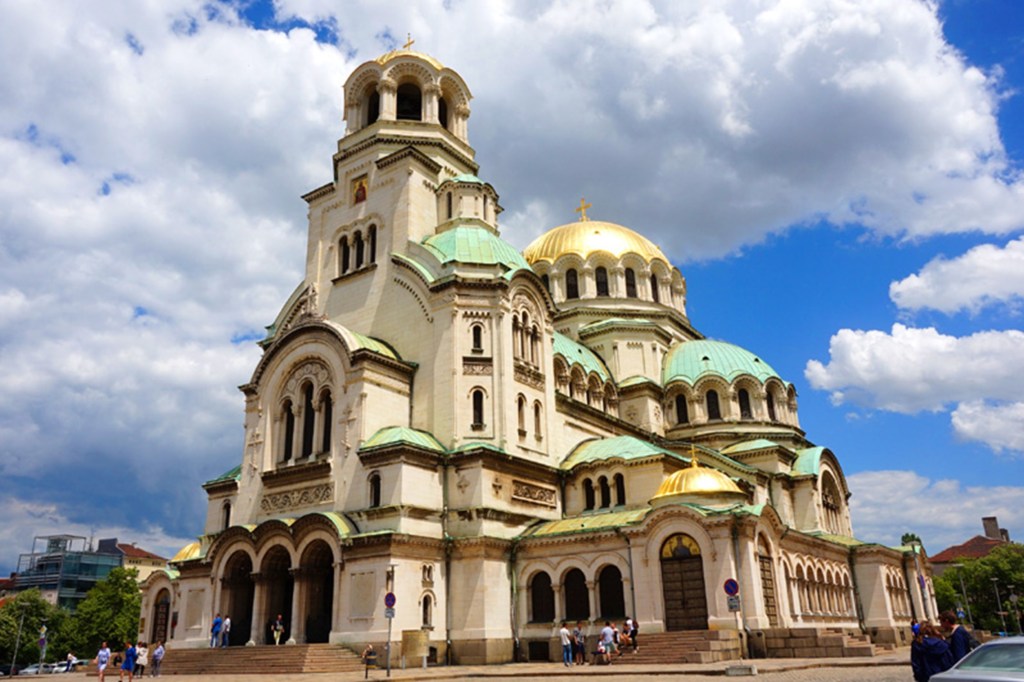
Our hotel, the Intercontinental, was respectable. More importantly, it stood within spitting distance of the Alexander Nevsky Cathedral, a neo-Byzantine colossus that looked like it had marched in from another century and refused to budge. It was the first thing to shake us from the stupor of our jet lag. It stood in quiet defiance of my absent expectations, a behemoth of neo-Byzantine splendor It was as grand as a Russian novel and only slightly more comprehensible. Built in 1882, it can hold 5,000 passive Christians or about 250 well-motivated revolutionaries, depending on the police response. The kind of building that demands admiration, even from heathen skeptics, and left me wondering how Bulgaria had kept a 60-year secret from my malignant curiosity.
One moment, you’re stepping off a plane, expecting a gray Soviet relic held together by rebar and nostalgia, and the next, you’re blinking at a cathedral so grand it looks like it was plucked from Byzantium and dropped smack in the middle of Sofia by an absent-minded deity.
Our journey to Bulgaria was part of a grand Balkan excursion, an ambitious undertaking meant to enlighten, entertain, and possibly leave us with sore feet and a suspicion of border guards. With no instant itinerary beyond the vague notion of walking until something interesting happened, we set off. The first thing we encountered, aside from a gaggle of very interesting churches, was a skate park full of teenagers positioned strategically next to a Soviet war memorial. The irony, though likely unintentional, was surprisingly exquisite.
Wandering the streets, I found Sofia to be a city of contradictions. Austro-Hungarian elegance bumped elbows with communist-era brutalism, and somehow, it worked. Vitosha Boulevard, the city’s main shopping artery, had the audacity to be beautiful. From its cafés, you could sip espresso while gazing at Vitosha Mountain, which loomed in the background like an ever-watchful chaperone. Also, for reasons beyond my understanding, there was pizza everywhere. Not just pizza, but an obsessive, omnipresent devotion to it. Bulgaria, it seemed, had quietly crowned itself the Balkan capital of pizza.
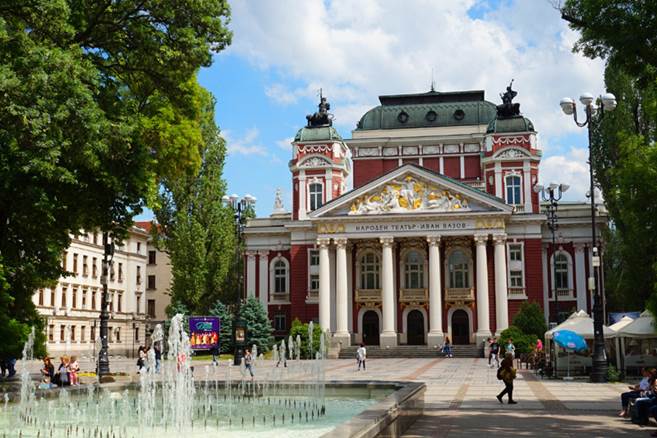
The National Theatre provided a more picturesque pause. The people-watching was excellent. We sat among sun-drenched retirees and watched the daily life of Sofia unfold: children engaged in elaborate stick-based negotiations, an old man playing the oboe with the determination of someone who had once dreamed bigger, Inter alia basoon, whose talents were inversely proportional to his enthusiasm, water dancing from a piazza-esque fountain, and old women sunning themselves like lizards on stone benches. It was a place that invited loitering.
Then there was the walking tour, the great equalizer of tourists. My guide, a woman who had either a deep love of history or a mild resentment toward her job, led us through ancient Roman ruins tucked inside a train station, mineral water springs where locals queued up to bottle questionable elixirs.
The President’s Palace was, to be fair, unassuming to the point of disappointment. There were only two sentinels stationed outside, which made me wonder if the Bulgarian presidency was could be the most secure job in Europe, or so underwhelming that Bulgaria’s leader enjoyed the benefits of total anonymity.
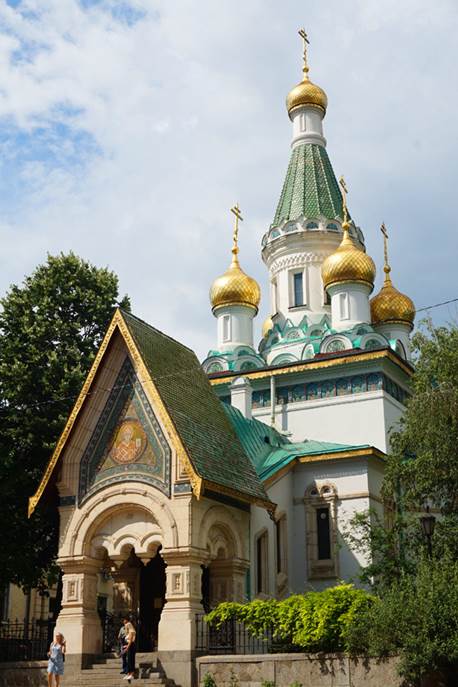
As we continued wandering, we found ourselves in front of the Russian Orthodox cathedral. It was stunning, at least from outside. Inside, it was less compelling, particularly given the ten-lev extortion fee just to take photos. I refused on principle.
Later, we stumbled upon a gathering of military personnel in full dress uniform, which briefly made me suspect that Bulgaria was either bracing for war or celebrating something of national importance. Either way, they took so long to begin doing anything that we lost patience and went in search of food.
Vitosha Boulevard, the main shopping district, had the sort of polished veneer that made me briefly forget I was in a former Soviet republic. It had the trappings of Western Europe, stylish cafes, brand-name stores, and an unreasonable number of pizza joints. Sofia, it turns out, is positively afflicted with a love for pizza. Some places serve it 24 hours a day, which suggests a level of national commitment bordering on the obsessive.
Despite its simple palace, Sophia is an unexpected smorgasbord of culture. And as it turns out, it has been continuously occupied for thousands of years, and its layers of history peek through in the oddest places. The city had layers, like an onion, or more accurately, like a mille-feuille pastry, delicate, surprising, and possibly dangerous if you weren’t paying attention.
After our walking tour, we visited the National Museum, housed in a former mosque. It had everything from prehistoric artifacts to Thracian gold, offering a historical perspective that most Westerners have never encountered. It was well worth the time. If you’ve ever watched the History Chanel, and wondered where the ancient Thracians lived, this is it.
After a very long day of walking, the Intercontinental Hotel was a welcome retreat. Our spacious and comfortable room had an abundance of electrical outlets, a small but vital luxury when traveling through Europe, and a breakfast buffet worth waking up for.
The next day, we headed for Serbia, but not before visiting a masterpiece of architecture and art; The Rila Monastery. About an hour south, beyond Sofia, Bulgaria sprawled into unexpected beauty. The Rila Monastery, tucked into the mountains, looked like it had been conjured from a storybook. The road to it was lined with fruit trees, every other house presumably containing a bootlegger perfecting their own variety of rakia, a local brandy capable of making a strong man rethink his life choices.
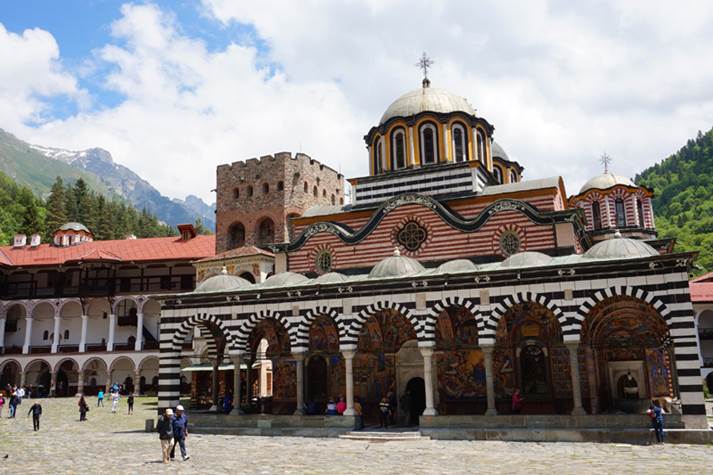
The monastery itself was a marvel, frescoes and artwork so vivid they made reality look washed out, archways that framed the mountains like an artist had planned it all, and a silence so complete it made you question whether you had ever really known quiet before, it all conspires to make you feel vaguely unworthy. I contemplated great thoughts there, about faith, history, and the precise moment when someone decided that an eight-foot haystack balanced on a wooden pole was the best way to store feed. Actually, the hay thing was an interesting throwback to farming, still practiced in rural Balkan states like Bulgaria and Romania, where the farms are small, and the hay is still cut by grim reapers in overalls with sharpened scythe’s and stacked in piles, fifteen feet high, the landscape resembling the pimpled face of an unwashed adolescent.

Bulgaria, in the end, was not just a country I visited, but a country that left a mark. It was a place where the ancient and the modern threw elbows at each other but somehow coexisted, where history was layered so thick you could trip over it, and where I, a man of little expectation, found himself thoroughly, completely surprised. And that, in the end, is what travel is supposed to do.
Overall, Bulgaria is a gem, but one best experienced in combination with other destinations. It’s rich in history, but accommodations outside Sofia are hit or miss, and infrastructure can be delightfully unpredictable. Pair it with Romania or Serbia, as I did, and you’ll find the trip well worth the effort.
Would I return? Absolutely. Would I still be surprised by it? No doubt; I would venture East to the Black Sea, then north to the Danube Delta to experience the wild horses and Eastern Balkan highlands. Another adventure in the waiting.

 Ramblings & Revelations
You must be logged in to post a comment.