
byChrisWhite – 2025
The Unshakable Weight of Jerusalem
Jerusalem is not a city for the faint of heart or the fragile of faith. It is where skeptics come to frown at miracles and leave rubbing their chins, where the past refuses to be polite and insists on making itself known with every uneven stone beneath your feet. Modern minds have been trained to distrust what is old and believe that everything true must come with a peer-reviewed study and a press release. And yet, here stands Jerusalem, unbothered by the opinions of men, wearing its history like a crown that no empire has ever managed to steal for long.
The trouble with understanding faith in the modern world is that we have been convinced to doubt the very things that have endured the longest. Faith, we are told, is a fragile thing, forever at risk of crumbling under the harsh gaze of progress. But if ever there were a place to put that nonsense to rest, it is here.
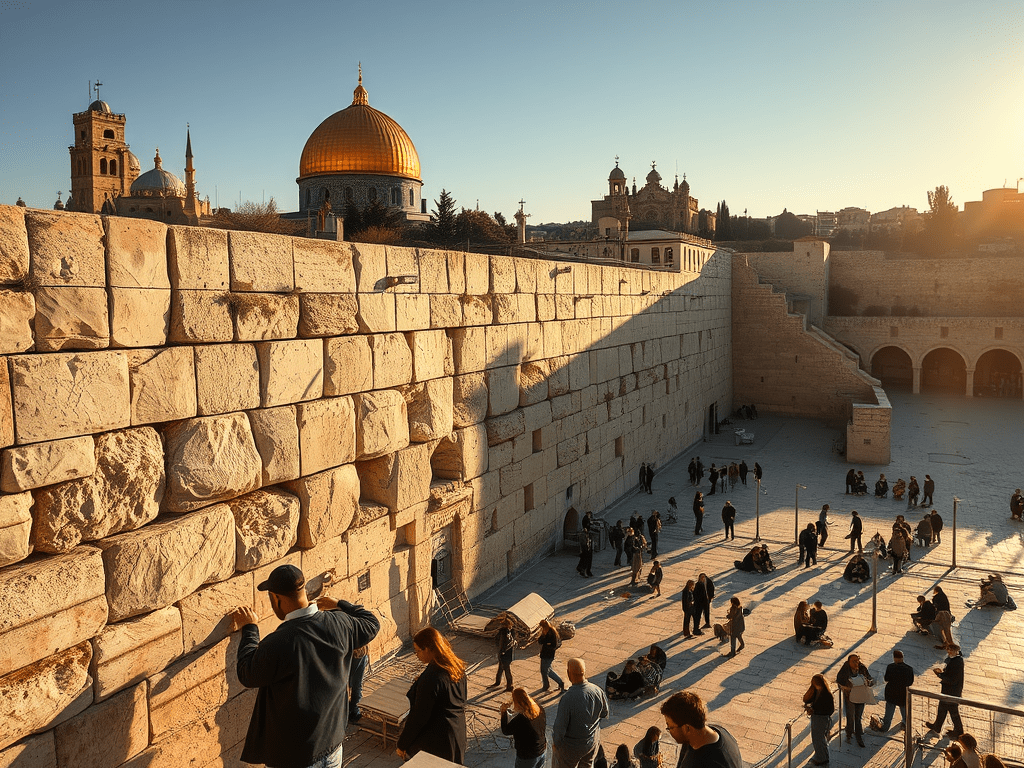
Come to Jerusalem. Walk through the Old City where the walls have outlived the kings who built them. Stand at the Western Wall, where prayers are whispered into cracks worn smooth by centuries of hope. Visit the Church of the Holy Sepulchre, where faith and history collide in a way that no historian, no journalist, no critic could ever fully explain.
Why You Should See It for Yourself
Israel is not a land for passive sightseeing, it is an experience that grabs you by the collar and demands you pay attention. It does not politely present history on a plaque, it throws it at your feet, shoves it into your hands, and dares you to ignore it.
So if you are of a mind to see the world in a way that makes it impossible to unsee it, pack your bags and come to Jerusalem. The city is not waiting for you, because it does not wait for anyone, but it will be there, just as it always has been, unshaken, unwavering, and as full of wonders as it was when the first pilgrim set foot on its sacred streets.
A Final Pilgrimage to Jerusalem: A Hope Diamond in the Rough
The next morning, we began our pilgrimage to the crowning jewel of our journey: Jerusalem. It stood before us, shimmering in the haze of history, a city that seems less built on stone and mortar and more on contradictions, sanctity, and the stubborn persistence of humanity. Along the way, we passed the unassuming Museum of the Good Samaritan. To the casual observer, it might have been just another dusty stop along the road, but our guide, whose knack for storytelling bordered on theatrical genius, brought the ancient parable to life.
He painted the Samaritan not just as a benevolent passerby but as a living rebuke to the so-called righteous. Those who ought to have been paragons of compassion, men bound for the temple, cloaked in their purity laws, stepped over a suffering man because helping him might inconvenience their rituals. The irony hit like a well-thrown stone: those closest to God in theory had missed Him entirely in practice. It was a tale I’d heard since childhood but never quite understood so clearly, until it was laid bare, with all the context and cultural weight it deserved. It was a lesson in irony so sharp it could cut, a timeless reminder that sanctity is often found in the most unlikely places.
Soon, we arrived in Jerusalem, the city of cities, and a place whose stones have soaked up more prayers, tears, and blood than any other place on Earth. Our first stop was an active archaeological dig, where we were handed tools and tasked with cleaning rubble. It was the kind of chore that feels both humbling and inflated with grandeur, as though brushing dirt from shards of pottery might unlock the secrets of civilizations past. My inner Indiana Jones rejoiced at the discovery of a fragment that might someday sit in a museum I’d likely never revisit.
After our efforts as amateur archaeologists, we checked into the Inbal Jerusalem Hotel, a sanctuary of modernity amid the ancient chaos. Refreshed and recharged, we ventured into the Old City for an evening light show at the Tower of David. This medieval citadel, layered with history upon history, seemed to breathe with the weight of its stories. As the walls lit up with vivid projections of conquest, resilience, and faith, I couldn’t help but imagine that these very stones might have witnessed the trial of Jesus, the whispers of Roman centurions, and the cries of zealots.
A Morning of Holiness and History
The next morning, we embarked on a journey through time. First, the Room of the Last Supper, where modern archaeologists believe Jesus broke bread with his disciples. Standing in that hallowed space, I felt an awe so profound it bordered on disbelief. Could this really be the place where history and divinity collided so poignantly?
From there, we walked to King David’s Tomb, the legendary resting place of Israel’s poet-king. While the tomb itself is obscured by centuries of architectural layers, the views from atop the structure stretched across the City of David, offering a glimpse into the past that felt almost tangible.
Next, we passed through the Zion Gate and into the Armenian Quarter, where we visited the Hurva Synagogue. This 16th-century masterpiece, with its grand Torah ark and panoramic dome, seemed to embody the resilience of a people who have rebuilt their sacred spaces time and again.
The Sacred and the Sublime
We reached the Western Wall, a site so imbued with reverence that even the most jaded traveler cannot help but be moved. After offering our silent prayers, we descended into the underground tunnels beneath the Wall, where the secrets of its construction were laid bare. The sheer ingenuity of the ancient builders was a marvel, stones fitted so precisely they might as well have been whispered into place by angels.
Our final spiritual stop was the Church of the Holy Sepulchre, a labyrinthine basilica that holds Golgotha, the stone of anointing, and the tomb believed to have held Jesus. Here, the air itself seemed heavy with devotion, each corner alive with whispers of ancient prayers.
A View of the Eternal City
As the day wound down, we ascended through narrow alleys to a rooftop where the golden Dome of the Rock gleamed in the waning light. It was a view that seemed to encapsulate the entire essence of Jerusalem, holy, contested, beautiful, and eternal.
This wasn’t just a day of sightseeing. It was an immersive plunge into the currents of faith, culture, and history. The smells of spices and smoke wafting from nearby markets mingled with the echoes of ancient prayers, creating a sensory symphony that left us in awe. It was, indeed, an incredible day, one that I’ll carry with me long after the dust of those sacred streets has settled.
To Bethlehem and Beyond
After an amazing breakfast with some Chocolate Babka, we ventured to Bethlehem, crossing the Armistice Agreement Line and stepping into the disturbing region of the ill-famed West Bank. The contrast was stark and sobering. Bethlehem, the birthplace of Jesus, is sacred and yet surrounded by a landscape that felt neglected, littered with trash and decay. The Church of the Nativity, built over the cave where Jesus was said to be born, was awe-inspiring, its sacredness undiminished by the less-than-glorious surroundings.
Lunch at Segafredo, with its balcony view of more refuse than scenery, offered a moment of levity. The meal, however, was redeemed by a stop at a shop selling ornaments and icons crafted from ancient olive wood. These pieces, wrought from trees that might have stood witness to biblical events, were a poignant reminder of the endurance of faith.
Reflections on Jerusalem: A City of Paradox and Promise
Jerusalem is not a place one can visit lightly. It challenges you, inspires you, and unsettles you in equal measure. It is a city of tension and transformation, where the sacred and the profane coexist in an uneasy truce. Walking its streets, you feel the weight of history pressing against the present, a constant reminder that this land has shaped what it means to be human.
If you have the chance, go. Brave the contradictions, the complexities, and the chaos. Walk where kings, prophets, and commoners have walked. Stand in places that have witnessed the best and worst of humanity. It will change you, as it changed me, leaving you richer in spirit and broader in perspective. After all, what else is there, in the brief ticks and tocks of our mortal clocks, that could be more profound than standing at the crossroads of faith, history, and humanity?

 Ramblings & Revelations
You must be logged in to post a comment.