
byChrisWhite – 2025
There are places in this world where history sits politely in the background, content to let the modern world carry on without much interference. The Golan Heights is not one of those places. Here, history clings to your boots like stubborn mud and insists on making itself known at every turn. It is a land where civilizations have come, conquered, declared themselves eternal, and promptly been evicted by the next ambitious tenant.
For this third installment of my adventures in Israel, we turn our attention to Geshur, an ancient city that, much like a well-worn hotel room, has housed a staggering number of occupants over the centuries. It first appears in the Hebrew Bible as an Aramean kingdom, a little place trying to keep to itself on the edge of Israel. But, as fate would have it, history does not allow small kingdoms to mind their own business for long. The Assyrians showed up first, followed by the Babylonians, the Persians, and the Itureans, who spent their time being fierce warriors and presumably not worrying about things like town ordinances.
Then came the Hasmoneans, who claimed the land for Judea, followed by the Romans, who, as was their habit, marched in, declared themselves in charge, and built things that have managed to last longer than most modern governments. They ruled with the confidence of men who thought they had solved the puzzle of empire once and for all. That confidence, as history gleefully demonstrates, was misplaced.
After Rome did what all great empires eventually do, collapsed under its own weight, the baton passed to the Ghassanids, a Christian-Arab confederation that took up the noble task of trying to maintain order under the ever-watchful eye of Byzantium. But history, never content with a quiet transition, sent in the Caliphates, then the Ottoman Empire, which folded the region into its sprawling domain the way an absentminded man might acquire property he never intends to visit.
But the story doesn’t stop there. The French took their turn, then the State of Damascus, and finally, after more diplomatic maneuvering and territorial juggling than a man can reasonably keep track of, the land became part of Israel. And yet, despite all this, the argument over ownership continues, as if history has not already made it abundantly clear that no one keeps the deed to the Golan Heights forever.
Lessons from a Land That Has Seen It All
If history teaches us anything, it is that human beings are forever convinced that their moment of dominion will last. But the Golan Heights stands as a fine reminder that land is indifferent to the ambitions of men. The hills have been claimed and reclaimed so many times that one imagines they must be utterly exhausted from all the paperwork.
Some may find this timeline inconvenient, preferring their history to be less complicated and more in line with whatever suits their perspective. But history is a stubborn old thing, unwilling to bend for the sake of convenience. It simply records the rise and fall of every conqueror, every empire, every hopeful soul who once stood upon these heights and declared themselves victorious.
But despite its turbulent past, or perhaps because of it, the Golan Heights is a place worth seeing. It is where the weight of history meets the sheer beauty of the present. The views are spectacular, the stories are endless, and if you stand still long enough, you might just hear the echoes of all those who came before, still arguing about whose land it truly is.
So, if you’re looking for a destination that offers history, breathtaking landscapes, and the undeniable feeling that you are walking through the very pages of time itself, then the Golan Heights is well worth your visit. Just be sure to step carefully, history has a habit of sneaking up on people here.
That’s Plenty of History, Now, Let’s See What the Golan’s Got to Say for Itself
So after bidding farewell to the mystic allure of Safed, we turned our sights eastward, toward the Golan Heights, a piece of real estate as dramatic in its history as it is in its topography. The journey wound through hills that seemed to grow steeper with every mile, as if nature itself were conspiring to make the place as impenetrable as its politics. Upon reaching the observation park, the first thing to strike me, aside from the gusty wind, was the sheer audacity of the geography.
Behind us loomed a steep hill bristling with what looked to be military equipment and the sort of buildings designed to discourage curiosity. Ahead, the land spilled out into a vast plain, a patchwork of Syria stretching below like a quilt someone forgot to embroider with peace. The scene was punctuated by a heavily guarded United Nations camp, whose presence was less an emblem of harmony than a stark reminder of its absence.
The views from the Golan Heights are undeniably spectacular, but they carry an edge of irony. For here, amidst such natural beauty, the human impulse for conflict has entrenched itself as deeply as the roots of the vineyards that now dot the region. Gazing out over the plains of Syria, it was clear why the Heights are a coveted prize. The terrain practically invites defense; the position is so commanding it might as well come with a sash and crown. If I were in their shoes, I’d want it too, though I might be inclined to skip the centuries of bloodshed in favor of a lively round of rock-paper-scissors.
Having absorbed our fill of panoramic vistas and geopolitical musings, we decided to shift gears and spirits, quite literally, at the Bahat Wine Cellar. This family-owned kosher winery proved a stark contrast to the tense air of the borderlands, a little oasis of refinement nestled in the rugged hills. The owners welcomed us with warmth and a distinct lack of concern for international politics, focusing instead on the far more agreeable matters of wine and hospitality.
The tasting menu was a triumphant parade of reds, whites, and rosés, a palette as diverse and harmonious as the dream of coexistence itself. Their wines, smooth and rich, had the kind of flavor that could persuade even the most hardened cynic to wax poetic. They also served a charcuterie board adorned with cheeses and olives so perfectly matched to the wines that one might suspect divine intervention.
Gamla: Where History Sticks to Your Boots Like an Overeager Stray Dog
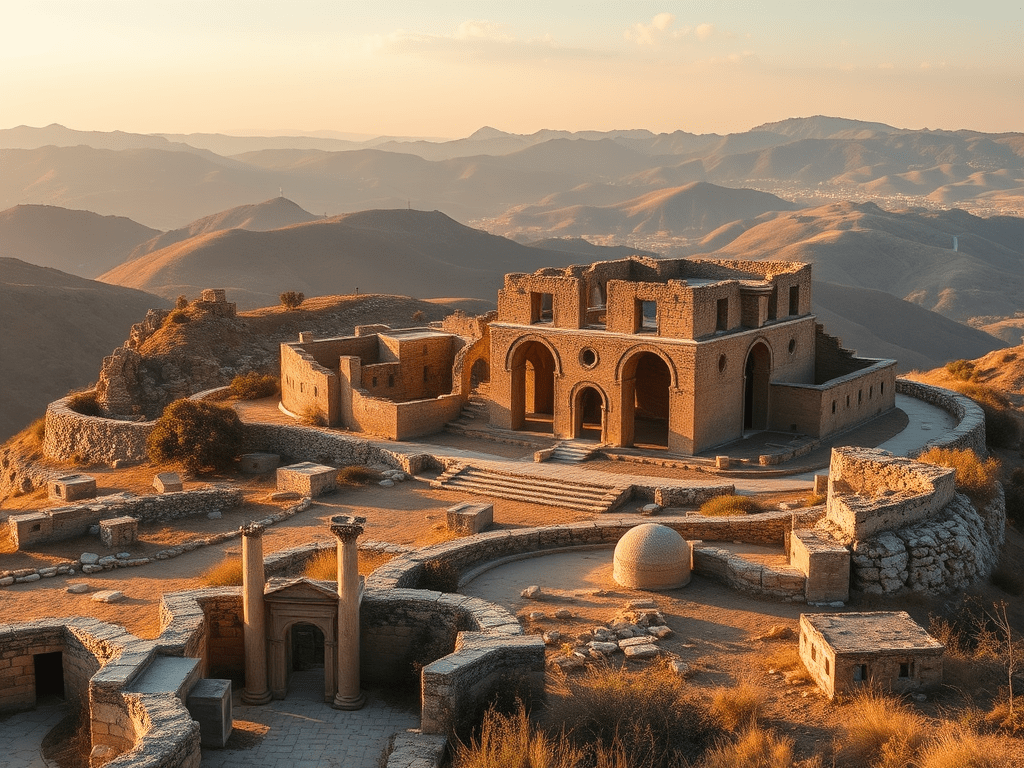
There are ruins, and then there are ruins with a grudge, and I’d wager that Gamla falls into the latter category. This ancient city, once a beacon of Jewish resistance, saw fit to defy the Romans, and while that was a noble endeavor, it ended about as well as one might expect when going toe-to-toe with the empire that considered “world domination” a mere pastime. The place was flattened in 71 CE, and I can only assume the Romans left whistling Dixie, dusting off their hands, and congratulating themselves on yet another fine display of overkill. But history, being the stubborn old mule that it is, never quite allows the past to stay buried. Gamla, despite its current state of scenic disrepair, refuses to be forgotten.
One of the most impressive things still standing (or rather, leaning with great determination against time itself) is what remains of one of the earliest known synagogues. Built when the Temple of Jerusalem was still in business, this was a place where faith flourished under the shadow of impending doom, a quality that many synagogues, churches, and small-town diners have somehow managed to maintain through the centuries. Gamla’s stones may be cracked, its walls collapsed, but its echoes are loud enough to drown out even the most determined history skeptic.
The Ghassanids: Christian Arabs and the Job No One Wanted
Now, here’s where things get interesting. While the Romans were busy crushing Jewish revolts, a whole other cast of historical characters was waiting in the wings, ready for their own dramatic entrance. Enter the Ghassanids, an early Christian-Arab tribe who, in the 5th century, found themselves in the employ of the Byzantine Empire, tasked with protecting the Golan region. Now, I am no military strategist, but this seems to me the historical equivalent of being hired to guard a porcupine from a den of wolves, an assignment with a short shelf life and a questionable benefits package.
Nevertheless, the Ghassanids did their duty, patrolling the Golan Heights with a curious blend of faith and force, proving that history is never as simple as modern narratives would have us believe. The Middle East, so often painted in broad and oversimplified strokes, turns out to be as layered as an overcooked lasagna. And if that wasn’t enough to shake up my view of the region, I also learned, to my complete and utter surprise, that there are still between ten and fifteen million Christian Arabs living in the Middle East today. I am beginning to suspect that what I learned in school about this part of the world may have been a tad… abridged.
Nimrod Fortress: A Fine Place to Keep an Eye on Things, Until You Forget to Pay the Rent
If there’s one thing the Middle Ages were good at, it was building massive fortresses in places no one could comfortably live. Case in point: Nimrod Fortress, a colossal stronghold perched on the southern slopes of Mount Hermon, watching over the Golan Heights with all the patience of a cat eyeing a particularly ambitious mouse. Built to guard the road to Damascus, it was a mighty fortress, designed to withstand sieges, invaders, and presumably, a lot of questionable medieval hygiene.
And yet, for all its grandeur, it met the same fate as most of history’s architectural marvels, it was eventually abandoned, left to the mercy of time, gravity, and the occasional nosy tourist. Today, its crumbling walls stand as a monument to the peculiar human habit of building things that time refuses to respect. A fortress meant to keep enemies at bay has, ironically, become nothing more than a scenic detour for those of us wandering through history’s leftovers.
Why You Really Ought to See This Place for Yourself
Now, I have rambled on about fallen cities, forgotten warriors, and fortresses that outlived their usefulness, but let me be perfectly clear, Israel is not a museum of ruins. It is a land of the living, where history does not sit quietly behind yellow caution tape but mingles with the present, insists on being acknowledged, and, if you’re not careful, trips you up in the form of a 2,000-year-old artifact underfoot.
As we departed, the sun began its descent, gilding the mountains with a golden glow that seemed almost too idyllic for a region so fraught with history. The drive back to our kibbutz was a scenic one, the kind of journey where the mind wanders and the heart settles into a state of quiet gratitude. For all its complexities, this corner of the world possesses a kind of rugged magic that lingers long after the last glass of wine is drained, and the hills fade into the twilight.
This is a place where faith and history shake hands, where the past is not a distant concept but a tangible reality, and where every road, ruin, and rocky hillside tells a story waiting to be rediscovered. If you ever find yourself in need of a journey that will challenge what you think you know about the world, then pack your bags and set your sights on Israel. The food is good, the history is even better, and if nothing else, you’ll leave with an entirely new appreciation for just how little you were taught in school.
The Dead Sea: A Day of Sacred Waters and Unforgettable Buoyancy
Driving south along the west coast of the Sea of Galilee, the road wound through a landscape steeped in history so thick it practically clung to the tires. We passed cities whose names echo through the Bible—Capernaum, Tiberias, Jericho—and others less renowned but no less storied, the kind of places where even the rocks could recite scripture, given a chance. Our first stop was Yardenit, a Christian pilgrimage site on the River Jordan, reputed to be the very spot where Jesus himself was baptized.
Now, I’ll confess, I’m not one to be swept up in religious fervor, but there was something about the place—a palpable energy that seemed to hum in the air. As we walked to the observation area overlooking the tranquil river, we watched scores of Christians being baptized in those ancient waters. They emerged dripping with faith and perhaps a touch of river mud, their expressions radiant with spiritual renewal. Flanked by arid desert, Yardenit stands as a lush oasis, a reminder that even the harshest landscapes can cradle moments of profound beauty.
Further south, we explored Beit She’an, an archaeological marvel and a Roman city so well-preserved it felt like stepping onto the set of an overachieving historical drama. The ruins spoke eloquently of a bygone world: an amphitheater where Roman citizens once roared for blood or bawdy comedies, public toilets that offered a peculiar sense of communal efficiency, and grand colonnades that whispered of power and excess. It’s a fine place to imagine yourself in a toga, so long as you don’t linger on the realities of ancient hygiene.
But the crown jewel of the day was Masada National Park. This fortress atop a sheer cliff, built by Herod the Great, is the kind of place that makes you marvel at both human ingenuity and hubris. Rising 1,300 feet above the desert floor, the fortress is geologically known as a horst, though “incredible natural fortress” seems just as fitting. Its cliffs fall so sharply that it’s a wonder anyone thought to build here at all, let alone Herod with his penchant for palaces and paranoia.
Our guide regaled us with the tale of Masada’s siege, wherein 960 Jewish rebels reportedly chose mass suicide over capture by Roman troops. While modern scholars quibble over the veracity of Josephus’s account, the story remains gripping, made all the more so by the artifacts—arrowheads, potsherds, and remnants of that fateful ramp—that lend it a stubborn credibility. Standing atop Masada, gazing out at the stark, endless desert, one can’t help but feel the weight of its tragic history pressing against the wind.
As evening approached, we reached the Dead Sea, where the surreal meets the sublime. Our hotel, the Isrotel Nevo Dead Sea, was a triumph of modern hospitality. From the plush lobby to the well-appointed rooms and a buffet that could make even a glutton blush, it was luxury incarnate.
The Dead Sea itself, however, was the true marvel. After slathering ourselves in its famous mineral mud, a ritual that left me feeling part tourist, part spa enthusiast, we waded into the salty waters. Floating was less an activity and more an inevitability. I lay back and defied gravity with ease, only to discover that standing up again was an altogether different challenge. Buoyancy is a blessing until you find yourself paddling to shore like an awkward otter, desperate for solid ground.
Dinner that night was a feast worthy of a king, or at least a very hungry traveler. The buffet was an extravaganza, more reminiscent of an Argentinian steakhouse than any traditional spread, where the sheer variety of dishes threatened to outshine the main course. As we dined, the events of the day settled into memory, each moment colored with history, beauty, and a healthy dose of wonder.
The day had been long, full, and utterly unforgettable, a tapestry of sacred waters, ancient stones, and the strange joy of floating where no man can sink.

 Ramblings & Revelations
You must be logged in to post a comment.