
byChrisWhite – 2025
Don’t get me wrong, I ain’t saying genealogy is a pursuit for the sane, but it does tend to attract a particular breed of folks who are real good at squinting at old documents and pestering the elderly for details about long-dead kinfolk. When I got started nearly forty years ago, there wasn’t a computer in sight, no fancy DNA tests to tell you that you’re one-eighth Viking and the other half confused. Just folks like me, armed with a legal pad and a dried-out ballpoint pen, scribbling down whatever my great-aunt Dora could remember about my 2nd great grandfather and that mysterious 2nd great uncle who ‘was poisoned with carbolic acid-accident, by his son in law and didn’t. live to point fingers.’
Then the internet showed up and turned this whole mess of genealogy into a carnival side-show. At first, we had bulletin boards, places where equally misguided individuals would swap half-true family legends like they were trading baseball cards. Then came personal family tree pages, then the behemoth of Ancestry.com, which made the whole business of tracking down your people feel like a professional sport.
It was a miracle and a curse all at once. On the one hand, you could suddenly trace a line back a thousand years if you were lucky, but on the other, you had to wade through a whole lot of nonsense from people so convinced they were the lost heirs to some European throne, that they reversed-engineered their way into fame.
Now, I got lucky on account of my mother having a last name that was just peculiar enough to be useful. Ragland. Not exactly a name you ran into at the grocery store in Tennessee. As a kid, I spent a fair amount of time wondering what kind of folks saddled us with a name like that, and turns out, over in Wales, they weren’t just anybody. They were castle-owning, history-making, joust-a-bout sorts, the kind who left behind a pile of stories and a crumbling fortress that still stands as proof they weren’t just making it all up.
I can’t quite remember when I first stumbled onto the history of it all, maybe twenty-five years back, but once I did, it was like opening a floodgate. One minute I was just some fellow who didn’t care much for European history, the next I had books stacked high enough to make a big-city librarian nervous, all of them filled with the deeds of long-dead kings and the sort of folks who spent a lot of time conquering and getting conquered. Turns out, I had kin who had marched with William the Conqueror, and if you follow the trail far enough, you bump into my direct ancestors Charlemagne and Clovis, and maybe even Merovich, though that particular branch gets a little murky.
Now, before anybody starts thinking I’m some kind of medieval history professor, let me be real clear, I know just enough to be dangerous. I got good at following my own family’s footprints through the centuries, but you ask me to explain the finer points of feudal land tenure, and I’ll stare at you like a possum does a pair of headlights.
After spending years buried in old records, I figured it was only right to go see the places that had put all this Welsh blood in my veins. So in 2015, I finally packed up and headed for South Wales, setting my sights on counties Monmouthshire, Gwent and Glamorgan, where the Raglands (or Rhaglans, as they were once known) had made their mark. And since I wanted my wife to actually enjoy the trip and not file for divorce halfway through, we made a grand tour of it, two weeks roaming England and scooting up into Edinburgh, Scotland before finishing off with a proper stay in a fancy Welsh inn, giving us two full days to dig into the lands that had shaped my mother’s people.
Now up until this point, we’d been rolling through England in a luxury motor-coach, which is a fancy way of saying we didn’t have to worry about directions, road signs, or whether the next roundabout would be the one that finally broke our spirits. But all good things must come to an end, and that end came the morning we left the rental car agency at Heathrow. That’s when I was thrown into the deep waters, no-uhhh, the delightful experience of driving on the wrong side of the road while operating a left-handed stick shift.
Now, I’ve done some difficult things in my life, but I can say with certainty that learning to shift gears with my left hand while trying not to send my passengers into early cardiac arrest ranks high among them. It’s a bit like trying to juggle bowling pins while riding a unicycle across a rope bridge in high wind, technically possible, but not recommended. Emily, in all her infinite wisdom, had ensured that we got a van with a manual transmission, probably thinking that a little suffering would build character.
Had we gotten an automatic, we might have arrived at our destination with some semblance of dignity, but where’s the fun in that? The fate of my passengers was sealed before we left the rental lot, and karma it turns out, has a great sense of humor. Once Emily was banned from the front seat, things did go a lot smoother.
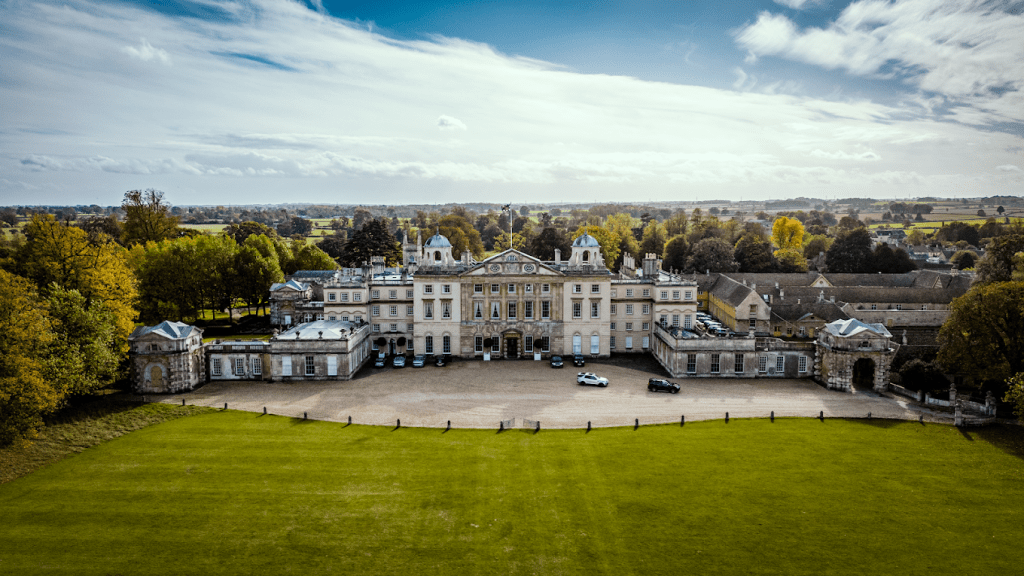
Our first stop was the Badminton Estate, which is supposedly an important site in my family’s lineage. Now, if you’re expecting a dramatic, history-laden revelation here, prepare yourself for a mild letdown. The grand estate was closed to the public, so after making enough wrong turns to convince any onlookers we were casing the place for a future heist, we accepted defeat and turned toward Wales. Before leaving, however, we did learn one important fact: Badminton House is where the game of badminton was invented.
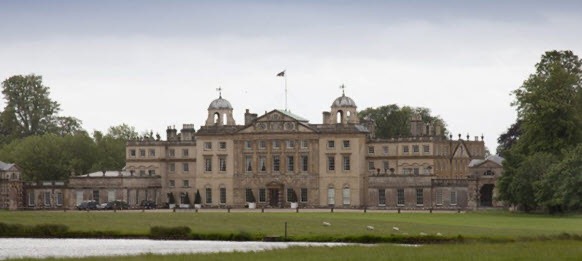
Badminton House – 52,000 acre legacy.
Now, I don’t know who first looked at a feathered ball and thought, “You know what this needs? A net and some pointless flailing,” but apparently, that’s exactly what happened here. Somehow, a noble family of towering lineage and vast estates came to the conclusion that swatting at a shuttlecock was the pinnacle of aristocratic entertainment. Perhaps croquet had gotten too rowdy for them, or maybe tennis was deemed too uncivilized. Either way, history has proven their dedication to the cause, as badminton remains one of the world’s finest sports for people who enjoy a competitive version of standing still.
With that little nugget of wisdom tucked away, we set our sights on Wales, just across the Severn, where the real adventure was just getting started.
Our grand entrance into Wales happened with all the majesty of a medieval knight crossing into enemy territory, if said knight was armed with a rented and unreliable GPS and a left-handed rental van driven by a right-handed redneck. The Severn Bridge stretched before us like a great iron invitation, and I confess, rolling across it felt momentous, as if we were stepping into a grand adventure.
That feeling lasted approximately five seconds before the GPS decided that the best way to get to our hotel was to veer directly into the river. I can only assume it was programmed by someone with a cruel sense of humor or a deep-seated grudge against American tourists.

Chepstow Castle
We made it to Chepstow without testing the van’s ability to float and stopped for lunch. Chepstow is one of those towns where you can tell history got plumb tired of moving and decided to settle down for good. The place boasts the oldest castle doors in Europe, which would be impressive if not for the fact that they’ve been taken off their hinges and stored inside the castle so they don’t get damaged by the weather. This struck me as the medieval equivalent of buying a raincoat and then locking it in a closet so it doesn’t get wet.
The castle itself is a relic from the Norman conquest, built in 1067, which means it’s been standing around waiting for visitors longer than most countries have existed. Among its more notable residents was Sir Nicholas Kemeys, who, upon being besieged, decided surrender was beneath him. He was, naturally, killed immediately, proving that while defiance makes for a great story, it does not always make for a long life. The place also played host to Bishop Jeremy Taylor, known as the ‘Shakespeare of Divines,’ which I assume means he either wrote very poetic sermons or was particularly dramatic about everything. And then there was Henry Marten, a politician who made the kind of decisions that get your name mentioned in history books, notably, the decision to help kill King Charles I. As you might guess, things did not end well for him either.
The castle is mostly in ruin, but the massive walls are intact and it is very impressive.
From Chepstow, we headed up the A466 toward Tintern, a road that appears to have been designed by a madman during a drunken fever-dream. It twists through the Wye Valley in a manner best described as scenic but also slightly life-threatening. Our destination was Tintern Abbey, which was founded in 1131 and later abandoned when Henry VIII decided he was done with monasteries.
The remains of it still stand, caught in a state of architectural limbo, as if the walls themselves aren’t sure whether to hold firm or crumble into the past. It had once housed a good number of my ancestors, though their final resting places had been moved long after the king’s tantrum had left the place in ruins. That said, the ruins are among the most evocative I’ve witnessed.
Not far from there, we rolled into Monmouth, a town that seemed determined to cram as much history into itself as physically possible. It had a castle that produced King Henry V, a medieval museum, and the Monow Bridge, the last remaining fortified river bridge in Britain, which once had the highly practical purpose of keeping invaders out but now mostly serves as a backdrop for dramatic tourist photos.

Monow Bridge, Monmouth
And then there was John Renie’s gravestone, a final resting place designed by a man who was either a genius or someone who deeply enjoyed making things complicated. His tombstone features an acrostic inscription that can supposedly be read over 46,000 different ways. I can only assume this was meant to confuse the devil long enough for Renie to make a clean getaway in the afterlife. If so, I hope it worked.
By the time we left Monmouth, we had seen more history than most people accidentally stumble across in a lifetime. We had also survived more confusing roads, unexpected detours, and strange encounters with medieval architecture than I had anticipated. We even successfully navigated a round-a-bout shaped like a figure-8. And yet, Wales still had plenty more in store for us.
From Monmouth, we set off toward Raglan Castle, the crown jewel of our journey and the ancestral pile of rocks that gave my mother’s side of the family its name. If you’ve never had the pleasure of visiting a medieval ruin, let me tell you, it’s equal parts awe-inspiring and deeply humbling to stand in a place where your forebears likely spent their days bossing around peasants, wearing uncomfortable cock-pieces, and engaging in whatever medieval folks did before television and the iphone was invented.
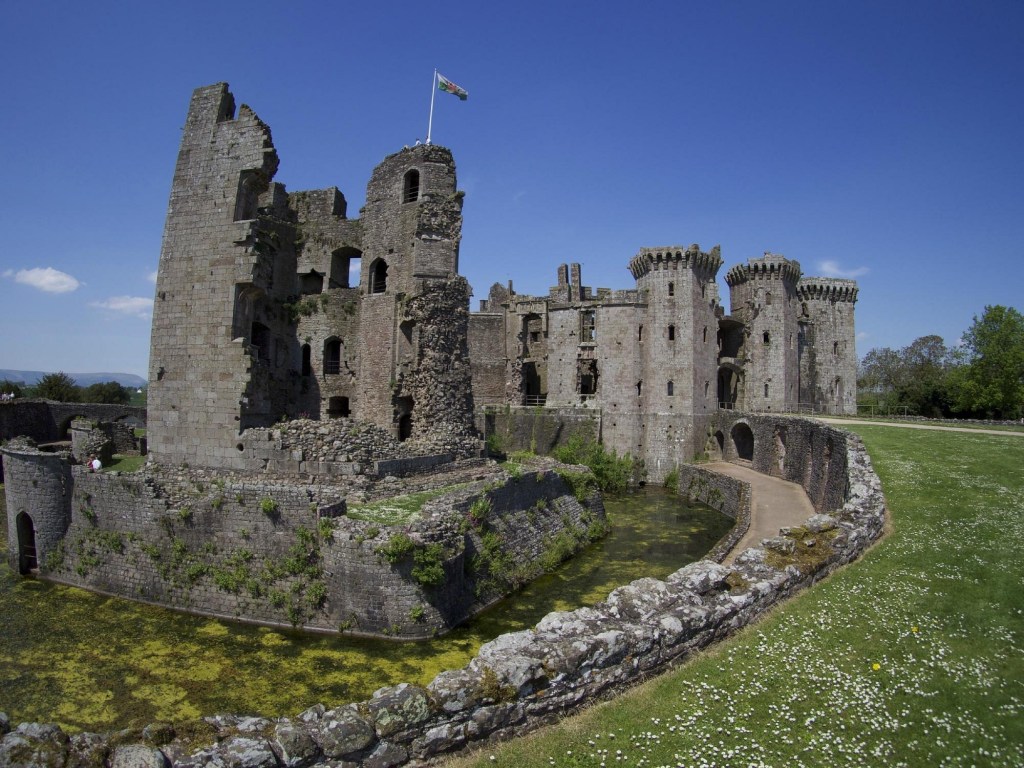
Raglan Castle, in its prime, was a stronghold so fine and mighty that even the 17th century couldn’t quite manage to erase it. Sure, it had been sacked and battered and left to decay like a once-glorious hog barn taken over by pigeons, but even in ruin, it was a sight to behold. This was the home of Sir William ap Thomas, a Welsh mercenary archer who fought at Agincourt and made a name for himself by ensuring the king lived to fight another day.
Now, William didn’t just fight bravely, he fought so bravely that King Henry V saw fit to knight him right there on the battlefield. Unfortunately, the other two Welshmen who also helped save the king weren’t as lucky. Sir Dafydd Gam and Sir Roger Vaughn got the honor of knighthood as well, only posthumously, which I assume was a bittersweet moment for their families. Gam, as it turns out, was likely the inspiration for the character Fluellen, the Welsh captain in Shakespeare’s play – Henry V, which proves that if you do your job well enough, eventually someone will put you in a play.
Sir William had the good fortune to marry well, too, Vaughn’s widow, Gwladys, daughter of Gam. Gwladys was so beloved that Shakespeare himself called her the ‘Star of Abergavenny.’ This woman was such a legend that when she passed, 3,000 people attended her funeral, which is more than most modern celebrities can claim. King Henry V gave the castle to Sir William and awarded him with the surname of Herbert after his Chancery performed a genealogical deep-dive into Sir William, and learned that no less than ten of his ancestors were named Herbert, most importantly, Herbert of Winchester, the Chamberlain of the Treasury of Winchester for William II of England and Treasurer and Chamberlain for King Henry I.
Gwladys Gam Vaughn and Sir William were the beginning of the mighty Herbert dynasty, which, if you trace it long enough, results in a lot of important people with impressive titles and very stiff collars.
Now, the real kicker in all this is my 14th great-grandfather, Robert Raglan. Raised at the castle after his parents met an unfortunate early demise, Grandpa Robert, upon maturity, decided he didn’t quite feel worthy of the family name Herbert, which had been bestowed upon his uncle for distinguished service. Instead, Robert took the name of the castle itself, essentially branding our family like a medieval marketing campaign, and from that moment on, the Raglan’s, later Anglicized to Ragland, were born. It was a bold move, and one that stuck all the way down to my mother, proving that, if nothing else, we come from a long line of people who know how to carve out an identity.
While we were wandering the castle ruins, my sister Lisa and I had the pleasure of signing the Ragland family guestbook, a moment made surreal when a clerk in the gift shop asked if we were Ragland’s, saying we both held a strong resemblance to other’s who’d made the family pilgrimage. I told her if they had the name, the likelihood was high, seeing as we had a few centuries of proof to back it up.
From Raglan, we continued on to Abergavenny, a town boasting a church referred to as the ‘Westminster Abbey of Wales.’ Inside St. Mary’s Priory, we found the Herbert Chapel, the final resting place of Sir William Herbert, my 15th great-uncle, and his wife Gwladys, who, as mentioned earlier, was so beloved that Shakespeare felt the need to write about her. The two are still there, laid out in alabaster tombs so finely carved that you half expect them to sit up and start ordering us to feather dust the place. The church also houses the Tree of Jesse, a medieval sculpture so exquisite that it has been called one of Britain’s greatest treasures. Seeing it in person, I’d say that’s a fair assessment.

We kept rolling westward, our next stop being Tretower, a medieval village where the castle and manor house still stand as reminders that Welsh lords didn’t mess around when it came to fortifications. The place had once been home to Sir Dafydd Gam, the same knight from Agincourt, who, despite being described as ‘squint-eyed’ and ‘rough-mannered,’ managed to carve himself into history. Just up the road stood Blaenllynfi Castle, another FitzHerbert stronghold, which had long since succumbed to time and the occasional opportunistic sheep. If there was a theme to our journey, it was that Wales had a way of preserving history through stubbornness alone.
Further west, we rolled into Cardiff, where Cardiff Castle loomed over the city like a king keeping an eye on his subjects. Lisa, being the adventurous sort, opted to stay and explore while we continued on. We swung by Llandaff Cathedral, a place so ancient that it features a ninth-century Celtic cross and the ruins of structures older than some entire countries. Not content with mere medieval history, we took a short detour to St. Lythans Burial Chamber, a Neolithic site standing proudly at over 5,000 years old, proving that Welsh history doesn’t just go deep, it goes prehistoric.
As we wound our way back south, we found ourselves in Llantwit Major, a town with ties to early Welsh Christianity. St. Illtud’s Church, one of Britain’s oldest colleges, stood as a monument to the Romans, the Welsh, and anyone else who happened to pass through and leave their mark. Some say St. Patrick himself studied there, though whether that means he left with a degree in sainthood is unclear.
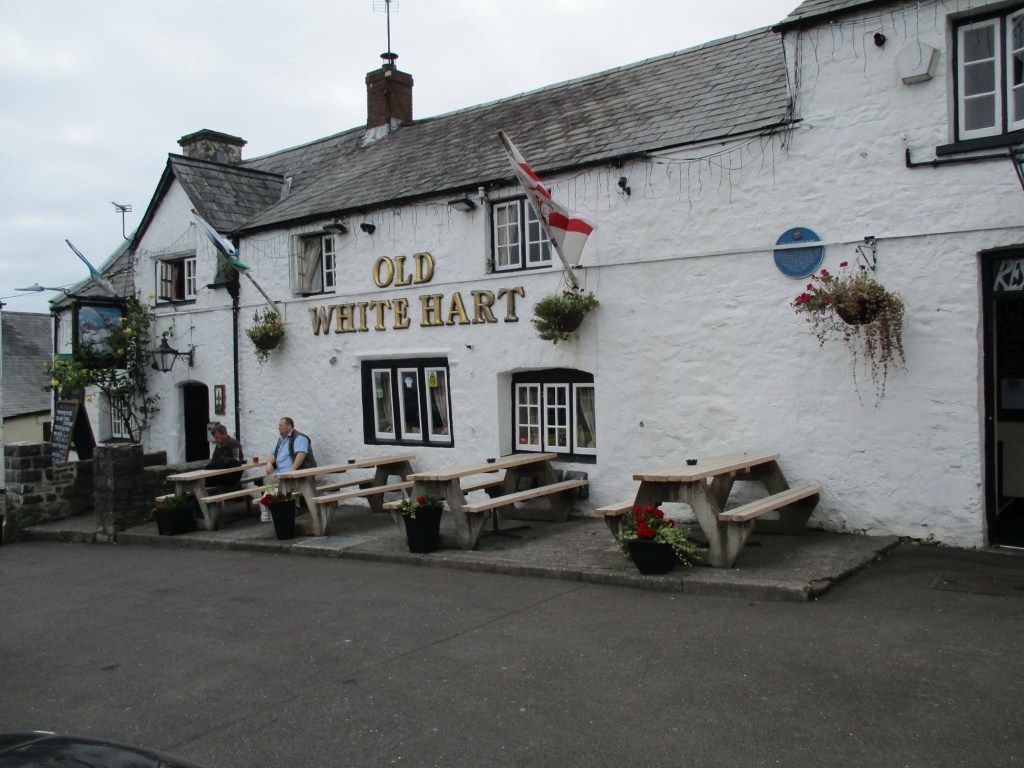
The Raglan family made its mark here, too, with Sir Hugh Raglan funding the construction of the Galilee Chapel in the 15th century. We stopped for lunch at the White Hart Inn, which, as it turns out, was built by my 12th great-grandfather as his home. Sitting there with a meal in front of me, I had to admit, there’s something poetic about eating in the same dining room that your ancestors, twelve generations back, once called home.
Finally, we made our way to St. Donat’s, a castle that had once belonged to my distant relatives, the Stradlings, before finding its way into the hands of none other than William Randolph Hearst. The American billionaire had taken one look at its medieval grandeur and decided he simply had to own it, proving once again that the wealthy have a way of making history their personal playground.
And so ended our first full day in Wales, a place where history and family-ties tangled together like roots beneath an old oak tree. We had stood in castles that once belonged to our kin, walked through churches where our ancestors had been buried, and eaten lunch in a house built by a man whose blood still ran in our veins. Not bad for a day’s work.
We picked Lisa up in Cardiff, then set off for Caldecott, where Emily had arranged for us to stay in a proper Welsh manor house, which had been purchased and converted into a Marriott property. Because nothing says ‘history preserved’ quite like a multinational hotel chain moving in and putting a Starbucks in the lobby.
The place, called St. Pierre, was smack in the middle of a golf course, which, if you’re into that sort of thing, probably made for a delightful stay. If you’re not, it was still a sight to behold, 16th-century gatehouse, old stone towers, and a story that went back to 1065. Apparently, it had ties to King Henry V, the crown jewels, and, if the lore was to be believed, J.K. Rowling.

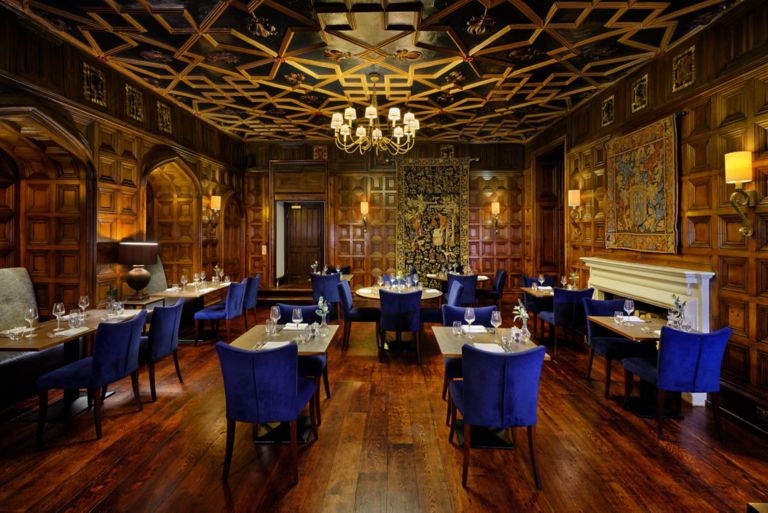
Now, if a place has been standing since before indoor plumbing was a concept, odds are, something interesting happened there. Turns out, King Henry V deposited the crown jewels at St. Pierre as collateral for a loan to keep his war with France going. Turns out, even kings occasionally need to put something on layaway.
The estate then passed to the Lewis family, who built up the present manor house and lived there until 1839. During World War II, it was used to shelter children from the Blitz, which means that across the centuries, the place had seen kings, soldiers, aristocrats, and at least one group of war-traumatized children who probably had no appreciation for Tudor architecture. By 1996, Marriott International took over, and while I know from having stayed there they did a fine job, I can’t help but think that William the Conqueror might have had some opinions on his old stomping grounds becoming a luxury spa retreat.
The next day, we set out for Caerleon, which sounds like a place straight out of a high fantasy novel but is, in fact, an ancient town near Newport. Caerleon holds a firm grip on history, being the site of the old Roman fortress of Isca Augusta. Now, I don’t know how much time you’ve spent in Roman ruins, but I can say this: if you want to feel insignificant in the grand march of time, stand next to something built by people in togas while realizing they had better plumbing than some places in modern America.
The town also had an Iron Age hill fort, which meant that for thousands of years, people had been standing on that same spot, looking out over the land and deciding that it was a good place to set up camp, at least until somebody came along and burned it down.
After we got our fill of Roman nostalgia, we moseyed over to Morgantown to visit Castell Coch, a proper castle that looked exactly like the kind of place where fairy tales begin. Of course, the reason for that was because it had been built in the 19th century by people who wanted a romanticized medieval castle rather than the drafty, plague-ridden reality. Castell Coch is a ‘reconstruction,’ meaning that somebody with deep pockets and a love of old things decided to rebuild the past the way it should have been, turrets, grand halls, and none of the inconvenient bubonic outbreaks.

With that, our time in Wales had come to an end. It had been the caboose of a two-week, winding, history-laden trip across England and Scotland, and let me tell you, it did not disappoint. The castles stood as testaments to centuries of ambition and disaster, the roads twisted through valleys with the kind of willful defiance, and the whole place felt like a land where the past hadn’t so much faded as dug its heels in and refused to leave.
We drove away with a much deeper appreciation for this wild and stubborn country, its layered history, its steadfast castles (more than any other country per sq. mile), and its way of making GPS navigation a game of high-stakes gambling. And if nothing else, I walked away with a newfound connection to my Welsh ancestry and the undeniable fact that if my forebears had been forced to learn left-handed stick shift on these roads, I wouldn’t be here today.
Wales is the kind of place where past and present tangle together like ivy on old stone, where every crumbling ruin has a story to tell, and where, if you aren’t careful, you’ll find yourself on the wrong side of the road while your passengers scream, pray, and regret ever getting in the car with you in the first place.

 Ramblings & Revelations
Responses
This was an absolute delight. I cannot imagine that I will ever get to see any of this in person so I savoured your every word . Thank you so much for taking the time to transcribe this trip for my reading pleasure.
LikeLiked by 2 people
You’re too kind Violet
LikeLiked by 2 people
A wonderful and insightful read. Living in Cardiff Wales, I gained a lot of knowledge from your post. I hope you enjoyed your visit…🤗
LikeLiked by 1 person
Thank you Sara. I’ll definitely be back sometime or another. Such a wonderful place to get lost and explore.
LikeLike
This is all so interesting! Fabulous pics. Love castles.
LikeLiked by 1 person
Thank you so much.
LikeLike
What sumptuous travelogue, Chris! Makes me all the more anxious to visit Wales (a big branch of my family tree hails from there as well).
LikeLiked by 1 person
Thank you so much. I highly recommend a visit. The landscapes are amazing; more castles per sq. mile than anywhere else, and very few tourists.
LikeLiked by 1 person
Fabulous post, Chris! What a great vacation (adventure!). That must have been quite a moment to sign the Ragland family guestbook. Wonderful storytelling and great photos!
LikeLiked by 2 people
Thank you Maddie.
LikeLiked by 1 person
Very nice getting to see the sights where our ancestors walked.
I’m a Southerner hooked on genealogy too. In my case, I grew up in rural northeastern NC, where my family had lived some 200 years, and Virginia about 200 years before that. Since my line had never moved far it was easy to find records in local libraries and courthouses. Taking a deep internet dive I find my family bumped into the Raglands in 1204 when Lettice Ragland, my 23rd great grandmother was born. As far as I can tell, that’s the only Ragland I have in my tree.
LikeLiked by 2 people
Well then, welcome aboard Cuz. It’s a surname tied specifically to a place, so it’s doubtful that we’re not distant cousins. Thanks for taking the time to share your story.
LikeLike
💯 wonderful and insightful read
I wish you a happy afternoon 🌅 Best regards 🌎🇪🇦
LikeLiked by 1 person
Thank you very much.
LikeLike