
byChrisWhite – 2018
They came into the city by rail and foot and aircraft and other less noble means, drawn like ants to a trail, as if Amsterdam were not a place at all but a magnetized point on the spine of Europe, humming with some low frequency of attraction. You could smell the water in the air long before you reached it, not brine like the sea but the layered silt of old canals, iron and rot and the breath of lilies crushed beneath the wheels of ten thousand bicycles.
The city did not so much welcome you as endure you. It had been here longer than my own country had been a concept. It had outlived storms and empires and Nazi’s and plagues, and it would outlive this little vacation too.
They tell you it is beautiful, and it is, though not in any way you were prepared for. The sort of beauty that doesn’t ask for your opinion. The beauty of an ancient scar that healed crooked but strong. Buildings lean like town drunkards in eternal conversation. Bridges hold hands over still water that remembers everything. It is a city of memory, not invitation.
And everywhere the bicycles. Oh those damn bicycles.
They move not singly but in herds, like flocks of iron-winged blackbirds, swarming and splitting and reforming with no perceptible signal. You do not see them so much as feel them, a sudden pressure in the periphery, a whisper of movement that passes within inches of your ribcage. Their bells are not bells but declarations. Not requests but screw-you’s.
It begins innocently enough, as these things always do. You step from the station with your luggage dragging behind like a stubborn step-child and you think: canals, stroopwafels, Van Gogh, legal weed. But by the time you reach your first street corner, you have seen it, the glint of a wheel, the blur of a moving shadow across the cobblestones, and you are forced back, retreating like a trespasser who has wandered into territory not meant for the uninitiated.
They do not slow. They do not yield. They do not pause to wonder if you know where you’re going. You are not part of their world, you are an interference. A blot. A mistake.
And this is the truth no one tells you in the brochures, in the guidebooks glossy with tulips and windmills and narrow houses that lean over water: Amsterdam belongs not to man, but to the machine. And not the roaring engines of Detroit, nor the gleaming sedans of Tokyo or Stuttgart, but to the dreaded bicycle. The humble, brutal, rust-clad bicycle, reborn here in Amsterdam as pure predator.
It is not romantic. It is not quaint. It is war.
The people ride them as if possessed. Mothers with infants strapped like satchels. Teenagers texting while gliding between buses. Men in suits with no helmets and the glare of immortality in their eyes. Women who seem made of wind, hair trailing behind like battle flags. Old men bent forward as if toward the grave, yet moving with terrifying speed.
And when they ride toward you, you learn new things about your body. How it moves. How it hesitates. How quickly it wishes to pray in four-letter prayers.
There is no point at which this becomes less terrifying. You do not adapt. You do not become one of them, no matter how many days you spend attempting to walk with vigilance, head swiveling, ears tuned to the cadence of death on two wheels.
You do not understand the lanes. They are red. They are curved. They are sacred.
You are not welcome there. You learn this the hard way. You learn this again and again, in increments of shame and near-misses.
The signage means nothing. The symbols mean less. The city is ancient but the war is modern. The rules are unwritten and enforced with cruelty.
The bells ring like the last notes of a funeral song, and still you step wrong, still you hesitate, still you look left when you should have looked right and the scream of a man in Dutch, something guttural and loaded with consonants, slaps against your skull and you stagger back, heart hammering like a cat caught in a rabbit trap.
And if you laugh, it is not because you are amused. It is because your mind has reached the edge of understanding. The absurdity has bloomed full. The logic has collapsed into farce. You have become the joke and the city is the one telling it.
There is a word for this. The Germans have it. Of course they do. Schadenfreude. The pleasure derived from another’s misfortune.
And nowhere is this more relevant than in the square, in the courtyards and alleyways, in the market roads of Amsterdam, where tourists stumble like lambs into the paths of oncoming steel.
And they fall. Oh, they fall. And when they do, the city does not pause. The wheels keep turning. The bells keep ringing. The natives pedal past with blank expressions, neither curious nor cruel, only indifferent, as if to say: You knew what this was when you boarded the plane.
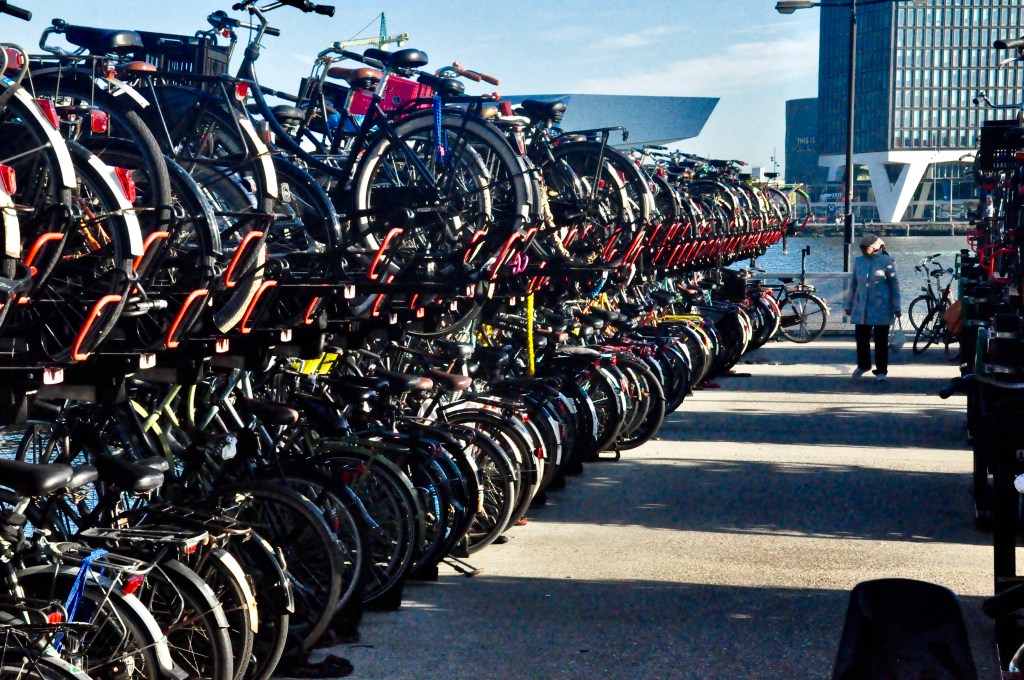
What strange gods the Dutch now serve. Gone are the maritime deities of their past, the trading spirits and Protestant saints. Now they kneel to the altar of chain and sprocket and pedal. They have built sanctuaries, entire garages like temples, structures of industrial devotion where bicycles sleep in stacked repose, row upon row, level upon level, the machines of the faithful at rest before morning prayer. Bicycle flats, they call them. The scale of it is biblical.
They have a Bicycle Mayor.
Pause on that.
A Bicycle Mayor.
An official post. A real title. Not satire, not a flourish. A civil servant whose only mandate is to make the city more hospitable to the riders. Not to all people. Not to children, not to the elderly, not to the blind or the disoriented or the romantic fool stumbling home from too much Dutch gin. To the bicycles. Only the bicycles.
And what is she proposing now? Roofs for the bike lanes. Canopies to shelter the wheeled faithful from the indignity of rain. Let the walkers drown, let the umbrella-toting pilgrims suffer wind and sleet, but protect the riders. This is the logic. This is the theology.
You begin to see the signs. The city’s monuments have bicycles etched in brass. Murals depict saints on saddles. There are lullabies for bicycles, anthems, children’s stories. The mythos has taken root. The wheels have become halo.
And still the tourists arrive. And still they are broken against the crimson paths, the color chosen to blend with blood. Some part of them dies there, usually pride, sometimes hipbone. Occasionally, more.
There are statistics, yes. In 2017, more deaths by bicycle than car. Let that linger. Let it ring in your ears like one of those tiny silver bells attached to handlebars. A death toll not wrought by the automobile, the great villain of the modern city, but by the instrument of the sustainable, the green, the good. The good?
It is the great lie of Amsterdam. The balance. The fabled harmony. They will tell you of the trams, the gentle cars, the gracious pedestrians. But you have walked the streets. You know the truth. The cars are ghosts. The trams are timid. The pedestrians have learned to shrink. Only the bicycles move with authority. They do not negotiate. They do not apologize. They arrive, and if you are not gone from their path, they take what they are owed.
So let us lift a glass, not a toast, but a ritual libation, to this city of canals and cruelty, of ancient grace and modern madness. To Amsterdam. Let us name it holy in its contradiction, sanctified by the blood and bruises of the visitors it swallows and forgets. And let us remember not to forget ourselves, should we wander there again, beneath the glowering sky, near the rattling tram lines, beside the water that never rests, while the wheels spin and spin and spin a lullaby of schadenfreude.

 Ramblings & Revelations
Responses
Oh my. Having lived in the bay area of San Francisco, I know a militant bicycle rider when I encounter one. And to even imagine they exist in such numbers, or holds the hallowed place in society that you so deftly bring to life here scares the living sh*t out of me, No thank you. The tulips will have to wait.
LikeLiked by 1 person
Haha. Yes, it was surprisingly horrid. I’m accustomed to the two-opposite extremes of cows and drunk bridesmaids on music row. Amsterdam is a death-trap wrapped in a beautiful bow.
LikeLiked by 1 person
Your writing is absolutely delightful. Amsterdam is definitely no place for me, I don’t want to have to work that hard to cross the street :)
LikeLiked by 1 person
Thank you so much. I appreciate your encouragement.
LikeLiked by 1 person
Amsterdam’s been ambivalent to tourists since the seventies! I worked for a Dutch company and they truly believe most Americans are stupid and lazy! Not that I disagree with them.
LikeLiked by 2 people
Yeah, I don’t think they require a positive post from lil’ ole me in order to promote their tourism. Honesty, was/is the better choice. And regarding their view of Americans, and really for all the ‘cans of the world—pick/proclaim a bad or good quality and you’ll always be right. That goes for the Dutch too. I’ve been worried about our younger generations for a while, but of late, I’ve seen some real positives. But that’s just from my perspective-not speaking for others. Thank you for stopping by. You have a lot of great content. I plan to spend some time a little later digesting your work/books.
LikeLiked by 1 person
Thanks! I have Dutch relatives and they tend to have their druthers! Young people better speak otherwise they’re gonna be canon fodder in some ungodly war.
LikeLiked by 1 person