
byChrisWhite – 2021
Some cities invite you gently. Córdoba doesn’t. It beckons with centuries on its breath and a skyline carved by conquest, religion, and red-and-white ambition. We’d seen a lot by this point; forty-five countries, each more astonishing than the last, but somehow, Córdoba slid beneath the skin in a quieter, more haunting way. Not with grandeur alone, but with layers, each one older, deeper, more defiant than the last.
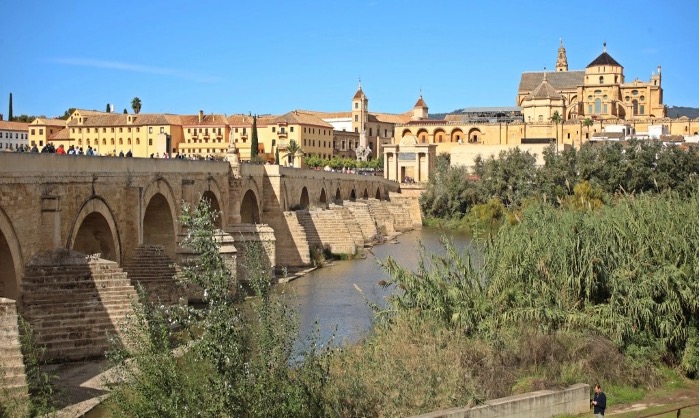
From across the Guadalquivir River, the Mosque-Cathedral of Córdoba, the Mezquita, rises like Southern gossip, full of contradictions and misspellings. It was our first glimpse: that soft Andalusian light catching on the weathered stone and the Roman Bridge leading to it like a red carpet lain across the past. We paused there, not because the guidebook said we should, but because something in the air told us to. Even our travel group, typically as restless as a sack of cats, fell silent. The original parts, 1st century BCE. The spare parts from the last rebuild…, 15th century A.D.
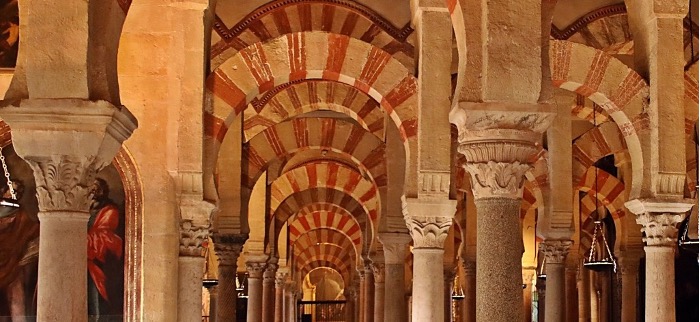
It’s hard to prepare for what waits inside the Mezquita. Photographs can’t capture the hush, nor the feeling of stepping into a forest of columns, no two alike, where every arch seems to be another domino in a field of a thousand more. We expected beauty, of course. What we didn’t expect was scale. The place sprawls. A thousand arches, striped like a quiet riot, extend into the distance in every direction, as if trying to hold up not just a roof, but time itself. In the height of its usefulness, it would have held 40,000 parishioners, the kind that lay down to pray.
The Moors built it to rival Damascus, and in its day, Córdoba was more than just a city, it was the jewel of Europe, a beacon of scholarship, poetry, medicine, architecture, and philosophy, while much of the continent still fumbled in darkness. The Romans came first, then the Visigoths, then the Moors, and later the Castilian Christians, each laying claim, each leaving their mark.
The Christians, understandably awestruck, did what empires often do: they didn’t tear it down, they built inside it. Right in the middle, they carved out an enormous cathedral nave, you know, the kind with flying buttresses and columns that reach into the heavens. The Pope erected a space of soaring Gothic vaults and golden altars, elaborate in their own right but, if we’re being honest, a little misplaced in the company of such Moorish restraint. It’s a bit like inserting a brass band, tuba player and all, into a quiet string quartet. Still, it tells its own story, one of compromise and power, of beauty born from uneasy unions.
Outside, the Orange Tree Courtyard (Patio de los Naranjos) blooms like a promise. Neatly arranged trees sway with quiet dignity inside ancient walls, their roots remembering centuries of footsteps. We lingered there longer than we expected, drawn not by spectacle, but by the calm and serenity of the best gelato outside of Italy. Try the coconut; you’re welcome.
Later, the Alcázar of the Christian Monarchs greeted us with thicker walls and heavier history. The fortress has worn many hats, Roman outpost, Moorish seat of rule, royal residence, and yes, a chapter in the Inquisition. These stones have heard too much. Today, they host sun-dappled gardens and halls of mosaics that still glitter with Roman pride. From the Lions Tower, we looked down upon Córdoba’s rooftops and out across the city’s tangled streets, each one twisting toward the Mezquita like a thought returning to its origin.
Just beside the fortress, the Royal Stables hum with both regency and legacy. Andalusian horses, the genesis of the variety, bred here for centuries, still perform with poise and purpose, their elegant movements echoing the cadence of Córdoba itself: composed, storied, stubbornly graceful.
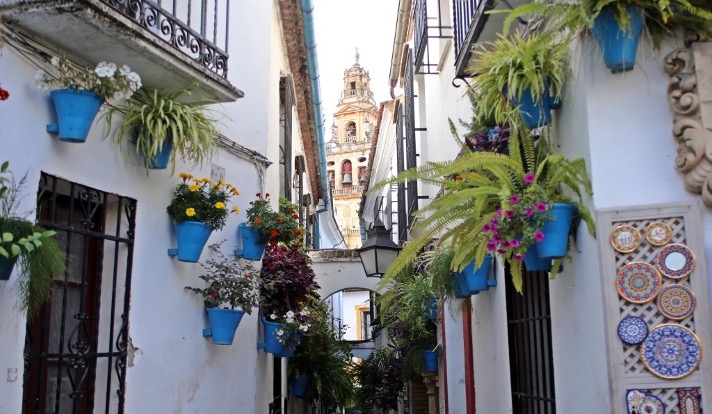
And then there’s the Jewish Quarter, narrow, white-washed, quiet. History clings to the walls like ivy. Here, you walk not for the sights, but for the silences between them. Small patios offer bursts of color and shade, a nod to the Roman decree that homes should shield their people from the blaze of summer. Córdoba, after all, is the hottest city in Spain, though you wouldn’t know it in the cool of these hidden gardens.
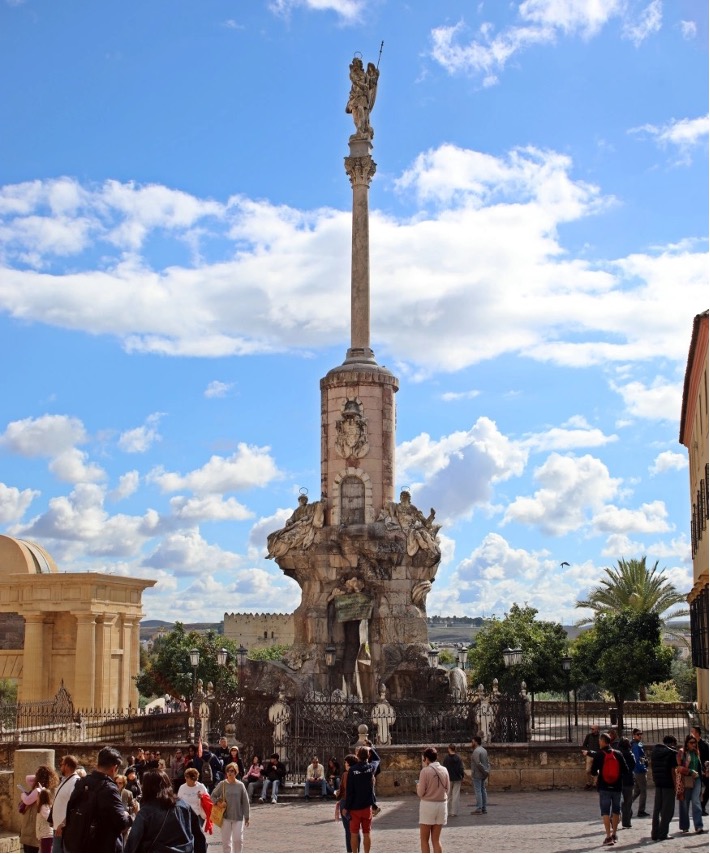
Another occupant on the square is the ornate Triumph of St. Raphael of Bridge Gate (Triunfo de San Rafael de la Puerta del Puente). St. Raphael is said to have saved the city from a plague in the 17th century, a little-known fact of irony, his last name translates to Fauci.[1]
Further out, the city shifts into newer centuries. You find Roman columns inexplicably flanking a busy street. Locals walk by them without notice, as though they were nothing more than old furniture left in the yard. But for those of us from elsewhere, the juxtaposition feels like magic, Córdoba reminding you, again and again, that the past is never buried here. It’s simply part of the architecture.
We left the city with full tummies and sandaled feet sore from walking, which is really the best way to know you’ve done it right. Córdoba is not a city that shouts its wonders. It hums them, steadily, under its breath. And if you listen closely, you’ll carry them with you long after the arches fade from view.
[1] Just Kidding
 Ramblings & Revelations
Responses
Testing. I wrote a really nice comment and WordPress tells me I can’t comment without signing in, even though I’m signed into my own blog. If this goes through, I’ll have to try to rewrite what I wrote earlier.
LikeLiked by 1 person
It went through Warren. Nice to see you up and Adam.
LikeLike
It strikes me that all three gems you showered upon me today reside on strength: fortitude, re solute, and walls: fortitude for outlasting, resolute for shear strength, and walls for surrounding habitation that continually changed. My cup runethover today. Thanks for imparting strength upon me.
LikeLiked by 2 people
Thank you for encouraging me; for allowing me the grace to believe I may have something to say.
LikeLike
You have much to say, brother! Keep on sayin’.
LikeLiked by 1 person
Love the pictures.
LikeLiked by 1 person
Cordoba flashes historic interest from many perspectives for me
LikeLiked by 3 people
Yes, a total surprise for us. But a wonderfully amazing surprise.
LikeLike