
byJ.C.White – 2025
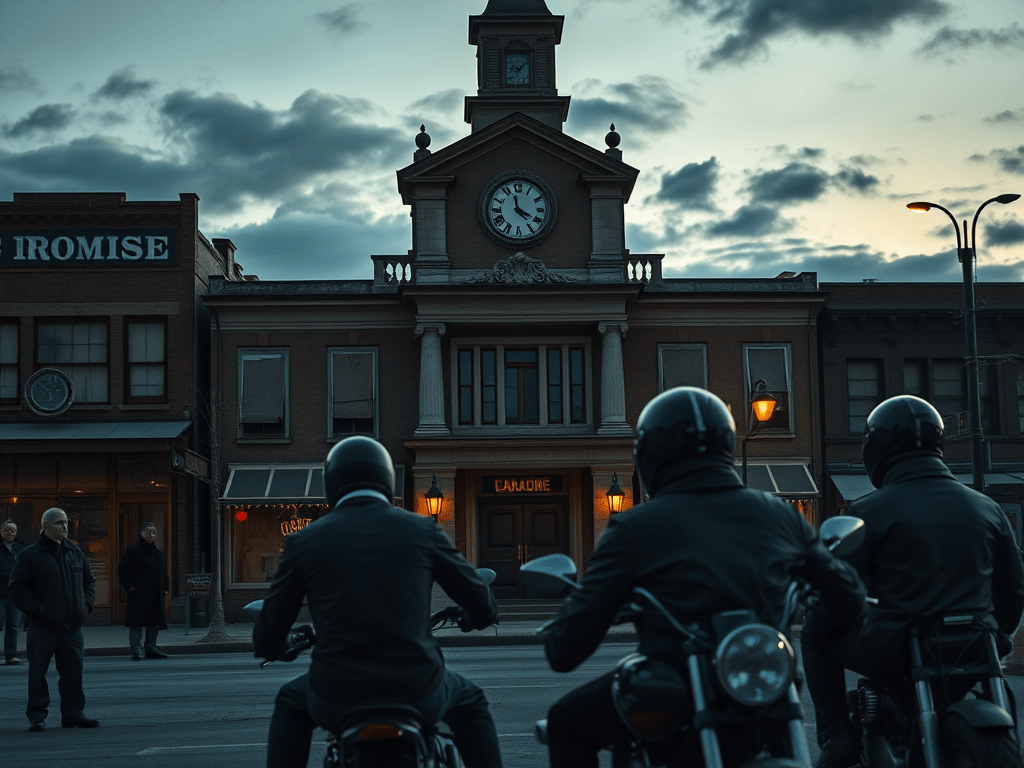
In our county the courthouse clock still keeps its own time, slow as sap in January, and the bell rings a little late, as if waiting on somebody who isn’t coming. My grandfather used to say the town was built on the back of a promise and three lies: the promise that cotton would last forever, the lie that trains would keep stopping, and the bigger lie that men don’t forget. The trains quit stopping when I was a boy. The forgetting came later and bit deeper.
We keep a ledger in a vault at Parker, Parlow & Trust, a bank named way grander than it lives. The ledger runs a straight line from 1893 to the week after last, same careful hand changing through the years, same neat columns tallying debts and wages and failures brought in by men who wore different hats but carried identical worries. I was turning pages in that book the afternoon the black-clad motorbikes rode into town like a swarm that had learned the names of the streets from a map and not from shopping the sidewalks.
They came with masks, black as pew Bibles left shut too long, helmets mirrored so you only saw yourself when you looked. They called themselves anti-fascists, or let the word be called for them, and if you asked where they were from they said America the way a salesman gives name to a product – impersonal. There were rental vans with tags from five states and pallets of bricks that had found their way to corners that never needed masonry. Some man nobody recognized stood on the fountain lip and handed out envelopes you could see were thick. Someone said a foundation paid them per diem and another someone said a billionaires’ fund out West and a woman who sells insurance nights said it was all theater to knock the price of property down so the same men could buy it cheap. In a place like ours rumor doesn’t run; it sits on the courthouse steps and writes its own law.
I stood under the live oaks with the other men who still come to town without a reason and watched the swarm test the air. They were pale from whatever mother’s basement breeds such faith. Their boots were new. You could smell the factory. A boy with swole forearms inked to an ambiguous wrist set down a bag of goggles and gloves like a preacher setting a Bible on the rail. The square had the quiet of a room where a sick man sleeps too still. Across from us the storefronts wore their boarded faces. The army-navy store was closed for good. The barber with shaky hands had taped a handwritten sign about new hours and lower expectations. Since the last plant closed you can hear the economy in the whisper between passing trucks and toilets flushing.
My grandfather taught me the county by walking it. He was a soldier in a war that didn’t end when he came home and the fights he picked were with cigars and memory. He would pause at the corner where a drugstore once sold nickel malts and say the families here used to live like they had a God that favored them. Then he’d point across the tracks and say there were once families there too, and most days they did not. He hated the way the town told its story neat. He said a man who smooths the past will lie about the present. He said this and died before I understood him.
By three the square was thick with spectacle. A woman in black climbed a bench and called the courthouse a temple to fascism, though if fascism can be held up with mildew and paint chips then it’s a kind of miracle. A boy with a bullhorn told us our history and I recognized nothing of it but the names. He had a list of banks and hedge funds like a catechism and when he said the markets would profit from the chaos his eyes shone with the cold faith of a paid prophet. I watched a man with a camera rig move through the crowd and point people where to stand, the way a wedding photographer shapes joy for later consumption.
They lit a trash can on fire and we all leaned because fire is older than politics. The can grew a halo and tilted and rolled hot down the slope and kissed the brick of the old haberdashery. Someone cheered. The cheering sounded like a coach’s whistle through a wall.
Sheriff Baxter’s boys made a line, not our Baxter from the ridge but another one wearing the name tag, and the line was tired before it stood. The deputies had the resigned look of men called out to referee a game being played in another stadium, all on camera. One of them said, as if speaking to the wind, that big money was pushing little people against smaller people and the only thing getting crushed was culture. He said it and the wind did nothing with it.
In the bank lobby old Mrs. Raymond pressed her face to the glass and mouthed a prayer I couldn’t hear. She has three grandchildren and one works two jobs and the other two don’t work one. She has a piano with no middle C. She asked me if I thought they would burn the town and I said the town had been burning for years, only slow and without flame. She nodded, not because she agreed but because there wasn’t anything else to do with her neck.
By four the envelopes were open. You could see the corners of cash and the neatness of the bills, as if someone who had never held sweat-money had counted them. A man in a branded vest, the kind of brand you never see on an American store shelf, moved through with a clipboard and tallied something, maybe bodies, maybe minutes spent on camera, maybe the length of a nation’s temper. A girl with a bandanna told a local boy to knock over a trash can and he did not, and she did it herself and looked disappointed the world didn’t end.
I thought of the ledger in the vault and what our lines would show when this day got written. The page would catch the number of windows broken and the plywood purchased and the insurance paid or denied. It would not show the grace of old Mr. Weatherly stepping into the street when a bottle came for a deputy’s head and snatching it out the air like a baseball he’d seen for fifty years. It would not show the shame in a boy’s eyes when he realized he had been posed for a photograph in a town not his own.
A rumor got loose about buses at the fairgrounds and half the square ran to film them. The buses did exist because I saw them later, idling with the same indifference as chicken trucks. Whether the men in black rode them or simply wanted us to believe it, belief did the work just the same. A pallet of bricks sat near the war memorial and the shrink wrap shone in the afternoon like it had been peeled back and rewrapped by hands wearing clean gloves.
We are good at making villains here because villains keep us busy. The story moved through the benches that a certain billionaire with a taste for social engineering had cut checks and another man richer and more godlike had shorted some fund, and this was the play, to rattle the cage until the stock fell, until the real purchase could be made where the poor live. I have never met a billionaire. I know men who sell used air conditioners from their yards and account for the cash with a little notebook they keep under the sink. I suspect the notebook is closer to God than the billion.
A storm built in the west like a rumor that happens to be true. Clouds stacked like cotton gins. The air took on that old-metal smell. The woman on the bench declared we were complicit with empire and a man in a Carhartt jacket asked her where she paid taxes and she answered, “Earth,” with a straight face. It began to rain. Not a lot, just enough to make the paint run on the signs. The cameraman hunched a trash bag over the lens and the shot lost its drama. The fire died because water does what water does.
I saw a boy take off his mask and wipe his eyes because rain will humble you faster than scripture. He looked about sixteen. Another boy clapped him on the shoulder and told him to put the mask back on, that they weren’t finished being what they were paid to be. The first boy kept it off a breath too long and in that breath he looked like every boy who ever realized there is no paycheck in a soul. Then he put the mask back on and the world, according to the anti-fascists resumed.
My grandfather used to tell a story about his own grandfather, a man with a horse and a taste for speed, and how he rode too hard one night and broke his neck on a rock that wasn’t moving and never would. “That’s how we do,” he’d say. “Fast against something that doesn’t care.” He said it with a smile that knew he was not talking about horses.
By dusk the swarm thinned. The vans took on the faithless because they pay better than the faithful poor. A speaker truck that had howled empire all afternoon limped away with a squeal of belt. The deputies drank warm water and leaned against their cars and said nothing to anybody, afraid of a monster called optics. The square remembered itself. The bell rang late and the pigeons came back to the cornice because like us they only ever go as far as they have to and then return.
In the vault the ledger waited. I went back in and turned the key and wrote in my hand the line for the day: number of panes replaced at the haberdashery, two; plywood, five sheets; paint for the barber’s sign, one quart; the bank’s door scratched but not shattered; cash withdrawn by men who do not want to appear on anyone’s list, high. I left space for the insurance claim that won’t be honored and for the rumor that will be.
If you ask me what it all meant I will tell you I am a man with a pencil and not a prophet. I will tell you it felt like theater staged by people who could afford tickets and starved of extras so they hired us to be the crowd. I will tell you the billionaires, if they are there, don’t need to pay for ruin because we make it wholesale and put it on layaway. I will tell you there were anti-fascist boys with good hearts and anti-fascist girls with rented fury who believed in using anarchy to fight ism’s they cannot define with their own experiences, and who believed they were saving a country they have only ever known through tinted glass, and there were men on benches who believed they were saving another country that never truly existed. I will tell you the storm did more good than any speech.
Before I locked the vault I touched the old pages, the ones my great-grandfather wrote, where he noted the year the gin shut down and the season the river flooded back through the low fields and soured the cotton. He tallied the dead without names and the debts with. He did not write who paid him to say what. He wrote what the town could stand to read. Maybe that is all any of us can do. The bell rings late and we add the line that says we heard it.

 Ramblings & Revelations
Responses
Great article!
LikeLiked by 1 person
Thank you!
LikeLiked by 1 person
Which came first: the chicken or the egg? You have a canny way of aligning the past with the present. Well done. Now, if we can get you to take one step further and tell us about the future, you will be complete. Great writing.
LikeLiked by 1 person
Thank you Warren. Don’t think I’m much of a fantasy or sci-fi guy. Reality, unfortunately, is much more gothic these days. Easier when you’re not having to make it up.
LikeLike
I think this whole dystopian horror comes down to this line- He wrote what the town could stand to read. and we are currently living through the time they changed their minds and rewrote it- as what they want us to believe. Great storytelling Chris.
LikeLiked by 1 person
Great analogy Violet. Thank you.
LikeLiked by 1 person
Great story! I especially like this line: “He said a man who smooths the past will lie about the present.”
LikeLiked by 1 person
Thank you Diana.
LikeLiked by 1 person
Your ledger sings like a hymnal for unpaid debts – cash tallied, mercy omitted, memory taxed at the highest rate. You name the theatre and the funders’ shadow, yet keep faith with small, stubborn kindness – the bottle caught, the rain’s correction, the bell that rings late and true.
LikeLiked by 1 person
Thank you Bob.
LikeLiked by 1 person
The metaphors and analogies are stupendous. One feels the fury and despair. Great read!
LikeLiked by 1 person
Thank you Cynthia.
LikeLike