
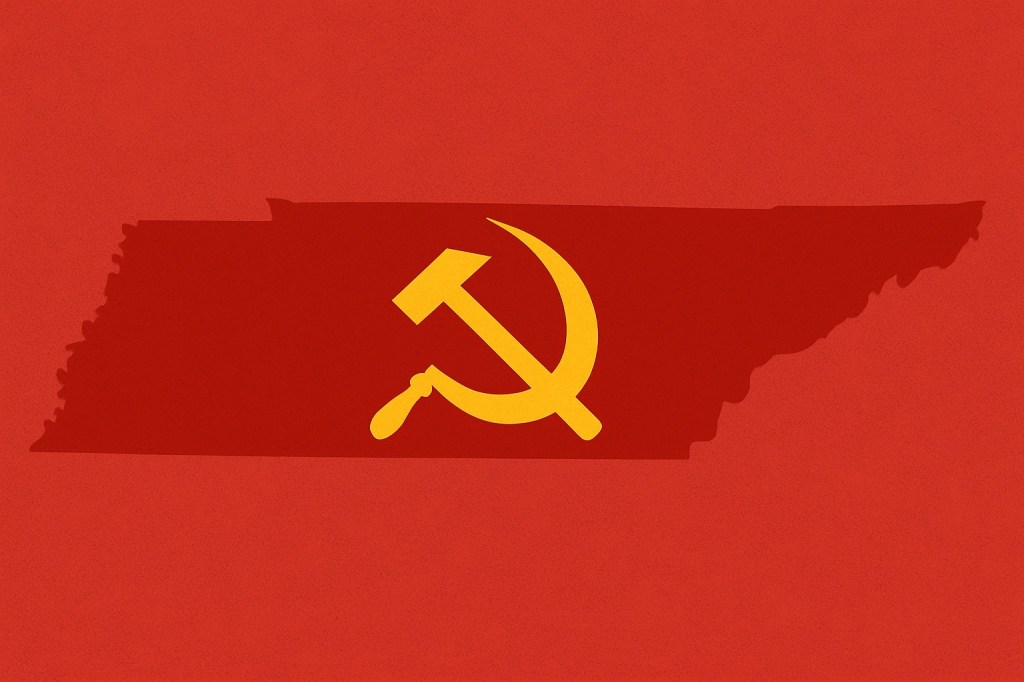
Welcome to Utopia. Please Check Your Property at the Door
byJ.C.White – 2025
Every few generations, a man decides the world has been doing life all wrong. People are messy, greedy, selfish, and violent, and he (often she) has the solution. Plato had his Republic, Thomas More had his Utopia, Karl Marx scribbled his way into the Communist Manifesto. Tennessee’s contribution to this tradition came in the form of a German lawyer who wandered into Cherokee territory and announced he was founding Paradise. His name was Christian Gottlieb Priber, and if you’ve never heard of him, that’s because history tends to categorize failed utopias alongside diet fads and Ponzi schemes.
Yet his story is worth telling. Not because he succeeded, but because he failed so spectacularly. Utopias always sound better on paper than they do in practice. On paper, everyone shares everything, nobody goes hungry, and the only crime is not being sufficiently cheerful. In practice, somebody always wants more than their fair share, and soon enough, you need guards, gulags, and gallows to enforce equality. Paradise always requires a very highly paid police force.
Before Orwell, before Stalin, before Venezuela discovered that socialism and empty grocery shelves go hand in hand, Tennessee had its own instructive tale in the person of Christian Priber.
From Saxony with Love
Christian Gottlieb Priber was born in Zittau, Saxony, in 1697, a respectable little German town with respectable little expectations. He was educated, trained as a lawyer, and seemed destined for the kind of life where one dies surrounded by dusty books and unpaid bills. But Priber was restless. He was a man of the Enlightenment, an era when intellectuals believed that reason could solve everything, from poor harvests to human nature.
In Saxony, Priber was part of a radical set. Think of them as the 18th-century version of Twitter activists: loud, indignant, and certain that the world could be remade if only people listened to them. The trouble was, Saxony’s rulers didn’t care much for pamphlets proposing to overthrow centuries of tradition. Priber’s writings earned him scrutiny, and perhaps exile.
So he tried England. That didn’t work either. Britain was already full of utopians, most of whom had been laughed out of coffeehouses. When Europe couldn’t satisfy his grand ambitions, he looked westward, as so many eccentrics did, toward the blank slate of the American colonies. In 1735, he boarded a ship and landed in Charleston, South Carolina.
Charleston was genteel, proper, and hierarchical, exactly what Priber hated. Within weeks, he was planning his escape to the inland areas. You know, those areas protected by treaty against colonial incursions. However, he had good intentions, of course, you know, for the Indians, not for himself, and he himself deemed it was okay to break treaties. First, he had to unload the trappings of his old life.
Craigslist, 1735 Edition
Before leaving Charleston, Priber placed a classified ad in the South Carolina Gazette. He offered for sale everything a well-to-do European gentleman might own: wigs, boots, pistols, powder, a silver repeating watch, a sword with a gilt hilt, English seeds, and fine furniture. The ad concluded: “He intending to stay but a few weeks in this Town.”
It was the colonial version of Craigslist’s “moving sale.” Imagine the buyers: a planter bargaining for a second-hand sword, a clerk thrilled to finally own a silver watch, a young man slipping on Priber’s old wig like a child trying on his father’s hat. Each purchase helped Priber withdraw from colonial society.
He sold nearly everything, strapped on a pack, and set off on the Indian Trail. Five hundred miles lay ahead, through dense forests, across rivers, over mountains, into Cherokee territory. Colonists thought him mad. A German lawyer abandoning Charleston for the wilderness? It was as if a Wall Street banker announced he was quitting to live in a yurt in Mongolia.
But Priber was not mad. He was determined. His vision was too large for Charleston. He wanted a blank canvas, and he found it in the Appalachian foothills.
Tellico: The Original Test Market
After months of travel, Priber arrived in Tellico, a Cherokee town in what is now Monroe County, Tennessee. The Cherokee called it the “Overhill” region, west of the Appalachians. Here, at the edge beyond European expansion, Priber planted himself like a missionary of a new faith.
He learned Cherokee, his sixth language. He dressed in their style. He befriended Chief Moytoy, fathered children with Moytoy’s daughter, and lived among them. Traders who visited Tellico later described him as charming, honest, and strangely magnetic.
He also proved useful. English traders cheated the Cherokee with false weights and measures. Priber built them standardized scales, allowing them to demand fair trade. To the Cherokee, this was a revolutionary concept. To colonial authorities, it was a dangerous endeavor. Here was a European who wasn’t just living among Indians but empowering them against English merchants.
And he went further. He told the Cherokee never to sell land to the English. He warned that the English would take everything. He advised them to stop fighting the Creeks and Shawnee and instead unite into a pan-Indian alliance to resist colonization. In other words, he tried to turn the Cherokee into NATO before NATO was cool.
Colonial governors heard of this and turned pale. One man was uniting tribes against them, and worse, he was European. This was no ordinary eccentric; this was becoming a political threat.
The Kingdom of Paradise: Where Free Love Meets Free Lodging
And then Priber unveiled his masterpiece: the “Kingdom of Paradise.”
In this utopia, there would be no private property. All goods would be held in common. Everyone would be equal; no man richer, no woman poorer. No need for marriage, relationships would be free, fluid, and temporary. Women could change partners daily if they wished. Children would belong to the community and be raised collectively.
Antoine Bonnefoy, a French trader, recorded Priber’s declaration:
“Women would live with the same freedom as the men; they should be free to change husbands every day; the children… would belong to the republic and be cared for and instructed in all things that their genius be capable of acquiring.”
Paradise, in short, meant free love, free childcare, free meals, and no landlords; a proto-hippie commune in the Tennessee hills. Hillary Clinton would have nodded approvingly. Karl Marx, still a century away, would have scribbled “good idea” in the future of marginalia.
To the Cherokee, some of this sounded familiar. They already practiced looser forms of property and family than Europeans did. But to Europeans, it was scandalous. To colonial authorities, it was treason. And to any student of human nature, it was, of course, doomed.
Because someone always wants more. Someone always keeps a secret stash. Someone gets jealous. And once jealousy enters, you need rules. And once rules fail, you need brown-shirts. Paradise cannot survive without policemen.
Paradise Has Rules (Just Not the Fun Kind)
Priber’s Kingdom was inclusive, but with conditions. Any Indian tribe could join. Runaway slaves were welcome. European defectors, too; debtors, servants, women fleeing bad marriages, women fleeing good marriages, women (in particular) were especially wanted. But they had to abandon European institutions: no kings, no priests, no landlords, no marriage contracts.
The irony was thick enough to spread on bread. A society with no rules except the ones Priber wrote. A community of equals with Priber as its guiding light. Utopians always abolish hierarchies, except the one where they get to sit at the top.
Paradise, it turned out, already had its first dictator.
The Trouble with Paradise
News spread. Colonial officials heard of a German living as an Indian, warning tribes against land cessions, and promoting a utopia of free love. To them, he was less philosopher and more anarchist.
Twice, soldiers were dispatched to Tellico to arrest him. Twice, Cherokee warriors under Moytoy refused, declaring Priber their friend. Imagine British redcoats confronted by Cherokee braves: “Hand over the German lawyer.” “No. He’s with us.” “But he’s undermining colonial authority!” “Yeah, that’s why we like him.”
For five years, Paradise survived in theory if not in fact. Priber wrote, planned, and dreamed. But Paradise has enemies, and eventually, they caught up to him.
Paradise Lost (in a Jail Cell)
In 1740, on his way to meet the Creek and expand his project, Priber was arrested by Georgia militia. His escort of Cherokee could not save him. He was hauled to Fort Frederica and imprisoned by Governor James Oglethorpe in Georgia, America’s 13th Colony.
Among his possessions were two books: one, the first known attempt at a Cherokee grammar; the other, a complete account of the Kingdom of Paradise. Both disappeared. Perhaps destroyed, rotting in some forgotten trunk. The world lost what might have been the strangest constitution ever drafted.
In prison, Priber became a celebrity. Oglethorpe introduced him to visitors like a sideshow attraction: “This is my German socialist, dresses like an Indian, speaks six languages, dreams of abolishing marriage. Harmless now, but quite the nuisance.”
He lived out his years in that cell, dying sometime in his 40s. Paradise never progressed beyond the blueprint stage.
Tennessee, Utopia Capital of the South
Priber wasn’t Tennessee’s last utopian. Something about the Volunteer State attracts dreamers who think they can outwit human nature.
- Nashoba (1825): Frances “Fanny” Wright, a Scottish-born reformer, bought 2,000 acres near Memphis to prepare slaves for emancipation. Noble in intent, fatal in execution. Only whites could be trustees. Slaves had to buy freedom by working for their liberators. Equality with a twist of hypocrisy. It lasted five years.
- Vineland (1840s): Rosine Parmentier, from New York, dreamed of a 50,000-acre wine paradise in Polk County. Europeans brought grapevines; Appalachia brought rocky soil and stubborn weather. The commune withered. Moonshine remained the only reliable vintage.
- Ruskin Colony (1896): Inspired by John Ruskin, reformers built an 800-acre socialist commune in Dickson County. They banned religion, pooled labor, and promised equality. Within three years, arguments tore it apart. They relocated to Georgia, merged with another commune, and collapsed again.
Tennessee utopias are like summer camp romances: intense, idealistic, and always doomed by August.
Why They Always Fail
The problem is not with crops, weather, or leadership squabbles. The problem is human nature.
Socialism assumes people will share willingly. But most people, given the choice, would rather share other people’s work than their own; some work harder, some work less, and resentment brews. Suddenly, the dream of equality requires discipline. Discipline requires enforcers. Enforcers require punishments. And the commune becomes a prison with better slogans.
Priber’s Paradise would have followed the same path. Free love becomes jealousy, jealousy becomes control, control becomes surveillance. Propertylessness becomes theft, theft becomes policing, policing becomes punishment. What begins as utopia ends as totalitarianism. Always.
Modern Echoes: Soft Socialism with Hard Edges
History bears this out. The Soviet Union promised workers’ power; it delivered gulags. Mao’s China pledged equality; it delivered famine. Cuba promised liberation; it delivered breadlines. Venezuela pledged to prosperity; it delivered empty shelves.
Even Europe’s softer versions reveal the pattern. Welfare states must regulate ever more tightly, tax ever more deeply, and eventually muzzle dissent. Britain, once the bastion of free speech, now jails citizens for offensive tweets while turning a blind eye to actual crime. Social democracy smiles until you say something unpopular, then Paradise shows its teeth.
Utopia requires obedience. Obedience requires fear. Fear requires force.
The Moral of the Story
Christian Gottlieb Priber deserves remembrance, not as a hero but as a warning. He was brave, intelligent, multilingual, and imaginative. He crossed oceans and mountains for a dream. He inspired loyalty. But he failed because his dream was impossible.
Socialism cannot sustain itself without force. Utopias cannot survive without guardians. Paradise cannot exist without prisons.
Priber died in a cell, his Kingdom unrealized. Tennessee’s later utopians followed a similar pattern: noble dreams, fatal flaws, and inevitable collapse. And modern nations continue the experiment, each discovering anew that equality enforced becomes tyranny disguised.
So, admire Priber’s audacity. Laugh at his contradictions. But remember his lesson: if someone promises you Paradise, ask who holds the keys, because Paradise without locks is short-lived, and Paradise with locks is no Paradise at all. It’s Russia, China, North Korea, and Venezuela.

 Ramblings & Revelations
Responses
those that don’t want to hear won’t listen and those that have the capacity to listen demand their sports ball. Great write up 💯 Mike
LikeLiked by 1 person
Good point. Thank you Michael.
LikeLiked by 1 person
What a wonderful article. I was new to this bit of history and enjoyed it very much. Thank you for providing this trip through Utopia.
LikeLiked by 1 person
Thank you Violet. Just endured yet another trip through the realms of Covid. Haven’t felt much like writing this last couple of weeks. But it gave me time to read.
LikeLiked by 1 person
Very interesting bit of history!
LikeLiked by 1 person
Thank you Diana
LikeLiked by 1 person
You are such a wonderful fiction writer that I had to check to see if this was really nonfiction. Kudos to your versatility. I loved the “story”.
I once almost considered settling in Tellico Plains. Thanks for the remembrance. I have a book story to relate there another day.
I’ve never heard of a repeating watch; I had to look it up. Thanks for the education. An enlightening story.
LikeLiked by 1 person
Thank you Warren. I do occasionally drift into the other realms of blog writing — genealogy, travel, history, advice. I had another round of covid lately and I’d been sitting ‘round reading/sleeping a lot.
I was having difficulty concentrating enough to write fiction, no creativity whatsoever. And I’d been studying the idea of writing this story for several months. I love discovering little historical details about my home state. It encourages me to take day trips.
Hope you’re doing well in your part of the world.
LikeLike
Thumbs up.
LikeLiked by 1 person
Sometimes one feels so ignorant when learning about history. Great post. Thanks for sharing.
LikeLiked by 1 person
“Sometimes” is “all the time” for me. But it’s that blissful awareness of my own ignorance’s that encourage me to buy more books. I pray that my intellect never catches up to my curiosities or available bookshelf space. At 61, and still quite ignorant according to some, I don’t see it happening. Thank you for taking the time to read it and share your thoughts.
LikeLiked by 1 person
This is a fascinating piece of history that, until now, I had never learned.
Over this past Labor Day, my wife and I used our movie membership to go see a very interesting true story called Eden.
I believe it took place in the 1930’s.
It was about a German man that took his young wife and adopted son to the Galapagos islands.
Apparently there was another German man living on the island with HIS wife. He typed furiously on his typewriter about Society and its ills.
Passing ships would bring his letters back to Europe. His ideas ended up in German newspapers.
And this is why another of his former countrymen sailed all the way to the Galapagos.
But Eden is soon lost as another group shows up led by a French movie star. She has grand plans to build a luxury resort on the Island.
But, as you pointed out, ideas flow well on paper.
Reality has its own ideas.
I believe that you would enjoy Eden.
It is yet another failed social experiment.
Thank you for sharing your article on this important piece of American history.
LikeLiked by 1 person
Thank you for the words and especially the recommendation. I’ll definitely check it out.
LikeLiked by 1 person
👍
LikeLiked by 1 person
There were others that were referred to as their “Voice Of Reason”….Mayor Koch (NYC) for one. The 59th Street Bridge was renamed Koch Bridge. Chris White, you are my Voice Of Reason. Truly, Donnie Mariano
>
LikeLiked by 1 person
Hello in New York my friend! Thanks brother.
LikeLike
It was a great read! I really enjoyed it.
LikeLiked by 1 person
Thank you!
LikeLike