
byJ.C.White – 2025
LEONARDO da VINCI ONCE SAID, “Nothing can be loved or hated unless it is first understood.” I have always believed that applies to nearly everything: politics and pandemics, people and art, even food that looks suspiciously alive. Travel, then, is the only way to make peace with the world’s strangeness. Reading about a place is like reading about love; useful perhaps, but lacking the heartbeat.
The last time we crossed the Spanish border was in November 2021, that curious chapter of our past that historians will one day footnote as the era of the Fauci/Chinese Flu. My more delicate friends prefer the term “COVID,” but I don’t. I was in Wuhan, China, in November of 2019, breathing in what the world would later call the plague, and thus, if we’re assigning blame for the crap I endured by geography, I suppose I could be patient-zero.
You’re welcome, evil masterminds out there.
In truth, three events aligned like cheap stars in a travel brochure that year to send us back to the Iberian Peninsula. First, we’d booked a trip to Israel, but Israel was closed to pilgrims, prophets, and probably pigeons. Second, Emily, blessed be her gift of finding discount travel miracles, unearthed a coupon that made Spain irresistible. And third, Spain was one of the few countries willing to let the diseased and the travel-desperate cross its borders. The only risk was that if we’d tested positive, we’d have to quarantine there. Imagine the horror; being trapped in Spain, sentenced to Rioja and tapas.
We loved every minute of it. That trip began in Lisbon, wound through Portugal’s sunburnt coast, slipped along Spain’s Mediterranean edge, and finally exhaled in Madrid.
This time, for November 2025, we decided to begin where we’d left off, Madrid, and drive north, chasing both saints and scenery. Our path would take us through Castile y León, Cantabria, Asturias, and finally Galicia, where the land gives up and lets the Atlantic take over. It was, loosely speaking, our own version of the Camino de Santiago, one of the Big Three pilgrimages, along with Rome and Jerusalem. We chose the only one that didn’t involve foreign language speaking TSA-esque officials confiscating our anointing oils, and well… chocolates.
Madrid, of course, is the Spanish capital, the proud, bustling heart of a nation that refuses to ignore the suggested brochure nap-time siesta’s. It is art and appetite, history and hedonism, all scrubbed and glittering beneath the Castilian sun. But beyond Madrid, in the small walled villages of the north, where the streets are so narrow even ghosts have to turn sideways, there’s another Spain. The old Spain. The one that still kneels before saints, still curses in Latin, and still remembers every war by the taste of the bread that was lost because of it.
That was the Spain we came to see. The Spain that could not be understood until it was walked, driven, and occasionally tripped over. And in the end, as all good pilgrimages do, ours led us to Santiago de Compostela, before boarding a train and plane back to what we lovingly call the real heaven: Tennessee.
Oh, and lest I forget, this time we weren’t alone. Our merry band of pilgrims included my sister Lisa, frequent flyer and fellow sufferer of my historical digressions; Sharon Vance, from the booming metropolis of Christiana, Tennessee, who once endured Finland with us and inexplicably came back for more; and, our newest recruits, Chris and Vickey Stewart, brave souls who agreed to join us without reading the fine print.
Chris, whose wit is both weapon and liability, kept us in stitches and corrupted me entirely. Somewhere between León and Oviedo, we learned that the patron saint of Oviedo, heaven help us, is Woody Allen. The revelation alone was funny enough, but Chris’s Kodak joke sealed my moral downfall. I won’t repeat it here out of respect for the canon law of decency, but suffice it to say, had the Inquisition still been operational, we’d have all been excommunicated by dessert.
II. Another Bloody Church
Neither Emily nor I are Catholic, but I’ve always felt a peculiar kinship with the faith. Maybe it’s because I’ve knelt, figuratively, if not theologically, in hundreds of their cathedrals and basilicas across the globe. Each one gives me a little sump’n-sump’n, as the kids today like to say, a tremor of awe, or perhaps indigestion from too many tapas.
We first heard the term ABC in Sofia, Bulgaria, muttered by a weary tour guide like a confession. It stands for “Another Bloody Church,” a phrase adopted by travelers who’ve seen too many domes and too few bars. Every European city tour, without fail, includes a stop at some ancient cathedral, complete with a lecture on its patron saint, its centuries of reconstruction, and which king was decapitated where. The irony, of course, is that many of these tourists are not pilgrims at all, just sunburned vacationers with audio guides and hangovers.
But you can’t tell the history of Europe without telling the history of its churches. For centuries, the cathedral was the city’s nucleus, its political office, art museum, social club, and rumor mill all rolled into one. The church competed with the monarchy for power, and usually won because, unlike kings, priests didn’t have to die before being replaced.
Atheism is allowed, of course, but I’ve never understood people who are so allergic to religion that they can’t admire the art and architecture. It’s a kind of self-inflicted blindness, like refusing to eat soufflé because you don’t believe in eggs.
Me, I love them. I love the echo of sandalwood and candle smoke, the hush of footsteps on marble floors worn down by centuries of believers and skeptics alike. Some of the greatest art humanity has ever produced lives on those walls, in the saints’ mournful faces, in the gilded reliquaries that resemble jewel-encrusted lunchboxes, in the stained-glass windows that turn sunlight into theology.
And the history of stained glass itself is a sermon worth hearing. In the early medieval period, before anyone trusted money more than bread, artisans were paid in food and shelter. A fair wage, if you didn’t mind a little famine now and then. Those craftsmen, true believers or not, spent decades, even generations, laboring on cathedrals they would never live to see completed. Their glasswork was exquisite: tiny shards arranged into intricate mosaics that glowed like divine puzzles.
By the late Middle Ages, the economy had “modernized.” The workers now earned coin instead of supper, which meant they worked faster. And when you’re getting paid by the window, artistry takes a backseat to efficiency. Thus, the glass pieces grew larger, the details coarser. It’s the eternal moral of Western civilization: once money enters the chat, art starts wearing cheaper shoes.
And here’s a cheerful thought for you. That radiant cobalt-blue glass you admire in cathedrals? It was made with cobalt oxide, highly toxic stuff. Those artisans literally died for our aesthetic pleasure. So next time you stand in a nave bathed in blue light, feel free to whisper a thank-you to the anonymous craftsman who gave his lungs so your Instagram feed could sparkle. Even the atheists owe him that.
Now, Spain takes its stained glass seriously, especially in León. The Cathedral of León is often ranked among the three greatest in the country, and rightly so. Its windows are an explosion of color and light, French Gothic in style, echoing Notre Dame de Paris, though on a more human scale. The other two contenders, in my humble and entirely correct opinion, would be the Cathedral of Seville, the largest Gothic cathedral in the world, and the still-unfinished Sagrada Família in Barcelona, Antoni Gaudí’s fever dream of stone, geometry, and divine albeit gaudy obsession.
And then there are the relics. Holy relics are an entire religion within a religion, body parts of saints, scraps of cloth, wood that allegedly once floated near something biblical. I’ve seen more holy kneecaps, jawbones, and foreskins than I can count, and I don’t say that lightly. Spain, however, is where the relic game reaches championship level.
Because of the 700-year Moorish occupation, from 711 A.D. until the Reconquista in 1492, the northern provinces of León, Oviedo, and Gijón became vaults of the sacred. As the Moors advanced northward, priests fled with their relics, bits of the True Cross, locks of the Virgin’s hair, an eyebrow of Saint Somebody, and hid them in these mountainous strongholds. Many never left. Oviedo in particular remains a kind of holy archive, filled with treasures too strange and too sacred for modern sensibilities.
I’ll spare the squeamish the details, but suffice it to say that if Indiana Jones ever lost faith, Oviedo would restore it. For those curious, I’m happy to share the inventory privately, preferably over wine, because nothing pairs with the mummified hand of a saint quite like a glass of Rioja.
III. Genealogical Tourism
For thirty-five years I’ve been chasing ghosts with surnames. I’ve followed them through courthouses, church registries, and DNA websites that promise miracles but mostly connect you to strangers who think you owe them Christmas cards. Still, genealogy remains one of the purest pursuits of curiosity; a conversation with the dead that doesn’t require a séance or Ouija board.
This trip to northern Spain wasn’t just about tapas and cathedrals; it was personal. My mother’s bloodline winds back through León and Oviedo, through kings and queens and probably a few professional drunkards and sinners. To stand in the cities that once held my ancestors felt less like sightseeing and more like closing a long, open parenthesis in my life.
León itself feels ancient in a way that Rome would envy, stone that remembers everything, streets too narrow for modern arrogance. It’s humbling to walk through a tenth-century basilica and realize your forebears are not abstract names in cursive ink but people who prayed here, coughed here, and were eventually buried here, possibly against their will.
To know where your ancestors rest, and to be able to visit their tombs, is a rare privilege. Standing before the resting places of King Alfonso V of León, Queen Sancha of Castile, and King Ferdinand I, I had one of those rare human moments when time folds in on itself. There’s something both magnificent and absurd about realizing your distant cousins once wore crowns, while you’re still trying to remember where you parked the rental car.
Lisa, my sister, often joins me on these genealogical escapades. She is part travel companion, part audience, part witness to my habit of crying in front of old stones. We’ve made a tradition of turning ancestral pilgrimages into half-comedy, half-religious experience. On one of our favorites, we looped around England and southern Scotland, ending up in south Wales. There we visited Raglan Castle in Monmouthshire, where our fifteenth great-grandfather once held court, or at least paid rent. Later we had lunch at a pub in Llantwit Major that was originally built as our twelfth great-grandfathers home. I raised my glass in toast, though I suspect he’d have found my modern ale a bit underwhelming.
Genealogical travel, if done right, is as spiritual as the Camino itself. It demands humility, imagination, and an appetite for both history and irony. I’ve spent years tracking down long-dead relatives who never once tried to find me, and I keep doing it gladly. There’s something deeply satisfying about knowing your people, what they built, who they were, and which bad decisions you inherited genetically.
So yes, I owe a good deal of thanks to Ancestry.com and to Emily Cartwright, my wife, who tolerates my late-night family tree sessions and occasional proclamations like, “Honey, I found another ninth cousin twice removed who died in the Plague!” She nods kindly, the way one does with the mildly deranged, and books the next flight before I can start printing maps.
And that’s how we found ourselves, centuries later, standing in the same Leonese basilica where kings slept beneath marble, where my family line curled back into the dark, and where history itself, stubborn, beautiful, and still whispering inappropriate jokes, reminded me that we all return, eventually, to our beginning.
IV. The Village People
By our second day in Madrid, we’d already overdosed on grandeur. The Prado Museum had stuffed our eyes with more saints, sinners, and naked cherubs than a man should see before lunch. The Royal Palace, home to King Felipe VI and Queen Letizia, along with their daughters, Leonor the heir presumptive and Sofía the spare, looked every bit the stage set for a soap opera titled As the Monarchy Turns. Madrid is a magnificent sprawl of light and motion, too large to ever be fully seen, so we did what sensible travelers do: we surrendered to the highlights and fled for the villages.
Our first escape was a curious little place called Chinchón, about an hour southeast of Madrid. The town’s Plaza Mayor isn’t a square at all but a circle; a dusty amphitheater of stone and timber that hosts everything from bullfights to local gossip. The “pavement,” if you can call it that, is mostly compacted dirt sprinkled with pebbles, which seems like a questionable surface for both bulls and tourists. The buildings ring the plaza like old spectators, their curved facades draped in green balconies that overlook the ring. From these wooden perches, one can sip wine and watch either the spectacle below or the audience above; both equally dramatic.
Chinchón, they tell you, is “the town with a church and no tower, and a tower with no church.” You can thank Napoleon for that architectural irony. He tore one down, left the other standing, and the townsfolk, possibly out of defiance, possibly out of laziness, decided to keep it that way. There’s a certain charm in leaving history half-finished.
From Chinchón we pressed northward to Segovia, where the first-century Roman aqueduct stands like a stone exclamation mark announcing the city’s importance. It’s the kind of engineering feat that makes you question whether civilization has progressed or merely gotten better at pouring concrete.
Our hotel in Segovia was a converted 400-year-old convent, which sounded romantic until I remembered nuns aren’t known for their hospitality. To my surprise, the rooms were modern, immaculate, and far too comfortable for penance.
The town itself is a stage of fairy-tale proportions. The Alcázar of Segovia, once home to the Kings of Castile, juts up from the rock like something Walt Disney copied but never quite understood. Not far away, the Royal Palace of La Granja de San Ildefonso sprawls in symmetrical elegance, clearly built by someone who felt Versailles could use some Spanish competition. And crowning the Plaza Mayor stands the Cathedral of Segovia, a Gothic masterpiece that shelters a relic said to be a thorn from the crown of Christ himself; a subtle reminder that even divine suffering is marketable if displayed tastefully.
Our next stop was the medieval town of Medina del Campo, home to the fortress of La Mota, a grim but beautiful brick castle that has dominated the skyline since Spain was still deciding who got to be the king. From there we drove through the Toro region, where wine is the local religion and the bodegas are its chapels. We arrived at one just as a storm barreled over the hills, the wind lashing us sideways as if to test our devotion. The tapas were excellent, the wine decent, but not quite worthy of smuggling through customs.
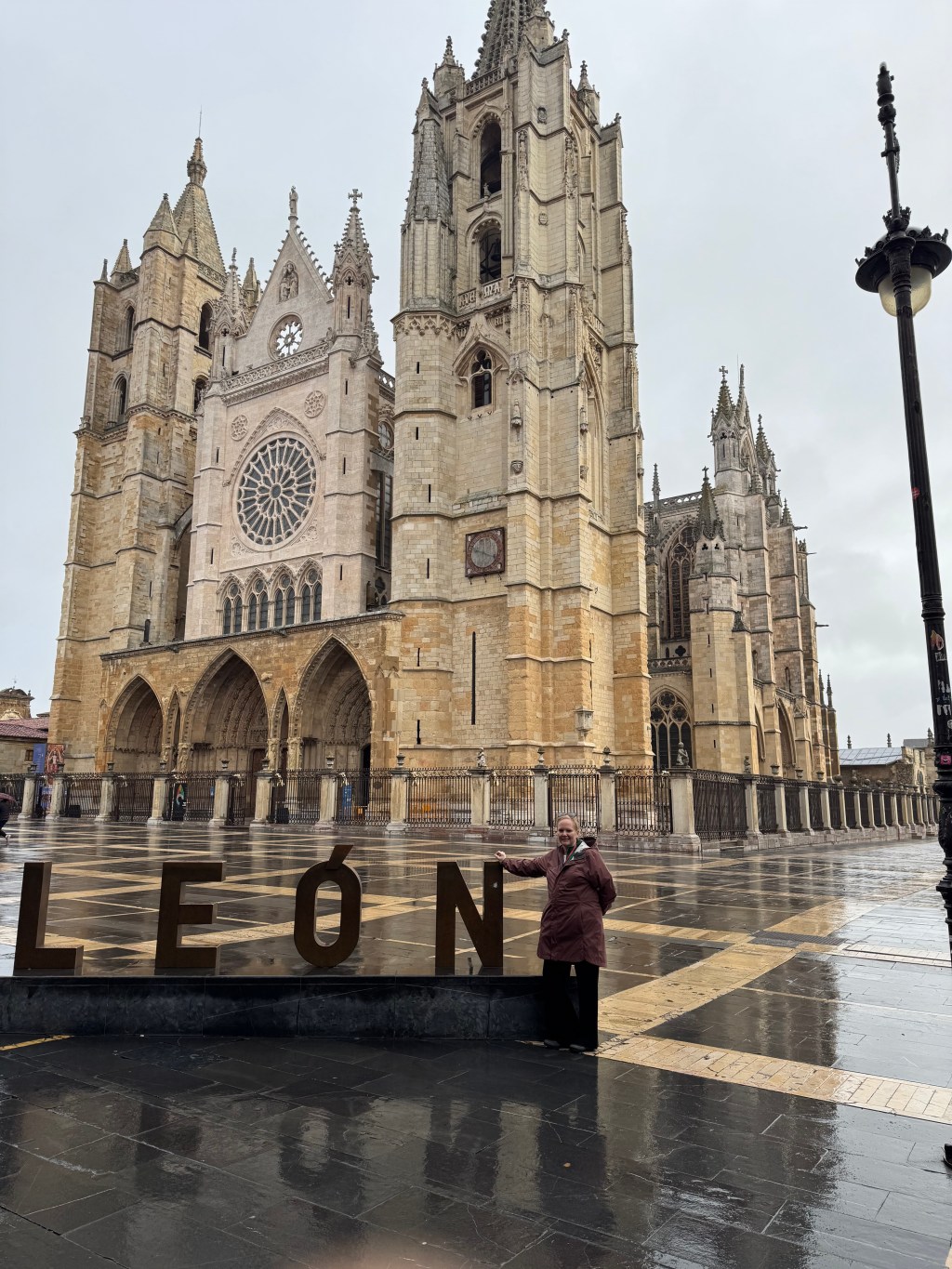
Then came León, one of my favorite places on earth. Our guide, a poised Leonese woman named Camino (fitting, for a pilgrimage), had studied at Cambridge and spoke English with that soft European precision that makes you feel your own language is misbehaving. She led us first to Casa Botines, one of Antoni Gaudí’s earliest works, a castle-like structure he designed before his imagination went completely feral. It now serves as a museum, and Lisa, my sister and resident art aficionado, was in heaven.
From there, we followed the old Roman road to León’s Cathedral, whose stained glass alone could convert an atheist, at least until lunchtime and hot churros with chocolate. It is a near twin to Notre Dame de Paris, though mercifully less crowded and without the burning smell.
But my heart belonged to the Basilica of San Isidoro, a 10th-century Romanesque treasure that holds the Royal Pantheon, final resting place of Spain’s early kings and queens, including my own ancestors, Queen Sancha of Castile and King Ferdinand I of León. Standing before their tombs was one of those rare collisions of faith and fact that make genealogy feel extra holy.
Napoleon, as usual, ruined the moment, his troops had once camped inside the pantheon, looting relics and displacing the royal remains. For decades, no one could tell which bones belonged to which monarch. Eventually they identified Queen Sancha, which was enough for me. The rest, I decided, could remain anonymous nobles; I couldn’t read the inscriptions and we all end up as dust anyway.
What truly astonished me, though, was the Chalice of Doña Urraca, a relic passed down from King Alfonso V to his sister Queen Sancha, then her and grandpa Ferdinand’s daughter Queen Urraca. It’s a gold and agate cup, modest in size but rumored, by scholars, mind you, to be the actual Holy Grail, the very cup Jesus drank from at the Last Supper. Two Egyptian documents trace its journey from the sacking of the Church of the Holy Sepulchre in 1009 A.D. to its eventual gift from the Fatimid Caliphate to the Spanish crown. In 2017, experts examined it and confirmed the possibility with academic restraint. I, on the other hand, declared it the real deal. Mic drop.
After all, we found what Monty Python and King Arthur never did, hidden in plain sight in León.
By day seven we were headed to Oviedo and Gijón, following the old pilgrim road toward the Atlantic. Oviedo is a city of steep streets and sudden grandeur. Its Cathedral of El Salvador holds relics so sacred they could bankrupt the Vatican gift shop: the Victory Cross, the Cross of the Angels, and most astonishingly, the Sudarium of Oviedo; the face cloth said to have covered Christ’s head after crucifixion. Scientists have DNA-tested it, carbon-dated it, and found it matches the blood type on the Shroud of Turin. Even the skeptics had to squint a little. Standing before it, I felt something wordless and electric, like history whispering directly into my spine.
From Oviedo we drove into the Picos de Europa, the jagged green lungs of Spain, toward Covadonga and Ribadesella. There, the Neo-Romanesque Basilica of Covadonga, carved from pink limestone, glows like a dream against the mountains. Beneath it lies the tomb of King Pelayo, the man who, with a handful of warriors and a wooden statue of the Virgin Mary, repelled the Moors in 719 A.D. and sparked the Reconquista. It is impossible to stand there and not feel that the earth itself remembers that battle.
After lunch in Ribadesella, a jewel of a town strung along the Cantabrian Sea, we wandered its medieval streets and admired yet another Gaudí architectural creation, the Bishops Palace, before returning to Oviedo for one final dinner.
By the eighth day, we’d crossed the mountains and were cruising west along the wild Cantabrian coastline toward Betanzos and Santiago de Compostela. The views were cinematic, mountains rising like folded velvet, the sea breathing blue fire below. I won’t mention the five-thousand rusty windmills, so don’t ask.
Betanzos, one of Galicia’s best-preserved medieval towns, greeted us with narrow cobbled lanes and Gothic arches sharp enough to draw blood. And then, at last, came Santiago de Compostela, the sacred terminus of the Camino. The old city is enormous, stone upon stone, towers leaning like elders having an inappropriate conversation. Inside its vast cathedral rest the relics of Saint James, apostle and patron saint of Spain. The air itself feels thick with devotion and the travel fatigue/scent of thousands of pilgrims who’ve walked forty days to reach it.
The next morning we visited Rías Baixas, a seaside stretch of Galicia famed for its Albariño wines. A tasting confirmed that divine inspiration can indeed come bottled. We ended at Pazo do Faramello, an 18th-century manor built by an Italian nobleman named Gambino, who arrived as a pilgrim and stayed for love, or maybe the seafood.
As you can see, we don’t sleep much on these trips. But for us, this is the only way to travel: fast, curious, a little reckless, devouring as much beauty and history as the clock will allow. We don’t travel to escape life, we travel to live it louder. And in northern Spain, among saints and sinners, kings and peasants, and the endless hum of pilgrims’ feet, life felt louder than ever.
V. Outsourced España
For the curious American traveler, one of the more surprising discoveries about Spain, aside from the fact that lunch happens at 3 p.m. and dinner at midnight, is the origin of its name. España.
We say it with such exotic reverence, as though the syllables themselves taste like olive oil and sound like guitar strings. Yet the word’s roots, much like the country’s, are tangled in conquest and coincidence.
Back home, when we hear the word Spanish, we usually picture Mexico, or the wider sprawl of Latin America; places that inherited the language the way one inherits an antique piano: beautiful, valuable, and impossible to move without injury. What we often forget is that the Spanish themselves were the original exporters of this verbal empire. Before tacos and telenovelas, there was Toledo and Castile, where the empire’s bureaucracy learned to conjugate verbs and swing swords with equal authority.
Now, I don’t use the phrase indigenous peoples with the same ease some do. The term feels too modern, too tidy for the messy sprawl of human history. The Incas, the Aztecs, the Mayans, yes, they were there first, but they too had migrated from somewhere else, some forgotten elsewhere long before Columbus ever sharpened his quill.
So when we say indigenous, what do we mean exactly? A hundred years? A thousand? Since the beginning of time, or simply long enough for the moss to take root on your ancestors’ shoes?
When Columbus; let’s call him Cristóbal the Ambitious—sailed west under the Spanish crown, he didn’t so much discover the New World as he did interrupt it. He found not untouched wilderness, but people already busy conquering one another the old-fashioned way. Every tribe, every kingdom, every empire was busy rearranging borders long before Europeans showed up with better weapons and worse manners. Murder, alas, is humanity’s oldest form of diplomacy.
So Spain didn’t invent colonization any more than it invented sin. What it did perfect was the outsourcing of both; exporting its faith, its flag, and its language to anyone with a coastline. The irony, of course, is that Spain’s own name isn’t even Spanish.
The word España comes to us, indirectly, from the Romans, who borrowed it from the Phoenicians; those ancient Mediterranean middle managers of civilization. The Phoenicians looked upon this rocky peninsula, noticed an abundance of long-eared creatures hopping about, and christened it I-Shaphan-im—“Land of the Rabbits.” The Romans Latinized it into Hispania, and from there, through centuries of empire, faith, and fumbling, we got España.
And that, ladies and gentlemen, is the grand etymology of one of the world’s most storied nations: The Land of the Rabbits.
After all the palaces and cathedrals, after the relics and the Grail and the ghosts of my royal ancestors, I find it both humbling and hilarious that an empire which once ruled half the planet began with a word meaning bunny country.
So there you have it, our little pilgrimage through northern Spain and the Camino de Santiago: a journey of faith, history, and tapas, stitched together by the ghosts of kings and the laughter of modern travelers trying to read road signs in Galician.
Spain taught us many things, that time moves slower with purpose, that beauty is often older than reason, and that every culture, no matter how proud, once started with a rabbit problem.
As usual, we collected a new set of traveling companions along the way, the kind of people who begin as strangers at breakfast and end as lifelong witnesses to your jet-lagged or possibly drunken confessions. By the second day, we were already swapping stories, snacks, and hand-sanitizer like old friends on a school field trip. There was Laura, who could find beauty in a parking garage; Holly, who laughed like she’d been saving it up for years; Moreno, the philosopher disguised as a quiet Mr. Miyagi; and Vanessa, who somehow managed to look glamorous in every climate zone.
And then there was Roberta, our guide, patient, encyclopedic, and unflappable, which is impressive considering she had to herd 19 cats through five regions, two languages, and an alarming number of wine tastings. By the end of the journey, we’d all promised to stay in touch, to share photos and stories and the occasional humblebrag for decades to come. Whether that happens or not, they’ve all earned permanent spots in our digital afterlife, tagged, friended, and immortalized in the pixelated scrapbook of memory.
And with that, I raise a final glass of Albariño to the Land of the Rabbits, grateful for its history, its humor, and its infinite capacity to surprise.
See Emily for photos.

 Ramblings & Revelations
Responses
Chris, I’ve been missing you, and now I know why. We hear so much about Southern Spain that I was delighted to learn more about Northern Spain. What a wonderful trip you had. Forget the flash fiction that gives you adrenaline; consider the glossy mags for this story. It’s well worth it. There’s so much in this story that stands out for me.” Divine inspiration can indeed come bottled.” That’s what I’m lacking. I must take up drinking again. “We don’t travel to escape life, we travel to live it louder.” What a mantra. This could be the nucleus of a story in itself. “So when we say indigenous, what do we mean exactly? A hundred years? A thousand? Since the beginning of time, or simply long enough for the moss to take root on your ancestors’ shoes?” You’re right. We really toss the word lightly, like we might toss a salad. Kudos to you for a wonderful story. It was a trip for you — but it was a trip for me.
Warren
LikeLiked by 2 people
Thank you Warren. I’m unimaginably happy to have slept a night in my own bed, but we both love the adventures so much, I don’t see us slowing down anytime soon.
We both needed to come back for work stuff but we’re headed to northern Portugal in two weeks for a river cruise of the Doro. We weren’t too far away from Porto when we visited Santiago de Compostela, but this next trip won’t be near as long.
I’m getting better at just taking notes during the day, then writing drafts of the notes later, rather than trying to write daily blogs while traveling. Of course, the snippets are more easily digested by readers who abhor long blogs, but I had to do it for my own benefit. It’s amazing how much you miss when you’re trying to write intensely everyday. My wife appreciated my general presence as well. The writers among us will understand this. I/we so love to write, that we can easily lose sight of why we’re doing it in the first place.
I was able to tame my obsessions and just enjoy the experience. And, I hadn’t written a travel blog in a while, so this trip fed the dragon in a way.
Thanks for the great observations as usual. Good to hear from you.
LikeLike
No post from you, travel or otherwise, could ever be too long. Enjoy Portugal, but watch out that you don’t get hit by a blue tile.
LikeLiked by 1 person
Thank you Warren, I’ll keep that in mind, my friend. If a rogue blue tile comes sailing off a Portuguese façade and clocks me square in the forehead, I’ll at least die knowing I was warned by somebody who has probably witnessed something similar in his own travels.
And rest assured, my posts will continue ignoring all natural endpoints and common sense. If there’s one thing I’m good at on these pilgrimages, it’s over-describing a sixty-second moment until it resembles a Dostoyevsky novel.
So thank you for the vote of confidence. I’ll enjoy Portugal with my eyes up, my camera ready, and my reflexes sharpened for incoming ceramic shrapnel. If I survive, you’ll hear all about it. If not… well, my wife can post my notes and turn them into short stories.
LikeLike
I enjoyed this and found it interesting, and informative, thank you
LikeLiked by 1 person
Thank you Joanne.
LikeLike
Wow, quite a trip. Thanks for sharing your very interesting travel details!
LikeLiked by 1 person
Thank you Dianna, I haven’t written a travel blog in a while. Well, I guess a year now. Glad you enjoyed it. Last year I wrote daily chronicles which really handcuffed me to the process and overwhelmed. People expected them, and we all know what writers do when people are asking for us to write… This year I decided to just take daily notes, turn the notes into readible material before bedtime nightly, and just keep working on it during trip so as to post it as one cohesive travelogue when I returned home. I may have disapointed a few people but I made my wife very happy, because I could pay attention to her and the experience, rather than the weight of a fun story. And making the wife happy is way better than the alternative.
LikeLiked by 1 person
You made the right choice! 🧳😊
LikeLiked by 1 person
Wow! I’m so impressed! Congratulations! I loved how you described our trip—so well written, with depth, full of details, life, and humor! And thank you so much for your kind comments about me! It was a pleasure to end the trip with some deep conversations with Emily and you, which made our meeting even more special. Thank you!
LikeLiked by 1 person