
byChrisWhite – 2018
My thoughts, lately, have been wandering down the winding lanes of parenthood, rattling around like loose pebbles in a tin can, and I figured the best way to sort them out was to put them down in writing. You know, make sense of the chaos by turning it into some semblance of a story.
See, I have this habit of wandering around inside my own head, getting lost in the what-ifs and why-nots, like an aimless traveler in a strange land. And if you, dear reader, are bold enough to join me on this rambling journey, I welcome you aboard the train. Just don’t expect it to run on time or stop at all the usual stations.
Now, before you accuse me of some grand hubris, an attempt to impart the secrets of perfect parenting, allow me to clarify: this is not about that. Far from it.
You see, I have only raised one child, and I dare say I wasn’t particularly great at it. This is more like a letter to myself, a self-addressed memo on the complexities of parenting, perhaps even an elaborate excuse for my own shortcomings in the field.
If you feel inclined to poke fun, by all means, do so. Laughter is the best way to make peace with our shared inadequacies.
If I were to sum up the whole message here, which is hardly advisable in the third paragraph, I’d say that no one person, no matter how noble their intentions, could ever hope to be the perfect parent. And that’s precisely the controversial idea I plan to defend in this discourse.
This realization didn’t come overnight. No, it was borne out of experience, mine, others’, and what I call the school of life, a miserable institution that lacks both monkey bars and recess.
See, I am an individual with my own peculiar set of abilities, inclinations, habits, deficiencies, and quirks. Some aspects of parenting align perfectly with my skillset, while others, well, let’s just say there are areas where I fall embarrassingly short. But that’s just me.
And what about the child? Surely, he comes into the world with his own set of unique complexities, much like I did. What if his way of learning runs counter to my natural way of teaching? What if his emotional needs stretch beyond the horizon of my own comprehension?
Of course, it’s possible that two people could meet, fall in love, tie the knot, and embark on the perilous journey of parenting without the slightest inkling of how to do it well. Both individuals could, in theory, possess the exact same strengths, weaknesses, and peculiarities, thus failing to fill in each other’s gaps. It could happen.
But in most cases, each parent brings something different to the table, a unique set of skills that, when combined, might just offer the child a fighting chance. Together, they form a patchwork quilt of sorts, stitched from both good intentions and wild inconsistencies, but nevertheless warm and comforting.
Can one parent embody all the qualities of strictness, discipline, creativity, freedom, empathy, and authority simultaneously? Can one person play the role of both enforcer and dream-weaver? I’ve never met anyone who could manage all that without losing their mind, and I suspect if they could, they wouldn’t be much fun at parties.
Parent Traps and the Little Rascals
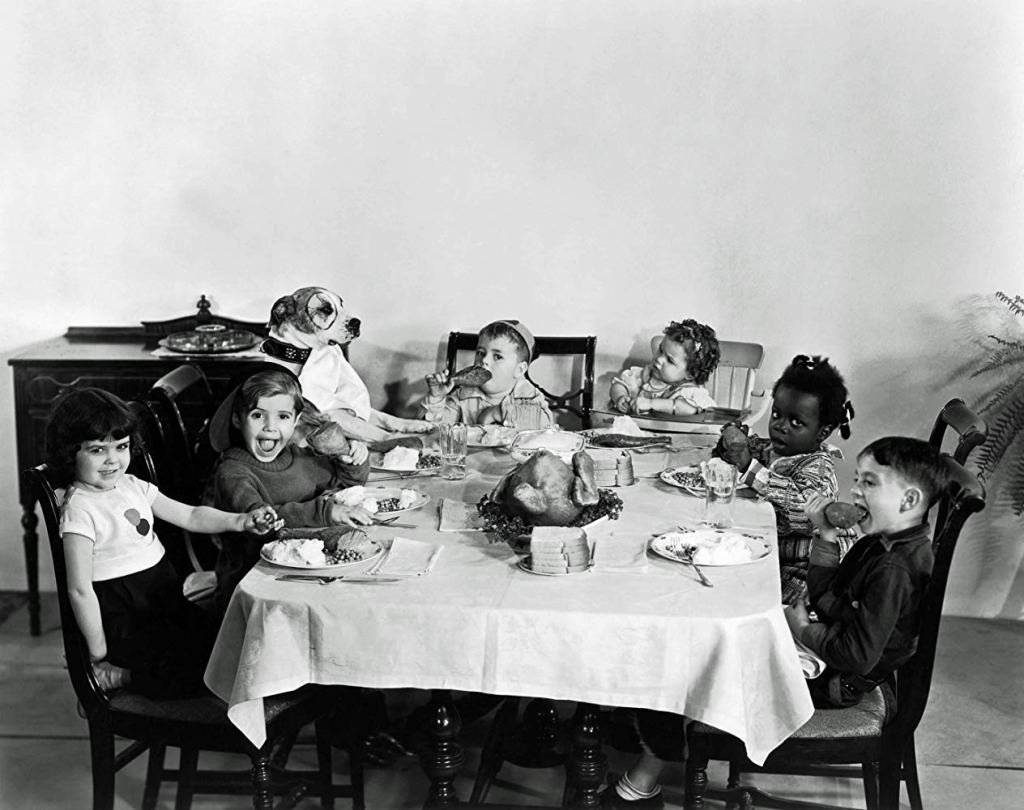
Now, I’ve decided to categorize some parental types into what I call the “Little Rascal” archetypes. Bear with me, and perhaps you’ll see yourself in one of these (though I’d advise against dwelling on it too long).
First, there’s Spanky. Spanky is the playful parent, the one who thrives on adventure and creativity. Spanky loves watching their child discover the world, encouraging every curiosity and indulging every whim. When their child is fascinated by dinosaurs, the house turns into a prehistoric playground; when the fascination shifts to outer space, out go the plastic dinos, and in come the glow-in-the-dark stars.
It’s all wonderful, except Spanky has one glaring weakness, an allergy to structure. Boundaries, routines, and limits are anathema to Spanky. It’s all infinite possibility, and no bedtime rules.
Then there’s Froggy. Froggy is analytical, the logical thinker, the problem solver, the one who believes every action has a reason, and every reason a consequence. Froggy’s talent for rationality, though admirable, often leaves him struggling to understand the chaotic, emotionally-driven minds of young children.
Froggy can tell you how to solve quadratic equations but may be utterly stumped when it comes to explaining why the teddy bear has to sleep on the left side of the bed.
Stymie, on the other hand, is all about hard work, tradition, and respect. A throwback to the 1950s, Stymie is the parent who believes in rules, in hierarchy, and in children knowing their place. Stymie is firm, dependable, and provides stability, but often struggles to accept that children are not miniature versions of themselves.
When an adolescent inevitably begins to push against the boundaries, Stymie feels personally affronted, as if the rejection of rules is a rejection of love itself.
And, of course, we cannot forget Buckwheat. Buckwheat is an artist, full of empathy and spontaneity. Buckwheat encourages creativity, helps the child follow their heart, and provides a haven of emotional support.
But Buckwheat’s tendency to float along the river of life without a paddle means that things like college savings and structured routines are likely to be overlooked.
Lastly, there’s Butch. Butch exudes confidence, the swaggering, stoic figure who allows his children to explore the world without much intervention. He values independence above all else.
The problem is, Butch’s emotional range is somewhat akin to a doorknob. He’s the quintessential “provider” but often lacks the emotional availability that young children so desperately need.
The Problem with Perfection
As you can see, dear reader, there’s no perfect parent among these characters, not even close. Each has strengths that can enrich a child’s upbringing and weaknesses that can leave gaps. It’s far too easy to get lost in the illusion of perfection, to believe that if we just try harder, love more deeply, or work more diligently, we can somehow achieve it.
But the truth is, parenting isn’t about achieving perfection. It’s about showing up, day after day, and doing the best we can, flaws and all.
Perhaps the most valuable lesson I’ve learned in all this is that individual effort can only go so far. We are, each of us, a collection of strengths and weaknesses, good at some things and woefully inadequate at others.
It’s only natural that our children would be better off with two parents to guide them, two voices to comfort them, and two sets of shoulders to bear the weight of the world.
And yet, the beauty of it all lies in the imperfection. In the messiness of it. Because even if we could be perfect parents, if we could balance the stern with the tender, the logical with the emotional, would we truly want to be?
It’s the cracks in the foundation that allow the light to shine through, the flaws that make us human and relatable. Our children don’t need us to be perfect, they need us to be real.
Conclusion
So, here we are, 3,500 words later, and perhaps not much wiser for it. But I hope, at the very least, that the journey has been worth it.
If you’re considering embarking on the adventure of parenthood, I urge you to find a partner who wants to be in the trenches with you, someone who will be there for the triumphs and the tears, the late-night feedings, and the early-morning soccer games. Because while one parent may be enough to keep the ship afloat, it takes a crew to sail it.
And as for me, I’m just an Alfalfa, a little bit of everything, and master of none. I’ve learned that all I can do is try, try to be better, try to learn, and try to love. And maybe, in the end, that’s all any of us can do.

 Ramblings & Revelations
You must be logged in to post a comment.