
by J.C. White – 2026
NOTE: Similar to the gothic noir piece I wrote on my recent trip to Madrid where I used a Spanish version of my own name as the protagonist, I decided to write this one while visiting Tuscany, using a playful epithetic Italian version of my name, inspired by the old city of Siena and the book I was reading on that trip, which was a non-fiction book by an Italian author. I hope you enjoy. It could have later additions, if either desired or inspired.
There are cities to which a man returns, and cities that return to him. Giovanni Bianco, Cavaliere di Scudo of Sienna, understood the distinction the moment he greeted the first wet gleam of lamplight on the old golden colored stones of Siena.
Nothing in that place had forgotten him.
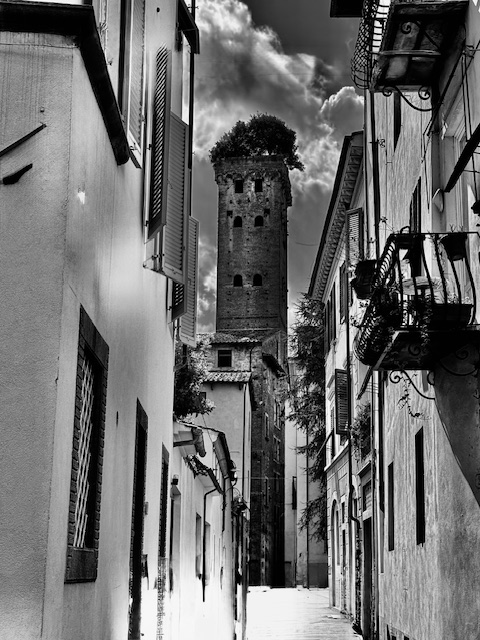
Not the blind freckled façades with their shuttered eyes. Not the cathedral dome and striped tower rising out of the morning fog. Not the trickling of rainwater lulling along the gutters. Least of all the towered-house at the apex of the crooked street, where a woman had once stood at an upper window in a white dress and altered the whole arrangement of his soul.
He had told himself, in the years since, that time was a patient eraser. It was not. It was a curator. It kept the worst things under glass and polished them in the dark.
So, when Giovanni stopped his horse at the foot of the hill and looked up into that steep, cobbled and waiting quarter of the city’s old town, he felt a sort of dread. Not dread exactly, no, but the more intimate corruption from which dread is sometimes born: recognition.
He stayed there longer than he meant to, one hand resting on the worn pommel of his saddle, while the rain began in earnest. A fine, needling spatter of cool water that silvered the street and laid a sheen across the irregular stone steps climbing ever upward toward the house.
In younger years he would have dismounted the horse and encountered the steps two at a time, full of hot piss and bitter vinegar, and the vanity peculiar to young men who often mistake intensity for depth.
But that man was gone now, if indeed he had ever existed in any durable form. What remained was a narrower, more cautious and less capable creature, more exact in his sorrows, less capable in footing and willingness to call anything by the names that once came so cheaply to him: love, fate, innocence, betrayal.
Sixty-one years had not cured him of feeling. They had merely taught him how feeling ferments in darkness, how it thickens there, acquires old sediment, and becomes something nearer to doom than grief.
Above him the windows of the house gave back no light. Yet he could not shake the conviction that someone had already seen him from within, had marked his arrival and hesitation, and was waiting with the stillness of those who have long ago surrendered surprise but not judgment.
At the uneven landing he found the gate unlatched. He dismounted and tied his mount to an iron ring embedded into the stone tower.
That small concession to his arrival chilled him more than any spectacle could possibly have done. He passed through the weed-strangled garden where the stone basin stood dry and cracked and the lemon trees, untended for years, had gone half-feral against the stone wall. Near the door a votive candle burned inside a red glass cup, trembling in the rain but not yet extinguished.
Somebody was here, then. Or had been recently enough to leave a flame behind. Giovanni lifted his hand to knock and saw that it was shaking. He almost laughed at that. Age had not made him brave; it had only taught him to disguise cowardice as caution and exhaustion as wisdom.
Before he could strike the old wormy wood, the door opened of its own slow accord, not dramatically, but with the weary civility of a servant who had been expecting an unwelcome guest.
The woman who stood within was not the one he had feared and not, in any honest sense, the one he had hoped to see. She was older by twenty years and worn in the manner of houses, not bodies, as though grief had inhabited her mind for so long it had taken certain structural liberties.
Her black dress consumed the light. Tight around her aging throat hung the little silver crucifix he remembered from another lifetime, and at the sight of it something in him gave way with so little noise he might have mistaken it for breath.
She looked at him without surprise, without tenderness, and without the least confusion as to who he was.
“Cavalier Bianco,” she said, as though pronouncing the name of a man reported drowned and found at last in winter reeds. I began to think remorse itself had died before it could find the address. “Il vostro destriero sarà trattato con il massimo riguardo,” the woman assured the care of his steed.
Inside, the house smelled of wax, moldy curtains, and the medicinal sweetness of flowers laid too near the dead. Then he saw the parlor door standing open and understood. At the far end of the room, beneath two tall candles and the stern, dark, almost cartoonish gaze of a painted saint, lay the body of Signora Vietri, her hands folded around a rosary, her face reduced by death to the hard little mask that age had been carving toward for years.
Giovanni removed his hat. For a moment he could not speak. It was not sorrow that seized him first, though sorrow did come. It was the vulgar, naked recognition that he had arrived too late for apology and exactly in time for judgment.
He had once loved the daughter of this house with the kind of faith that mistakes itself for permanence. Then he had betrayed her, not with another woman, which would have been crude and common, but with the ambition of battle, lands, and title, which is colder and often more final. He had gone away when staying would have cost him something. The cost of leaving, everything. Men forgive themselves for that every day. Houses do not.
The woman moved aside to let him enter. From upstairs came no sound at all, yet he felt the full pressure of another presence, whether memory or soul he could not have said.
Rain tapped faintly at the green wooden shutters. Candlelight worried the silken walls. Giovanni stepped into the parlor as a penitent might step into a chapel built expressly for his own humiliation, and there before the dead matriarch, with the daughter he’d never met, still unseen above him and the whole old house gathered around his trespass like a church tribunal, he understood that whatever road had brought him back to this threshold had not ended here. It had only now descended into its proper darkness. A darkness he’d soon come to regret.


 Ramblings & Revelations
Leave a reply to rcaplan2014 Cancel reply