
byJ.C.White – 2026
Nature herself has supplied most men with just enough common sense to write a law and almost none with enough justice to write a good one.
This, I know, seems at first an unnecessarily harsh judgment upon mankind. But mankind has survived harsher judgments.
Our difficulty may have begun at birth.
Nature sends certain animals into the world remarkably well prepared for it. A lamb arrives damp, bewildered, and poorly dressed, yet within an hour it is standing unshakably upon its own legs. A colt, having scarcely finished the administrative business of being born, gets up and begins considering advanced locomotion. Within a remarkably brief time it can confidently run away from danger.
A human infant, by comparison, enters creation incapable of holding up its own head.
For months, the creature must be carried, fed, cleaned, warmed, protected, entertained, and persuaded that darkness is not an existential crisis. Left to its own resources, it cannot migrate, burrow, hunt, climb a tree, or even roll reliably in the proper direction. Yet this same creature, having survived by the uninterrupted sacrifice of others, eventually reaches adulthood and begins giving Facebook opinions about how everybody else ought to live.
There is something philosophically non-academic about this arrangement.
Man’s first political philosophy is therefore not liberty but dependency. His first government is absolute monarchy, with himself as sovereign. He cries; somebody comes. He is hungry; somebody feeds him. He soils the kingdom; somebody cleans it. His subjects sleep only with his permission.
After several years of this he is informed, quite suddenly, that other people have rights.
He never entirely recovers from the disappointment.
This explains why the animal kingdoms often appear better governed than our own.
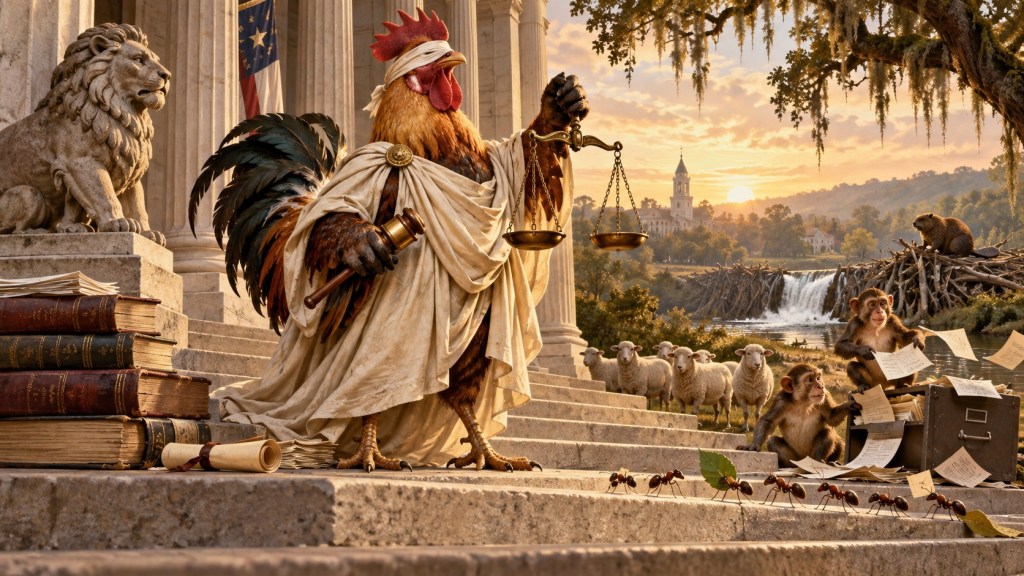
Consider the sheep.
Sheep have acquired a reputation for gentleness. They travel peacefully in society, rarely quarrel over theology, and have never, as far as we know, established a committee to determine which sheep are insufficiently committed to sheep values.
Their innocence is admittedly helped by appearances. As such, sheep can consume an enormous quantity of living things without ever looking particularly guilty about it. Nevertheless, the Republic of Sheep remains an impressive picture of civility and peace. They eat, wander about together, contribute wool, and refrain from writing self-aggrandizing memoirs about their public service or church donations.
The henhouse offers an entirely different political system and, in some respects, a still more embarrassing comparison.
There we find the near-perfect monarchy.
No king nor emperor ever possessed the natural authority of a rooster. He walks among his subjects with the confidence of a Bourbon and the wardrobe of a Medici. Yet when danger approaches, something astonishing happens.
He goes straight toward it.
He never stands upon a manure pile announcing that the present emergency requires extraordinary sacrifices from the hens.
He doesn’t remain inside the henhouse to explain that security considerations prevent him from personally approaching the fox.
He doesn’t send the youngest pullets forward while assuring them that history will forever remember their courage.
No. He puts the hens behind him and fights to the death.
If victorious, he mounts a perch or whatever elevation is available and sings his own Te Deum, which may be a demonstration of vanity, but at least the vanity follows the battle instead of preceding it.
His domestic administration is equally remarkable. Let him discover a grain of corn or an especially handsome worm and he frequently calls the hens to it. Here is an example of royalty possessing treasure and voluntarily sharing it.
King Solomon, surrounded by all his magnificence, might have found the comparison uncomfortable.
Then there are the bees. Bees have settled upon a monarchy of another kind. They possess a queen, a disciplined social order, specialized labor, group sex, magnificent architecture, efficient food production, collective defense, and no newspaper demanding to know whether the queen’s accommodations are costing taxpayers too much.
The ants have gone even further and established something resembling a republic.
Every ant, dare I say… has a job.
This alone places their political system far beyond serious human imitation.
There appear to be no ants whose sole occupation is explaining the labor of other ants. No ant discovers a crumb, forms a nonprofit organization dedicated to crumb accessibility, pays himself ninety percent of the crumb as executive director, and then lectures the remaining ants, tired and hungry, about personal sacrifices for the common good.
An ant finds something heavy and attempts to move it.
If it is too heavy, other ants arrive to assist.
The beaver republic may be more humiliating still.
Beavers undertake massive public works projects.
They survey a stream, select a location, cut timber, transport materials, construct a dam, alter the local hydrology, build housing, maintain the structure, and raise a family there.
They accomplish this without engineering consultants, permits from TVA, the Corps of Engineers, TWRA, or local zoning hearings.
No beaver appears before a planning commission with architectural renderings while another beaver complains that the proposed dam will alter the historic character of the creek.
They simply build the thing.
And it works.
Then we examine the monkeys.
Here, at last, mankind begins to recognize relatives.
The monkey possesses intelligence, curiosity, vanity, imitation, jealousy, appetite, social intrigue, and a marvelous ability to become distracted by something shiny. He can learn a useful behavior by watching another monkey and abandon it moments later because a third monkey has discovered a banana.
He has factions.
He has favorites.
He remembers insults.
He covets what another possesses.
He screams when agitated and becomes more agitated when others begin screaming too.
And, exactly like us, he’s prone to throw feces in the faces of others who offend him.
Give a monkey clothing, a technical manual, and a pocket protector and the resemblance might become uncomfortably troublesome.
Of all creatures, man entered the world most like him: helpless, dependent, imitative, social, jealous, ingenious, affectionate, frightened, acquisitive, over-sexed, and perpetually convinced that the object presently in somebody else’s hand would improve by being placed in his own.
Nature nevertheless endowed us generously.
She gave us the instinct of self-preservation. She gave us affection for our offspring, sympathy for our fellows, desire, curiosity, memory, imagination, and the extraordinary capacity to combine ideas until we could contemplate things no other animal seems the least troubled by: eternity, justice, property, beauty, death, interest rates, and whether a fence three inches beyond the property line constitutes an act of war.
Having bestowed these gifts, Nature seems to have dusted off her hands and said to us all:
There. Now do the best you can.
We did.
The result was government.
The difficulty with human law is not that human beings are incapable of recognizing real justice. Most of us recognize justice splendidly when somebody else owes it to us.
Our lady of justice is blindfolded because her eyesight becomes less dependable when she is sent the invoice.
Thus, and aside from our Constitution that was written when people were still intentionally educated, laws are seldom born from pure reason. They generally arise from circumstances. A bridge collapses, so we write a law about bridges. Somebody cheats his customers, so we regulate merchants. Somebody builds a slaughterhouse beside a school, so we discover zoning. Somebody discovers a loophole in the zoning ordinance, so we write seventeen pages defining “slaughterhouse.”
Then somebody opens a facility that kills animals but technically is not a slaughterhouse because the animals arrive already “inconvenienced.”
We amend the law accordingly.
This is how human civilization advances: one anecdotal footnote at a time.
The dream of a perfect and permanent body of laws is therefore impossible because circumstances are not permanent. Yesterday’s necessity became today’s nuisance and will become tomorrow’s absurdity.
The law remains because laws possess one characteristic not found in the natural world: after the reason for their existence dies, they frequently continue living.
A tree falls when it is dead.
But a law acquires a department.
And the department acquires employees.
And the employees acquire insurance and pensions.
Soon the original problem has been forgotten entirely, but there remains a handsome building containing forty-seven people charged with preventing its recurrence.
This would merely be comedic if mankind’s greatest weakness were inefficiency.
It is not.
Our greater weakness is that ancient inheritance from the cradle: the conviction that our own necessity is somehow more necessary than everyone else’s.
A town wants prosperity but objects to traffic.
It wants low taxes and magnificent public services.
It wants inexpensive houses but becomes alarmed when somebody proposes building them nearby.
It wants good roads but dislikes road construction.
It wants better restaurants but doesn’t want to pay the absurdly higher prices.
It wants factories but not smoke, electricity but not transmission lines, farms but not manure, good prisons without the prisoners, hospitals but not ambulances at midnight.
Every citizen desires the common good provided the common good can be conveniently located somewhere else.
This is where democracy encounters its oldest enemy, not tyranny, exactly, but desire.
A community discovers that it possesses enough votes to obtain some immediate advantage at another community’s expense. The injury may eventually harm everyone, including those demanding it. This objection is patiently explained by the experts paid to offer their experienced advice.
The crowd considers the matter.
Then somebody announces what the advantage is worth per household.
The matter is settled.
Human beings possess an extraordinary talent for recognizing distant catastrophe and choosing nearby convenience.
We will poison tomorrow’s well for today’s cheaper water and afterward establish a commission to investigate the mysterious decline in water quality.
This is not because people are uniquely evil. That explanation is much too flattering. Evil requires a certain grandeur of purpose.
Most injustice is more ordinary. It begins with phrases such as just this once, surely this will not matter, everybody does it, that is different, and the immortal foundation of human political philosophy:
But this affects me.
And so, we write the laws.
We write them when frightened, when angry, when prosperous, when poor, when offended, when threatened, when jealous, and occasionally when sober. Each generation inherits the accumulated wisdom of its ancestors together with their accumulated foolishness and is given the unenviable task of distinguishing between the two.
Naturally, we disagree.
One man’s ancient safeguard is another man’s ridiculous relic. One man’s reform is another man’s catastrophe. One man’s public necessity is another man’s governmental nuisance.
And because the law must eventually be enforced by human beings, another difficulty arises.
We demand impartial justice from creatures who have never experienced the world impartially.
Every judge was once a child.
Every policeman has preferences.
Every prosecutor has ambitions.
Every juror has prejudices.
Every citizen carries a private history into the public square.
We ask these creatures to put aside friendship, resentment, fear, social class, affection, vanity, tribe, advantage, memory, and self-interest and become, for a few solemn hours, Justice herself; blindfolded, balanced, disinterested.
It is an absurd demand when one considers it. The absolute hardest things to do in government are the right things.
It is also indispensable. And yet, a very few manage it. And they do so without any safety net, because these people are so rare that their overseers are unlikely to possess the same high level of accountability. Thus, it is easier to lose a government job for doing the right thing than it is for screwing up, because it is mob who holds the power, not the law.
That may be the entire tragedy and comedy of civilization.
The rooster does not require a constitution instructing him to defend the hens. The ant requires no statute compelling labor. The beaver needs no building code ordering him to maintain the dam. Animals do not mob their fellow citizens, they jump in and help. There are no examples of the French Revolution in the animal kingdom.
Their law is written in instinct.
Ours must be written on erasable paper because our instincts contradict one another.
We love ourselves and others.
We desire freedom and protection. But to offer protection to everyone means we sacrifice freedoms.
We want equality and advantage.
We demand justice and mercy, often in the same case, depending upon whether we are the injured party or the accused.
No legislature can reconcile these contradictions permanently because no legislature invented them.
These contradictions were waiting for us in the cradle. God made us this way. Some of us perpetually stupid, some too smart for our own good, and none with the self-perception to know which one they were born to be. It makes us dependent on one another, which may have been the plan, but mobs do not respect the laws of nature, they respect the lowest common denominator, which is its loudest member. The one who’s not embarrassed to say dumb stuff.
Then, the purpose of law is not to construct the perfect society. That ambition has always underestimated the human raw material.
Good law has the humbler task of preventing our virtues from being devoured by our appetites, our fears from becoming principles, our temporary advantages from becoming permanent injustices, and our majorities from mistaking numbers for wisdom.
For a majority is merely a large number of human beings. And human beings do not become wiser simply by standing closer together.
Sometimes they become a legislature, sometimes a mob.
Occasionally it is difficult to tell which until somebody is brave enough to take roll.
Nature gave us reason enough to understand justice but enough greed to evade it. She gave us sympathy enough to imagine another man’s suffering and selfishness enough to explain why, regrettably, nothing can be done about it until after lunch.
Then she sent us into the world utterly helpless without the assistance of the very people we’ve abused our entire lives.
That was her joke.
The lamb stands within the hour.
The colt runs.
The chick pecks.
The beaver builds.
Man spends his first year demanding that the universe deal with him personally, and the remainder of his life discovering elaborate philosophical reasons why it should continue.
And from this animal we ask for perfect laws.
We might ask then, the rooster to write opera.
The difference is that, given what he already does at sunrise, he might stand a better chance than we do at crossing over successfully into our realm, than we would in his.


Leave a comment